
Vandaag of morgen in huis

Kwaliteit gegarandeerd

Welkomstaanbiedingen ontgrendelen: GRATIS bezorging | Tot 80% korting | Gratis 30 dagen JoyPlus-proefperiode
Download de app
A flat battery always seems to happen at the worst possible time. You might be in a car park, on a dark road or at a campsite with no power socket. A car battery jump starter can get you out of a tight spot, but not every model is right for every vehicle or situation.
Marketing often focuses on a high amp rating, a large battery capacity and claims such as “safe” or “suitable for all vehicles”. This information is only useful when you also consider the voltage, engine size, connections and intended use. Read on to find out which pitfalls to avoid and which specifications matter.
A rating such as 2,000A, 4,000A or 7,000A sounds impressive, but peak current alone is no guarantee that a vehicle will start. Suitability also depends on the condition of the battery, engine size, temperature and starting procedure.
Always check the stated combination of:
A jump starter for a small petrol car is not automatically suitable as a diesel jump starter or for a heavy SUV.
Most portable models are designed for cars, motorbikes, campervans, boats and light commercial vehicles with a 12V lead-acid battery. However, a lorry or other heavy vehicle may have a 24V system. Connecting a 12V jump starter to a 24V system can cause damage.
Check your vehicle’s handbook before buying. A 12V jump starter is not designed for electric vehicles with high-voltage batteries.
Lithium jump starters gradually lose charge while in storage. A long stated standby time doesn’t mean you can forget about maintenance. Manufacturers often recommend recharging the device periodically; the recommended interval varies by model.
Check the accessories included, too. A storage case, USB-C cable, charging adapter, smart clamps or compressor can make the difference between a device that’s ready when you need it and one that leaves you searching for extra parts.
Peak current indicates how much current the jump starter can deliver for a short time, according to its product specifications. Use this figure alongside the stated engine size. A jump starter for a petrol car will usually need a different capacity margin from a model for a diesel engine.
If you regularly use it with an SUV, campervan, boat or van, a model with a higher stated capacity may be a good choice. A lighter model may be enough for a small car or motorbike. Always check that your vehicle has a conventional 12V lead-acid battery.
Where possible, choose jump leads with protection against:
A display, warning signal or “Ready” indicator can help you check the connection. However, it’s no substitute for reading the manual. According to the product information from various brands, these safety features are built in, but their exact operation and limits can vary by model.
A jump starter with a compressor is useful if you want to check or top up your tyre pressure while you’re out and about. Check the maximum pressure, air hose length, included valve adapters and automatic shut-off feature.
A jump starter power bank can charge phones, tablets and other USB devices. Check the number of ports and charging output. A jump starter with a torch is handy if you break down in the dark; check whether it has standard lighting, an SOS mode or a flashing mode.
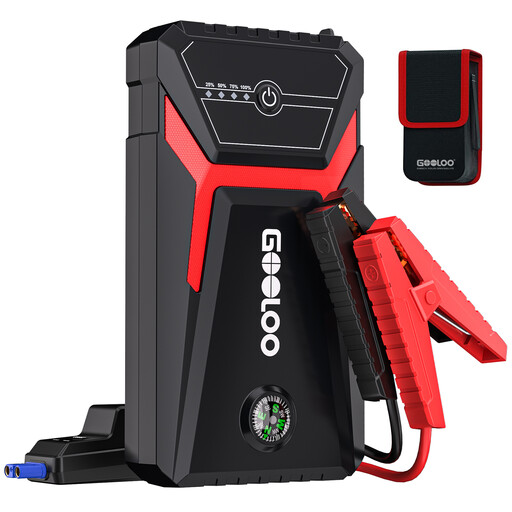
Why it suits this profile: The product specifications state a peak current of 1,500A and support for 12V vehicles with petrol engines up to 6.0L and diesel engines up to 4.0L. This makes it a straightforward choice for everyday car jump-starting.
The maximum petrol and diesel engine sizes are clearly stated. According to the product description, the smart cables have ten safety features.
Two USB outputs, a 400-lumen light and a stated weight of around 0.878 kg.
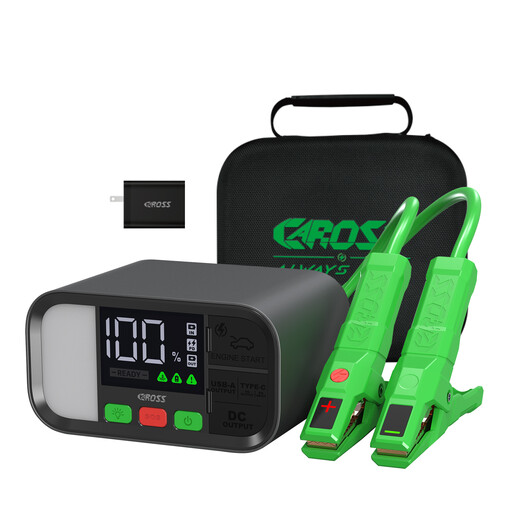
Why it suits this profile: This model is aimed at users who value simple operation and fast charging. The product specifications state 65W USB-C Power Delivery and a digital display.
According to the product description, Smart Connect technology is designed to help prevent reverse polarity. Always check the instructions, too.
1,600A peak current, a 16,000mAh lithium-ion battery, a display and a protective storage case.
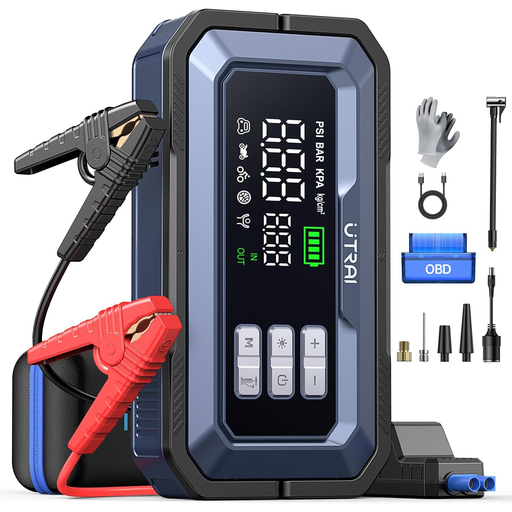
Why it suits this profile: With a compressor, OBD2 adapter, 160W DC output and support for diesel engines up to 14L, this model is well suited to campervans, boats, SUVs and intensive outdoor use.
The product specifications list an automatic compressor with adjustable pressure, temperature protection and ten safety features.
7,000A peak current, a compressor up to 150 PSI, a 2,000-lumen light and 18W USB-C charging.
We’ve put together a complete, up-to-date list of products that meet these strict selection criteria and current European safety regulations.
Don’t use a device if its casing is damaged or the battery is leaking or swollen. If you’re unsure about the battery or connection, it’s safer to call for roadside assistance than to try again.
It depends on the model. Some devices have a Boost function for low battery voltage. However, a jump starter can’t help with every battery that’s faulty, damaged or internally short-circuited. Check the minimum voltage and instructions for the model you choose.
Follow the manufacturer’s maintenance instructions. Many models should be recharged periodically, even if they haven’t been used. Check the charge level before a long drive, holiday or winter.
It depends on how you’ll use it. A compressor can be handy for topping up tyres if you drive a car or campervan, or enjoy outdoor activities. If you only need to start a car, a more compact jump starter without an air pump may be enough.
