
Vandaag of morgen in huis

Kwaliteit gegarandeerd

Welkomstaanbiedingen ontgrendelen: GRATIS bezorging | Tot 80% korting | Gratis 30 dagen JoyPlus-proefperiode
Download de app
A flat battery, soft tyre or unfamiliar warning light usually appears at the worst possible time. Yet many drivers choose car accessories based on one eye-catching number: a high peak current, a large number of amps or a long list of features. That can be misleading. A product is only right for your vehicle if its specifications, connections and operating conditions are a good match.
This guide helps Dutch motorists, DIY enthusiasts, motorhome and boat owners, and car detailers compare products with confidence.
With a car jump starter, the stated peak current tends to grab your attention. Also check which engine sizes and fuel types the device is suitable for. A model for a small petrol engine won’t necessarily work for a diesel van or motorhome.
For a portable car air compressor, maximum pressure alone isn’t enough. Check the hose, valve type, maximum continuous running time and how the pressure is set.
A car battery may be lead-acid, AGM, EFB or gel. LiFePO4 batteries are also widely used in motorhomes, boats and off-grid applications. A battery tester or car battery charger that only supports certain battery types may give inaccurate results or simply be unsuitable.
Before you buy, check:
According to the product description, the BT500 battery tester supports standard lead-acid, AGM, GEL and EFB batteries, but not lithium or deep-cycle batteries.
A digital parking disc can automatically display your arrival time, but always check that the model and how it is installed comply with local parking rules. With a digital parking disc, legibility, accurate timekeeping and visible placement are all important. The listing for the suggested model mentions KBA approval and E-mark certification; check the current rules in your local council area before use, too.
A useful car battery tester should do more than display voltage. Look for features such as:
According to its specifications, the VDIAGTOOL BT500 works with 6 V, 9 V, 12 V and 24 V systems and has a range of 5 to 3000 CCA. For an accurate reading, enter the correct battery type, standard and CCA rating.
When choosing a car emergency jump starter, check:
A high peak current doesn’t guarantee that every vehicle will start. Follow the instructions, check the positive and negative terminals, and don’t leave the device stored in a hot car for long periods. High temperatures can make lithium batteries age more quickly.
The charging current you need depends on the battery capacity. For example, a 6 A charger is intended for different uses from a 12 or 15 A model. Check that the charger is suitable for your Ah range and battery type.
An automatic charger with a display and protection against overheating, short circuits and reverse polarity is handy for use in the garage. Treat a pulse or repair mode as an extra feature, not a guarantee that it will restore a worn-out battery. According to the product description, EAFC chargers are designed for various lead-acid battery types, including AGM, GEL, EFB and flooded batteries.
Other car accessories can also come in handy for vehicle maintenance:
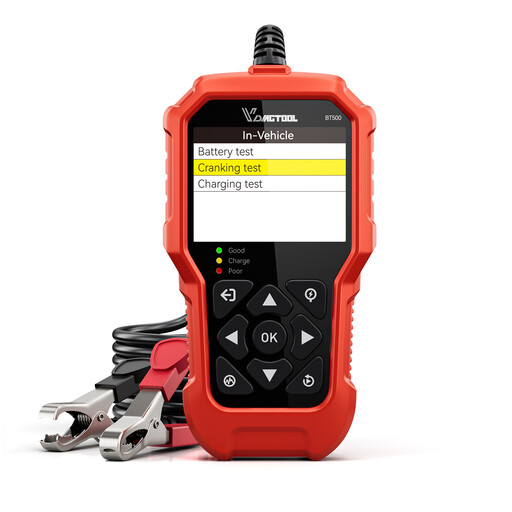
Why it suits this profile: Handy if you want to find out for yourself why your car is struggling to start, without immediately replacing several parts.
The product information clearly lists the supported voltages and battery types. Deep-cycle and lithium batteries are outside the stated range of use.
Measures voltage, resistance, SoC, SoH and the charging system, among other things; suitable for cars, motorbikes, trucks and boats within the stated range.
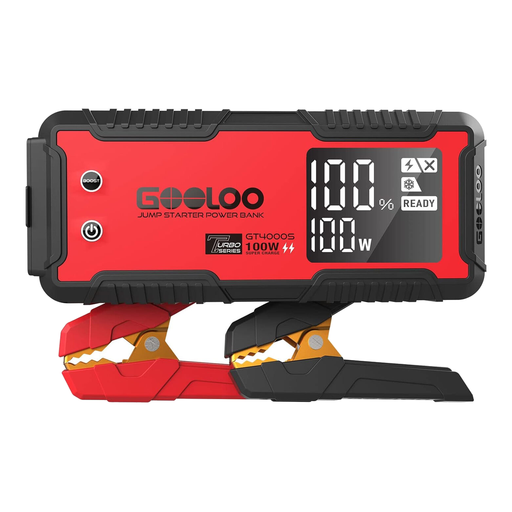
Why it suits this profile: Ideal for drivers who want to keep a powerful device with extra charging and lighting features in their car.
The specifications state the maximum engine size for petrol and diesel vehicles. This lets you compare suitability more accurately than by looking at the amps alone.
4000A peak current, 100W charging via USB-C, several safety features and a three-mode torch, according to the product description.
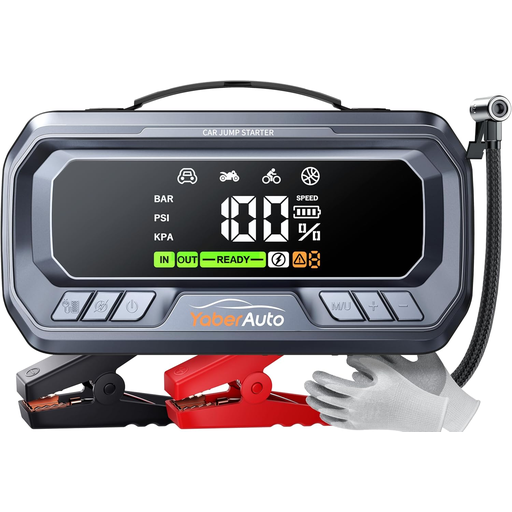
Why it suits this profile: A practical combination for SUVs, motorhomes, vans and drivers who also want to inflate their tyres on the road.
The product details list the engine size as well as maximum tyre pressure, temperature limits and usage warnings.
6500A peak current according to the product information, 160 PSI compressor, LCD screen, 65W USB-C and emergency lighting.
Recharge your jump starter regularly in line with the instructions, and check the cables before use. When using a charger, connect the clamps first and then plug it into the mains, unless the instructions say otherwise. Store batteries and chargers in a dry place, and avoid exposing them to frost or heat for long periods.
An OBD2 diagnostic tool can help you read a fault code, but a code doesn’t always explain the whole problem. Only clear codes once you’ve worked out what’s wrong. When polishing, use a suitable pad, start at a low speed and test it on an inconspicuous area first.
We’ve put together a complete, up-to-date list of products that meet these strict selection criteria and the applicable European safety regulations.
Check the battery type, voltage and capacity in Ah. A 12V charger is designed for a 12V system, but the charging current must also be suitable for the battery capacity. Also check whether it supports AGM, EFB, GEL or another battery type.
Its lifespan depends on how often it’s charged, storage temperature and how it’s used. Store the device somewhere dry and don’t leave it in a hot car for long periods. Before a long journey, check that the internal battery is sufficiently charged.
No. An OBD2 device can read fault codes and vehicle data, but it can’t identify every mechanical or electrical problem. Use the code as a guide and, if in doubt, consult a qualified garage.
