
People with an existing HDMI camera
You want to use a camera you already own as a video source. Check that it can output a compatible HDMI image without menu overlays and stay on during a call.


An HDMI-to-USB capture card is one option if your existing camera can output a compatible, unencrypted HDMI signal and your computer can use the card as a video source. Also check the HDMI connector, whether the image is free from menu overlays, the camera’s power supply, and compatibility with your USB port and video-calling app. If your main priority is keeping things simple, try an available webcam or phone as a camera first.
You want to use a camera you already own as a video source. Check that it can output a compatible HDMI image without menu overlays and stay on during a call.
You want your camera, USB connection and video-calling app to work together reliably every time. Check your camera’s connections and the support offered by your computer and software.
You want to find out first whether a webcam or phone you already own can work as a camera. That way, you can decide whether your setup really needs extra HDMI hardware.
Choose this option: if your camera outputs a compatible HDMI signal and you want to select its image directly in your video-calling app.
Bear in mind: you’ll need a suitable HDMI cable and a camera that stays on during the call.
Choose this option: if you need features such as HDMI pass-through or a separate audio input, or want to adjust signal settings in software.
Bear in mind: input resolution and capture output aren’t always the same; check the specifications for the exact model.
Choose this option: if you want to get started without extra HDMI hardware and already have a suitable webcam or phone.
Bear in mind: available features depend on your phone, computer and software; sharing an OBS scene involves an extra software step.
| Concern | What to look for when buying | Who is this important for? |
|---|---|---|
| HDMI compatibility | Check that the camera outputs the right HDMI signal, that menu overlays can be switched off and that the cable fits the camera. | I want to use my existing camera and first find out whether its HDMI image is suitable. Around 36% of consumers prioritise camera and HDMI compatibility. |
| Works with your computer and video-calling app | Check the USB connection and system support for the exact model; make sure you can select the card as a video source. | I want the camera to appear as a source in the video-calling app on my computer. Around 29% of consumers give compatibility with their computer and video-calling app top priority. |
| Use during longer calls | Check the auto-off settings, operating time and whether the camera can be powered externally. | I don’t want the camera to stop outputting an image midway through a call. Around 21% of consumers prioritise uninterrupted camera use. |
| Avoiding extra hardware | Try an available webcam or phone with your own computer and video-calling app setup first. | I want to make video calls easily without first connecting extra HDMI hardware. Around 14% of consumers prefer an option that doesn’t require extra hardware. |
A stated input format doesn’t necessarily tell you what resolution the capture card sends to your computer or video-calling app.
Compare the format your camera actually outputs with the capture output of the exact card model, then check your video-calling app’s settings.
Cameras can have different types of HDMI connector and may switch off automatically after extended use. This can cause the image to cut out during a call.
Before buying, check the cable type, overlay settings, operating time and power options for your camera.
You may need a suitable HDMI cable or camera power supply; what’s right for you depends on your camera.
For video calls, the camera’s image needs to travel over HDMI to your computer. An adapter that sends images from your computer to HDMI won’t do this.
Check that the device has an HDMI input and can act as a USB video source for your computer.
Cam Link 4K is a compact HDMI-to-USB 3.0 option for using a compatible camera as a webcam source.
The Live Streamer CAP 4K BU113 is an external capture card designed for use with a camera or camcorder.
USB Capture HDMI Gen 2 is designed for a single HDMI source in a permanent video setup.
The UVCHDCAP is an HDMI-to-USB-C capture device with HDMI pass-through and a separate audio input.
This product selection focuses on HDMI capture cards for a permanent camera setup with extra connections.
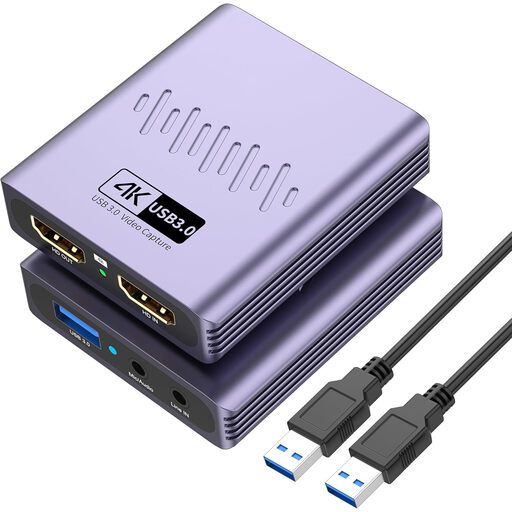 No image available
An option for a permanent capture setup if you need the additional audio and HDMI connections listed.
The product name lists USB 3.0 and video capture up to 1080p.
The product name also lists 4K pass-through, a microphone input and a headphone output.
First, check whether the camera can output a suitable HDMI image without menu overlays. Connect the camera’s compatible HDMI output to the capture card’s HDMI input, connect the card using the required USB connection, then select the source in your video-calling app. Check the connections and supported formats for your camera and card.
Use OBS Virtual Camera if you want to send an OBS scene to an app that can use a webcam source. Start the virtual camera in OBS, then select it in your video-calling app. If the app already recognises the capture source, this extra step isn’t necessarily needed.
Check your camera’s manual to see whether power-saving or auto-off settings interrupt HDMI output. Also check whether your camera supports external power while in use.
Many distance purchases come with a 14-day cooling-off period; the Dutch government lists exceptions, including purchases from a private individual. You’re also entitled to a product that’s fit for purpose. If there’s a fault, contact the seller for a solution; according to the Dutch government, there’s no set statutory warranty period that applies to all products in the Netherlands.
Don’t assume the answer is always yes or no: before recording or sharing, check which rules and workplace policies apply to the call. The Dutch Data Protection Authority states that organisations must provide secure communication options for work-related conversations.