
Analysts with a console or second PC
You want to include HDMI footage from another source in your analysis. OBS Project describes a capture device as a way to record console footage in OBS Studio.


If your footage is already on the same computer, start with a suitable OBS source. For HDMI footage from a console or second PC, an external capture card is a sensible option. Compare recording quality and HDMI passthrough separately, and check that the connections, cables and available desk space suit your setup. A capture card doesn’t give you the rights to rebroadcast footage from someone else’s tournament.
You want to include HDMI footage from another source in your analysis. OBS Project describes a capture device as a way to record console footage in OBS Studio.
You don’t have much room for an extra device, screen and cables. Check that the card and all its connections will fit on your desk.
You want to keep watching or playing on a separate screen during your analysis. As well as recording quality, check the HDMI passthrough supported by the model you choose.
First, work out where your footage is coming from. Then compare recording, the screen setup and the available connections. OBS Project describes capture cards as a way to add external video sources to OBS.
| What to consider | What should you look for? | Who is this important for? |
|---|---|---|
| Connecting the right video source | Work out whether the footage is already on the same computer or comes via HDMI from a console or second PC. Then check that your source and recording computer can connect to the card you’ve chosen. | If I want to include HDMI footage from a console or second PC in my analysis, I prioritise those connections. Around 33% of consumers say an external video source is their top buying priority. |
| A setup that fits on your desk | Map out the connections: source to HDMI-in, HDMI-out to a screen if needed, and USB to the computer. Check the ports and included cables for the exact model. | With limited desk space, I want to know where the device and cables will go before choosing a card. Around 25% of consumers prioritise a compact connection setup. |
| Separating recording from screen passthrough | Compare the recording and passthrough modes separately, including resolution, Hz and any HDR or VRR support. AVerMedia specifies 1080p60 recording and 4K60 HDR passthrough for the GC311G2, so passthrough isn’t the same as recording quality. | If I want to keep a particular display mode on a separate screen, I check it alongside the recording settings. Around 25% of consumers make their preferred display mode their top buying priority. |
| Commentary and source audio | Check how HDMI audio and your microphone come through in OBS. Make a test recording and listen back; OBS Project warns that selecting the same audio source in multiple places can cause an echo. | For an analysis with commentary, I want to check my voice and the source audio before broadcasting. Around 17% of consumers put audio connections first. |
A card can pass through a 4K signal while recording at a lower resolution. For example, AVerMedia specifies 4K60 HDR passthrough and 1080p60 recording for the GC311G2.
Compare the recording and passthrough modes separately on the specifications page for the exact version.
OBS Project also offers sources for things such as a game, window or media file. If the footage is already available on the same computer, you may not need an extra HDMI device.
First work out where your footage is coming from, then decide whether you need a capture card.
An external card needs to connect to both the source and the computer. A separate screen may also need an HDMI passthrough connection.
Check the ports, cable routing, screen and audio connections as one complete setup.
A capture card doesn’t give you the rights to someone else’s broadcast. The Dutch government states that permission is generally required to use copyright-protected footage; quotation is subject to its own conditions.
Use your own footage or material you have permission to use. Before publishing, check whether you have permission or whether a legal exception applies to the specific clips.
The StreamLine MINI+ GC311G2 is described as a compact external HDMI card for anyone looking to combine 1080p60 recording with a separate screen.
According to its model specifications, the Game Capture 4K S is designed for setups with 4K recording and a choice of passthrough modes.
According to NZXT, the Signal HD60 is designed for users who don’t need 4K recording or HDR.
The Ripsaw X is designed to capture HDMI camera footage, for example if you want to add a presenter to your analysis.
This selection focuses on external HDMI capture for analysis, with products that list recording up to 1080p and offer different connections or passthrough options depending on the model.
 No image available
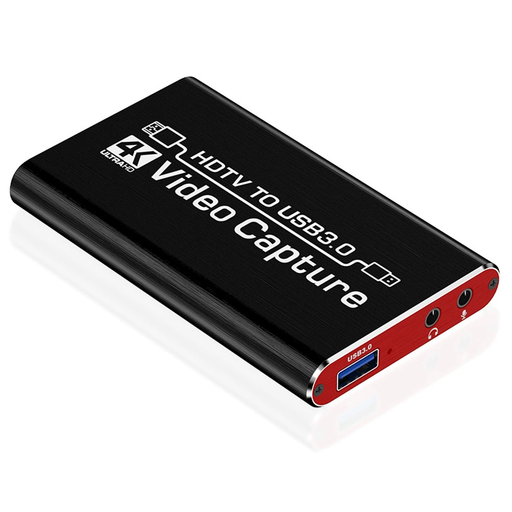
An option if you want to record an external HDMI source and 1080p60 recording is enough for you.
HDMI input: up to 4K 30Hz.
Recording: 1080p 60Hz.
Connection: USB 3.0.
 No image available
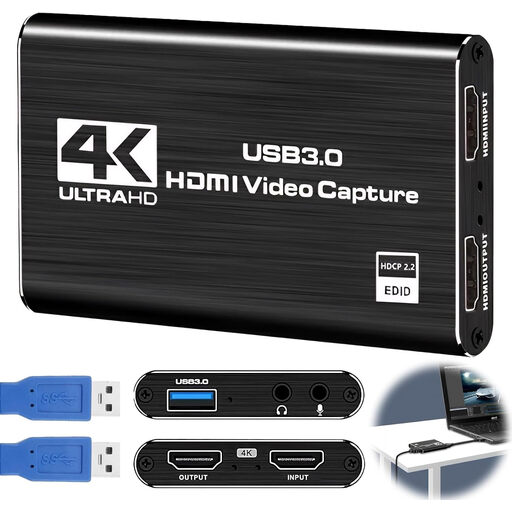
An option if you want to capture HDMI footage and need connections for commentary and listening.
Video recording: up to 1080p.
HDMI passthrough: 4K.
Lists support for UVC and UAC, a microphone input and a headphone output.
Not necessarily. OBS Project offers sources for things such as a game, window or media file, so choose the source that matches where your footage is coming from. For direct HDMI capture from a console, OBS Project describes a capture device as an option.
Check that the model you choose has the HDMI input you need and, for a separate screen, the right HDMI output, as well as the required USB connection to your computer. Add the card to OBS as a video source, then test the picture and sound before you go live.
OBS Project warns that selecting the same audio source both globally and as a separate scene source can cause an echo. Check your audio sources and listen back to a test recording. This can help you check your settings, but it won’t guarantee that all delays disappear.
In the Netherlands, consumer purchases are covered by a legal guarantee if a product doesn’t perform as you could reasonably expect under normal use. ACM ConsuWijzer explains that the seller must then offer an appropriate solution. Online purchases generally come with a statutory cooling-off period of up to 14 days after delivery; check which exceptions and returns conditions apply.
Not automatically. The Dutch government states that permission is generally required to make copyright-protected footage available to the public. Quotation may be possible under certain conditions, but discussing a broadcast doesn’t automatically make it legal to rebroadcast in full. Check the rights for the specific clips and any licence terms separately.