
Making demos on one computer
You mainly want to record a software window or your own screen and first find out whether extra hardware would make a difference. OBS Studio lets you use windows and screens as sources for recordings.


If you’re only demonstrating software on the recording computer itself, try capturing a window or your screen in OBS first; you don’t need an external video source for that. A capture card is for bringing in video from a separate HDMI computer or camera. If you need one, check the input, any pass-through, recording quality and audio separately: the product specifications quoted are provided by the manufacturers, not based on independent quality tests.
You mainly want to record a software window or your own screen and first find out whether extra hardware would make a difference. OBS Studio lets you use windows and screens as sources for recordings.
You want to record the HDMI output from a second computer and possibly view it on a screen at the same time. Check whether your setup also needs HDMI pass-through.
You want to add an HDMI camera to your software demo and need a way to use its footage as a video source in your recording software. OBS Studio supports video devices, including capture cards.
Suitable when: the software runs on the same computer you’re recording on. OBS Studio can use a window or screen as a source.
Bear in mind: this option won’t bring in HDMI video from a separate computer or camera.
Suitable when: you want to record a second computer and send its HDMI signal to a screen as well.
Bear in mind: pass-through and recording are separate specifications. Elgato lists a maximum of 2160p60 pass-through and 2160p30 recording for the HD60 X; StarTech.com lists recording up to 1080p60 with HDMI pass-through for the UVCHDCAP.
Suitable when: you mainly want to record a separate HDMI camera or don’t need HDMI pass-through. The Cam Link 4K, AVerMedia BU113 and Magewell USB Capture HDMI Gen 2 are models worth considering.
Bear in mind: don’t assume these models have a loop-through output. Check the exact camera output, model variant, host connection and supported recording settings.
| Consideration | What to look for | Who is this important to? |
|---|---|---|
| Whether you need hardware | Work out whether the demo runs on the recording computer or comes from another source via HDMI. | If my demo runs on the recording computer, I first want to know whether OBS can capture the window directly. Around 36% of consumers say their main buying question is whether they need extra hardware for this. |
| Pass-through to a screen | Check for HDMI input and HDMI output, and compare the pass-through and recording settings separately. | If I want to record the output from a second computer and view it on a screen at the same time, I look at the complete signal path. Around 29% of consumers prioritise this need. |
| HDMI camera | Check the camera output, exact model variant and supported input and recording modes. | If I want to add camera footage to my software demo, the camera needs to connect properly to the capture card and recording computer. Around 21% of consumers prioritise this camera connection. |
| Voice and software audio | Check which audio the capture model receives, then assign your sources deliberately in OBS. | If I want to record my voice and software audio clearly and be able to edit them later, I need to set up the audio sources properly beforehand. Around 14% of consumers say audio is their main consideration. |
OBS Studio can use a window or screen directly as a source, so you don’t need a card for that recording source.
Start with a short local window or screen recording. Only buy hardware if you want to capture an external HDMI source.
An unnecessary card means extra connections to set up.
Elgato lists a maximum of 2160p60 pass-through for the HD60 X, but 2160p30 recording; these figures describe different functions.
Compare the input, pass-through and recording modes separately for the exact model variant.
Elgato states that its capture devices won’t record HDMI video when HDCP protection is active.
Check that your demo source provides a suitable, unprotected HDMI signal. Don’t expect to capture protected content.
OBS warns that an audio device can cause echo if it’s selected both in the general audio settings and separately in a scene.
Before your demo, make a test recording using your microphone and any app or HDMI audio, then listen back to the saved file.
If the audio is missing or sounds doubled, you may need to spend extra time recording it again.
The Cam Link 4K is an HDMI-to-USB option for a camera; the HD60 X is a model with HDMI pass-through for a separate HDMI source.
The UVCHDCAP is worth considering if you’re looking for HDMI pass-through and recording up to 1080p60.
The USB Capture HDMI Gen 2 is an HDMI-to-USB model to look into if host operating system support is important to you.
AVerMedia presents the Live Streamer CAP 4K BU113 as a capture solution for an HDMI camera.
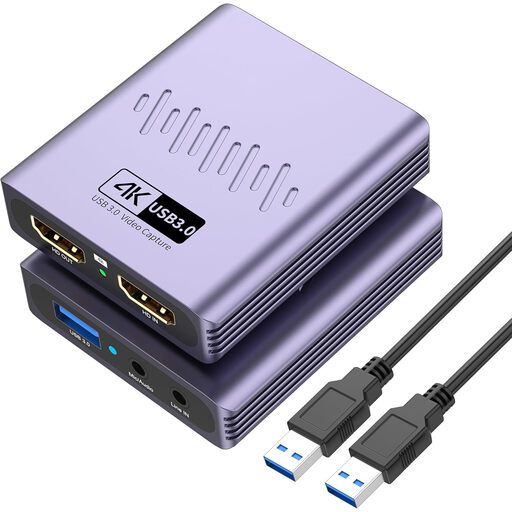
This selection of Joybuy products is aimed at capturing an external HDMI source while passing the signal through to a screen.
 No image available
A model worth considering if you want to record an external HDMI source and send the signal on to a screen as well.
The product title lists USB 3.0, 4K pass-through and video recording up to 1080p; the 4K specification refers to pass-through, not recording quality.
Also listed: a microphone input and headphone output.
Yes. If the software runs on the recording computer itself, you can first try capturing a window or screen in OBS. To capture video from a separate HDMI source, use a video capture device source in OBS with suitable capture hardware.
OBS warns that an audio device can cause echo if it’s selected both in the general audio settings and separately as a scene source. Check the source assignment and make a short test recording.
Under Dutch government guidance, when you buy as a consumer, you’re entitled to a product that works under the statutory guarantee. Any manufacturer, seller or extended warranty is in addition to this; report a fault to the seller.
If you’re creating and publishing footage of people on behalf of an organisation for professional or commercial purposes, the Dutch Data Protection Authority says you need a legal basis under the GDPR. Consent is one possible example, but it isn’t automatically the only legal basis. Before publishing, consider usernames, notifications and other potential personal data in their specific context.
Not automatically. The Dutch government says that, in principle, copyright-protected films, photographs and music may only be used with the creator’s permission. A copy for personal use can’t simply be distributed or made public. Whether a specific part of your demo falls under an exception or licence needs to be assessed separately.