What should you look for when buying?
First decide what you want to record, then check the monitor display and work out the connection and audio routes.
| What to consider |
What should you check? |
Who should pay particular attention? |
| Monitor display and HDMI passthrough |
Compare the resolution, Hz, HDR and VRR of the source, card and monitor; assess passthrough separately from recording. Elgato lists passthrough up to 2160p60 for the 4K S and up to 2160p144 for the 4K X. |
If I want to keep my preferred display mode on the monitor while recording on the second PC, passthrough is an important factor in my choice. Around 31% of consumers say monitor display is their main concern when buying. |
| Actual recording quality |
Check the maximum capture resolution and frame rate for the exact model and software. NZXT says the Signal HD60 can pass through 4K, but cannot record in 4K. |
If you need a recording file at a particular resolution and frame rate, check these separately from the passthrough specifications. Around 25% of consumers prioritise recording quality. |
| Audio from both computers |
Decide which PC audio, voice and microphone input you want in the recording; check the connections and test the routing in your recording software. NZXT describes audio as a separate challenge in a two-PC setup. |
If I want PC audio and microphone input to come through correctly in my recording, I’ll plan the audio routes in advance. Around 25% of consumers say audio recording is their main concern when buying. |
| Connection and placement |
Check whether your recording PC has a suitable USB port or spare PCIe slot, and whether the HDMI cable route will work. If you have signal problems, Elgato recommends using a shorter cable or lowering the resolution or frame rate. |
If you’re looking for a card that suits the PC you have and the distance between the computers, you’ll need to consider the connection and cable route together. Around 19% of consumers prioritise placement and connectivity. |
Joybuy product selection
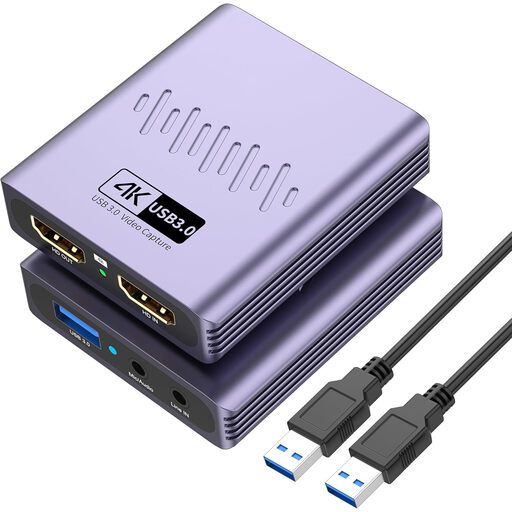
This Joybuy selection is aimed at an external USB setup where 1080p recording is sufficient and 4K passthrough is desirable.
 No image available
VIELLAN HDMI video capture card, USB 3.0
Suited to an external USB setup where recording up to 1080p is sufficient and 4K passthrough is desirable.
The product title lists recording up to 1080p and 4K passthrough; it doesn’t mention 4K recording.
The title mentions driver-free installation, a microphone input and a headphone output.
View at Joybuy
Frequently asked questions
How do I add the second computer’s video in OBS?
Connect the second computer’s HDMI output to HDMI IN on the capture card, then add a Video Capture Device source in OBS on the recording PC. Select the card and choose a supported resolution and frame rate; OBS Project explains how to select the card in this source’s properties.
What can I check if the picture is black or flickering?
First check that the source computer is switched on, the cable is connected to HDMI IN and the card supports the signal. If you have signal problems, Elgato recommends using a shorter cable or lowering the resolution or frame rate. According to Elgato, its capture cards cannot record HDMI signals with HDCP protection enabled.
Will I need extra audio equipment for two PCs?
Not necessarily. First decide which audio sources you want to record and test where they come through. NZXT recommends a mixer and extra audio cables for its own two-PC example, but these aren’t a general requirement for every capture card.
What rights apply to an online purchase in the Netherlands?
For an online consumer purchase, you generally have a 14-day cooling-off period after delivery, subject to legal exceptions; ACM ConsuWijzer explains this right. You’re also entitled to a product that works as it should. The Dutch government states that there’s no fixed statutory warranty period for all products in the Netherlands; if there’s a fault, contact the seller.
Can I record and publish everything that appears on the second computer?
No. Being able to record something doesn’t automatically mean you’re allowed to publish it. The Dutch government states that you generally need permission to use other people’s copyright-protected music, films and photos; a private copy for personal use can’t simply be made public. Before sharing your recording, also check whether the screen shows other people’s personal data.


