
Console streamer with limited space
You want to record console gameplay on your computer while continuing to play on your own screen. Elgato distinguishes between the footage you record and the signal sent to your screen via passthrough.


If you’re recording gameplay from a console to a computer via HDMI, choose a capture card based on the recording quality you want, the passthrough to your screen and your computer’s connections. A 4K60 passthrough specification doesn’t automatically mean the card can record in 4K60; commentary and footage of your hands also require separate recording sources. If you play on the same PC you use to record, try capturing the game directly in OBS first.
You want to record console gameplay on your computer while continuing to play on your own screen. Elgato distinguishes between the footage you record and the signal sent to your screen via passthrough.
You share a bedroom and want to be able to control or edit game audio, your voice and, potentially, a camera feed of your hands separately. OBS explains how to assign audio sources to separate recording tracks; the capture card is just one source in the setup.
You play and record on the same PC and want to know whether an extra device will add anything. Elgato says a capture card isn’t necessary to play and stream on the same machine in a single-PC setup; you can try capturing the game in OBS first.
Choose this if: your game and recording software run on the same PC; try adding a game source in OBS first.
Bear in mind: this option doesn’t replace HDMI input for a separate console, and it won’t capture your hands automatically.
Choose this if: you want to record console gameplay on a computer and your setup needs an HDMI input.
Bear in mind: check recording and passthrough separately; a high passthrough setting doesn’t determine the quality of the recorded video file.
| What to consider | What should you check? | Who should consider this? |
|---|---|---|
| Commentary and room noise | Check whether you can connect your microphone to the computer or to a suitable input. A stereo line-in isn’t automatically a microphone input. | If I want to edit my commentary separately afterwards and make sure it can be heard clearly, I look at the audio connections and where the recording is made. Around 33% of consumers prioritise clear commentary that can be edited separately. |
| Signal to your screen | Check for HDMI-out and whether the passthrough setting on the exact model suits your screen and console signal. | If I want to keep playing on my own screen while recording, I look for passthrough rather than relying only on the software preview. Around 27% of consumers prioritise playing directly on their own screen. |
| Source and computer | Make a note of your game source, computer, available ports and recording software, then compare them with the specifications for the exact model. | If I’m not sure whether my console, computer and connections will work together, I check that combination before buying. Around 20% of consumers prioritise connectivity and system compatibility. |
| Recording quality | Compare the maximum recording resolution and frame rate with what you want to edit or publish. | If the gameplay needs to be easy to see in my tutorial, I check the recording specifications, not just passthrough. Around 20% of consumers prioritise the final picture quality. |
For the Elgato Game Capture Neo, 4K60 is the stated passthrough setting; the maximum recording resolution is 1080p60.
For the exact model, compare HDMI input, passthrough and recording separately.
According to the manufacturer, the Elgato HD60 X has a stereo line-in; Streamplify lists a mic-in for the CAPTURE 4K. The function varies by model.
Check what type of connection your audio source requires. If necessary, connect your microphone separately to the computer.
A capture card records the connected video source. A microphone, camera footage of your hands and the setup of audio sources are separate parts of the recording.
Make a short test recording with gameplay, commentary and the camera source before filming the tutorial.
You may also need a separate camera source to show your hands.
The official specifications for Game Capture Neo and HD60 X show that their recording and passthrough capabilities differ.
The specifications for Live Gamer MINI GC311 and StreamLine MINI+ GC311G2 differ, so check the model number carefully.
Razer lists HDMI in and out, 1080p60 recording, 4K60 passthrough and analogue audio connections for Ripsaw HD.
For CAPTURE 4K, Streamplify lists a mic-in, recording up to 4K30 and passthrough up to 4K60.
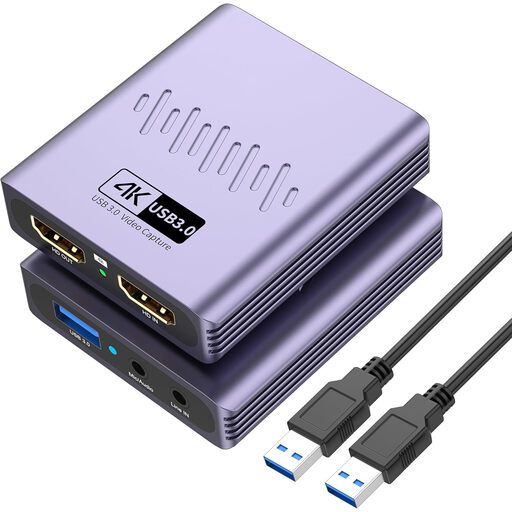
This selection of Joybuy products is aimed at capturing an HDMI video source with separate audio connections.
 No image available
May suit a setup where you record an HDMI video source via USB and want to use audio connections on the capture card.
The product name lists USB 3.0, recording up to 1080p, 4K passthrough, a microphone input and a headphone output.
Check that the listed connections and video settings suit your source, computer and desired recording.
An HDMI capture card records the connected video source, but it won’t automatically capture your hands or controller. Add a separate camera source for this, then check how the gameplay and camera footage appear together in the recording before publishing.
In OBS, you can assign audio sources to separate recording tracks and make a test recording first. OBS notes that standard video players generally play only one track at a time; bear this in mind if you won’t be editing the footage first.
Don’t expect noise suppression to remove much sound from a busy room. OBS describes the feature as useful for light background noise; listen back to your test recording and, if necessary, change where or when you record.
Elgato says its capture cards can’t capture an HDMI signal when HDCP protection is enabled, and that HDCP is switched on by default on PlayStation 5. For permitted gameplay, follow the setup instructions for your console and capture card; this doesn’t give you permission to record protected films or services.
Don’t assume you have general permission. The Dutch Data Protection Authority considers recognisable people in footage to be personal data and says the exception for personal or household use doesn’t apply when sharing outside a limited private circle. Assess the publication of identifiable footage separately, and position your camera and microphone so that people you live with aren’t recorded unintentionally.