
Console player with a separate streaming PC
You want to send the console picture to OBS on another PC. OBS Project describes a capture card as one possible video source in OBS.


If you’re streaming a game on the same PC that’s running OBS, you generally don’t need a capture card. For a console or a second gaming PC, a card can send the HDMI picture to your streaming PC, as described by NZXT Support Center. Choose one based on its separate recording and HDMI pass-through specifications, the USB connection you need and your audio setup. A capture card won’t block out room noise or housemates: check your OBS sources and camera framing separately.
You want to send the console picture to OBS on another PC. OBS Project describes a capture card as one possible video source in OBS.
You want to stream game audio and commentary without accidentally broadcasting room noise or showing identifiable housemates. So check your OBS audio sources and camera framing too.
You want to keep a particular display mode while you play. Compare the HDMI pass-through specifications with the card’s separate recording specifications.
| What to consider | What should you check? | Who is this important for? |
|---|---|---|
| Game source and connection to OBS | Work out whether the picture is coming from the same PC, a console or a second PC. Check that the card can handle the source via HDMI. | If I want to use a console or second PC with OBS, the video signal path needs to work first. Around 36% of consumers put connecting an external game source at the top of their list. |
| Audio and a shared room | Check which inputs capture your game audio and any party chat. Test each source separately in the OBS mixer and check the camera framing. | In a shared bedroom, I want to monitor my voice and game audio without streaming unwanted room noise or echo. Around 29% of consumers first consider sound and chat in a shared room. |
| Display mode while gaming | Note the resolution, refresh rate and any HDR or VRR requirements for your source and display. Then compare the model’s HDMI pass-through and recording output. | If I want to keep a particular display mode while recording the stream, both output modes need to suit my setup. Around 21% of consumers prioritise keeping their preferred monitor mode. |
| USB and required connections | Check the card’s USB version and system requirements, and work out which cables and audio connections your setup needs. | I want a card that connects to my computer and only offers features that my source and display can use. Around 14% of consumers first look at the connections and whether the complete setup is a good fit. |
HDMI pass-through determines what you can play on the connected display; the recording output to your streaming PC has its own limits. For example, Elgato lists a maximum 4K60 pass-through and maximum 4K30 recording for the HD60 X.
Compare the pass-through and recording specifications as two separate features for your source and display.
The card doesn’t control which microphone and audio sources OBS broadcasts, or who appears on camera. The Dutch Data Protection Authority points out that the household exemption doesn’t automatically apply when identifiable images are shared more widely in public.
Make a test recording, listen back to it and check the camera framing. Don’t include identifiable housemates without an applicable legal basis.
Elgato says the full capabilities of the Elgato 4K X require USB 3.2 Gen 2; recording options are more limited over Gen 1.
Before buying, check your computer’s exact USB port, cable and system requirements, and compare them with the card’s requirements.
A listing from a Dutch retailer claims HDR10 pass-through for the NZXT Signal HD60, while NZXT says this model doesn’t support HDR colour.
For an HDR setup, check the specifications for the exact model with the manufacturer.
The GC311 is designed for straightforward Full HD console recording; the GC553G2 is aimed at setups using HDMI 2.1 modes.
The HD60 X offers generous HDMI pass-through with a lower maximum recording output; the 4K X is designed for HDMI 2.1 setups.
The Signal HD60 is designed for streaming from an external source when Full HD recording is sufficient.
The Ripsaw HD could suit a setup for 1080p60 recording with separate audio connections.
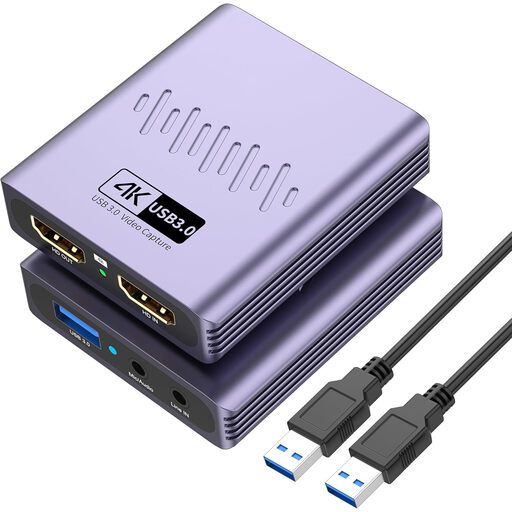
This selection of Joybuy products focuses on external HDMI recording with a USB 3.0 capture card. Check that recording at up to 1080p and 4K pass-through suit your source, display and streaming PC.
 No image available
Suitable for an external HDMI source when recording at up to 1080p is sufficient.
4K pass-through; video recording up to 1080p; USB 3.0; microphone input and headphone output.
The card won’t block out room noise or housemates; set up your OBS audio sources and camera framing separately.
Connect the console to HDMI IN on the card, HDMI OUT to the display and the USB connection to the streaming PC. Then add the card to OBS as a video capture source and check which cables and ports your model requires.
According to Elgato, Elgato cards can’t record an HDMI signal protected by HDCP. For PS5 gameplay, Elgato explains how to disable HDCP in the console settings; this doesn’t give you the right to stream protected films or other content.
Test each microphone and capture card source separately with a test recording, and check the OBS mixer. OBS Project warns that selecting the same audio source both globally and in a scene can cause echo; check audio monitoring too.
First check your upload connection and streaming bitrate. OBS Project lists an unstable connection or a bitrate that your connection can’t keep up with as possible causes of dropped frames.
The Dutch Data Protection Authority states that the exemption for personal or household use doesn’t automatically apply when identifiable images are shared more widely in public; an applicable legal basis is then required, and consent is often the most obvious option. BumaStemra says that you don’t need a separate BumaStemra licence for music from its repertoire on platforms such as Twitch and YouTube, but notes that other rights and platform blocks may still apply.