Choose a capture card that matches your camera’s unencrypted HDMI output, your computer’s USB port and your recording software. Then compare the actual recording resolution, not just the HDMI input specification. For longer sessions, check the camera’s power supply and audio too.
Who is a capture card for?
Connecting your camera
First, you’ll want to check whether your camera’s HDMI feed appears on your computer without menu overlays. The camera output, cable, USB port and hardware revision all play a part. Elgato outlines these considerations for the Cam Link 4K.
Keeping an eye on image quality
You’re recording demonstrations or presentations and want to know the quality of the saved footage, not just which input formats the card accepts. The specifications from AVerMedia and StarTech.com make the distinction clear.
Recording longer sessions
You need to record continuously, so you’ll want to consider camera power, audio, recording software and the saved file. OBS Project covers topics including video sources and recording formats.
What should you look for when buying?
First, check that your camera provides a usable HDMI signal and that your computer has the required connection. Then compare recording quality and the connections you’ll need for audio or longer sessions.
| Consideration |
What should you check? |
Who is this important for? |
| Compatibility |
Check your camera’s HDMI format, whether overlays can be switched off, and the card’s required USB port and system version. |
I want to make sure my camera sends a suitable signal to my computer without menus getting in the way, so connectivity is the priority for around 36% of consumers. |
| Recording quality |
Compare the maximum HDMI input with the maximum recording resolution and its corresponding frame rate. |
When I record a presentation, I want to know the quality the file will actually have; around 29% of consumers prioritise recording quality. |
| Long recordings and audio |
Test the camera’s power supply and check which video and audio sources are being recorded in your recording software. |
For a long session, I don’t want the camera to switch off or the wrong audio source to be recorded; this is the main concern for around 21% of consumers. |
| Ease of connection and support |
Decide whether you need HDMI pass-through, a separate audio input or support for your operating system. |
I only want to pay for extra connections or platform support if my setup needs them; ease of connection comes first for around 14% of consumers. |
Common pitfalls
-
Confusing HDMI input with recording quality
The maximum input and maximum recording resolution may differ. For the AVerMedia BU113, the manufacturer specifies a maximum input of 2160p60 HDR and a maximum recording resolution of 2160p30.
For the exact model, compare the input, capture or recording resolution, and frame rate separately.
-
Assuming an HDMI connection guarantees compatibility
Your camera menu or another overlay may remain visible in the recording. The camera may also be unable to run for the whole session if its power supply isn’t suitable for the recording duration.
Before buying, check that your camera provides a clean HDMI signal and make a test recording for the intended duration.
-
Not checking your computer’s port or the hardware revision
According to the manufacturer, the AVerMedia BU113 doesn’t support USB 2.0. Elgato also lists different system requirements for the Cam Link 4K revisions.
Compare your computer’s USB port and operating system with the documentation for the exact model.
Brands to consider
Elgato
The Cam Link 4K is a compact HDMI-to-USB option for using a suitable camera feed on a computer.
- Elgato lists support for formats including 1080p60 and 2160p30 with a suitable, unencrypted HDMI source.
- There are three hardware revisions with different system requirements, so check which model you’re choosing.
AVerMedia
The Live Streamer CAP 4K BU113 is designed for capturing camera footage via HDMI and USB-C.
- AVerMedia specifies recording up to 2160p30 and a UVC connection.
- The stated 2160p60 HDR refers to the input, not the maximum recording resolution; USB 2.0 isn’t supported.
StarTech.com
The UVCHDCAP is an external UVC card for unencrypted HDMI sources.
- StarTech.com lists HDMI pass-through, a 3.5 mm audio input and recording up to 1080p60.
- The manufacturer doesn’t list 4K recording for this model; extra connections are only useful if you need them.
Magewell
The USB Capture HDMI Gen 2 is an external single-channel card that supports several computer platforms.
- Magewell lists support for Windows, Linux, Mac and Chrome OS, and specifies that the device is suitable for extended use.
- According to Magewell, the actual capture frame rate may be limited by USB bandwidth, so check that the input and recording combination suits your needs.
Products at Joybuy
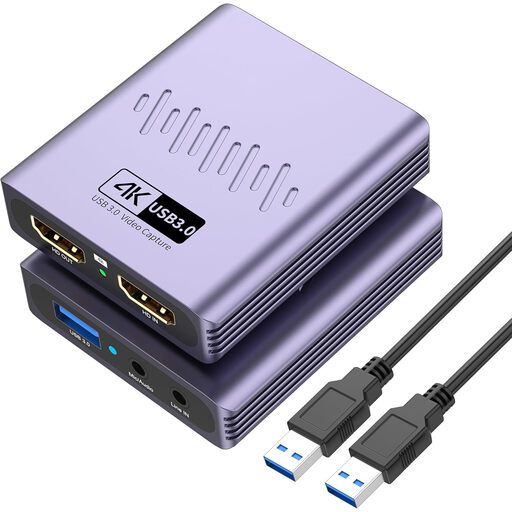
This selection is aimed at connecting an HDMI camera via USB 3.0 when recording at up to 1080p is sufficient.
 No image available
VIELLAN HDMI video capture card with USB 3.0
An option if you want to connect an HDMI camera via USB 3.0 and recording at up to 1080p is sufficient.
The product name lists video recording up to 1080p, 4K pass-through, a microphone input and a headphone output. 4K pass-through doesn’t mean 4K recording.
The product name also mentions driver-free installation; check that your camera provides a suitable HDMI signal and that the connection works with your computer.
View at Joybuy
Frequently asked questions
How do you connect a camera to record its feed on your computer?
First, check that your camera can provide a suitable, unencrypted HDMI feed without menu overlays. Connect the HDMI output to the capture card, plug it into a supported port on your computer and select the video source in your recording software. Also test which audio source is being recorded.
Does a 4K HDMI input mean you can also record in 4K at the same frame rate?
No, the maximum input and recording resolutions may differ. AVerMedia lists a maximum 2160p60 HDR input and maximum 2160p30 recording resolution for the BU113; check these specifications separately for each card.
What should you prepare for a longer recording?
Check that your camera can be powered throughout the session, make a test recording with both video and audio, and check the file format. OBS Project describes MKV as the default container and recommends it for most recordings; you can convert the file to a more widely compatible format if needed.
Which extra connections or accessories should you check?
Check whether you need the right HDMI cable or a suitable camera power supply. Also decide whether you’ll use HDMI pass-through or a separate audio input, and whether any computer adapter will work with your setup.
Can you record a camera feed showing other people in the Netherlands without restrictions?
That depends on the purpose and how the footage is used. According to the Dutch Data Protection Authority, a private recording for household use is generally outside the scope of the GDPR, but the GDPR may apply if, for example, footage is made available online without restriction. Organisations processing personal data need a valid legal basis; consent is one possible basis. Consider this before recording or sharing footage of other people.


