Start by measuring the clearance beneath your seating and checking that the supplied floor head and tube will fit underneath. Make sure a crevice tool can reach the back edge. Then choose a working range and collection system to suit the length of your cleaning round: greater capacity may mean a larger or heavier vacuum. Manufacturer specifications won’t tell you whether a particular model will fit under the seating at your premises.
Who is this choice relevant to?
Cleaners working around low seating
If you need to reach dry debris under seating and along the back edge, check the clearance and the attachments supplied with the exact model. Miele lists a flexible crevice tool for the Guard M1 Flex; the Consumers’ Association also recommends considering how you’ll use the vacuum when choosing.
Those responsible for longer cleaning rounds
If you clean several seating areas in a row before opening time, weigh up cord reach and capacity against weight and ease of moving the vacuum. Numatic and Kärcher publish cord and capacity specifications for specific models.
Buyers considering dust collection in an occupied space
If people are nearby, or you’re thinking about how to dispose of collected dust, compare a dust bag with a dust container and consider what emptying it involves as part of your routine. The Consumers’ Association explains that a dust container needs emptying when it is nearly full.
What should you look for when choosing?
First, check the clearance beneath the seating and whether the vacuum can reach along the back edge. Then consider your route, the floor, how you’ll dispose of the dust and whether visitors may be present.
| What to consider |
What to look for when buying |
Who is this most relevant to? |
| Reach beneath and behind seating |
Measure the clearance and check that the tube and floor head will fit underneath. Also check the crevice tool. |
I want to reach debris by the back edge without the tool getting stuck. Around 29% of consumers prioritise reach beneath seating. |
| Finishing the round before opening time |
Compare the cord length with your route and socket locations. Consider capacity and weight on the same basis. |
If I’m cleaning several seating areas in a row, I want to know whether the reach and capacity suit my round. Around 23% of consumers prioritise working range and capacity for this reason. |
| Floor head |
Check the flooring in the space and which floor heads and crevice tools are included with the exact model. |
I want a tool that suits the floor around the seating, without assuming it will also fit underneath. Around 18% of consumers prioritise flooring and tool choice. |
| Collecting and disposing of dust |
For a bagged model, check which type of bag it needs. For a model with a dust container, find out how and where you’ll empty it. |
I want to decide in advance whether a dust bag or emptying a dust container better suits my working routine. Around 18% of consumers prioritise how dust is disposed of. |
| Noise during preparation |
Compare the noise ratings for the exact models and consider who will be nearby while you’re cleaning. |
If people are already present early in the day, I want to consider noise alongside reach and the floor head. Around 12% of consumers say noise around opening time is their main concern. |
Common buying pitfalls
-
Assuming a long cord means the floor head can reach everywhere
The cord tells you about the working range, but not whether the tube and floor head will fit beneath low seating or reach the back edge.
Measure the clearance and check the supplied tools alongside the cord length for the exact model.
-
Assuming a bagless vacuum is maintenance-free
With a bagged model, you need to replace the bag; with a bagless model, emptying the dust container is part of the routine.
Choose a collection system based on how and where you can dispose of the collected dust.
-
Assuming a higher wattage means better cleaning
According to the Consumers’ Association, a more powerful motor does not automatically mean a vacuum cleaner will clean better.
Look at the floor head, the surface and relevant cleaning information rather than focusing on wattage alone.
Brands to consider
Miele
Bagged domestic canister vacuum cleaners. The Guard M1 Flex is one example to consider if you’re looking for a flexible crevice tool.
- Miele lists a flexible crevice tool and an 11 m operating radius for the Guard M1 Flex.
- Check separately whether the floor head will fit under your seating. These specifications do not automatically apply to other Guard models.
Numatic
Professional dry vacuum cleaners, including the PPR240-11, for those weighing up greater capacity against carrying weight.
- Numatic lists a 9 l dust bag and a 12.5 m cord for this model.
- The stated weight is 9 kg, including the machine and kit. Greater capacity does not prove that the floor head will fit under low seating.
Kärcher
The T 11/1 Classic Adv Re!Plast is a professional dry vacuum cleaner whose cord, capacity and stated noise level are worth considering together.
- Kärcher lists a 12 m cord, an 11 l capacity and 61 dB(A) for this version.
- The stated weight excludes accessories, so don’t compare it directly with a weight that includes a kit.
Philips
Bagless domestic canister vacuum cleaners. The FC9332/09 is one example with a dust container and a floor head for different surfaces.
- Philips describes this model as having a dust container and a TriActive floor head.
- Consider separately what emptying the dust container involves, and don’t assume claims about suction performance or hygienic emptying have been independently tested.
AEG
Bagged canister vacuum cleaners. The AB61C2DBS is one example to consider when comparing tools, bag capacity and stated noise levels.
- AEG lists an AllFloor Auto floor head, a 3-in-1 accessory, a 3.5 l dust bag and 73 dB(A) for this version.
- Don’t assume its operating radius based on other models in the same range.
Bosch
Bagged canister vacuum cleaners. The BGL8SIL0L is one example for comparing operating radius and bag capacity.
- Bosch lists an operating radius of 15 m and a bag capacity of 5 l for the BGL8SIL0L.
- These specifications apply to the BGL8SIL0L and should not be assumed to apply to other Bosch models.
Vacuum cleaners on Joybuy
This selection on Joybuy includes bagged and bagless canister vacuum cleaners. Compare their tools, working range and capacity with the clearance beneath your seating and the length of your cleaning round.
 No image available
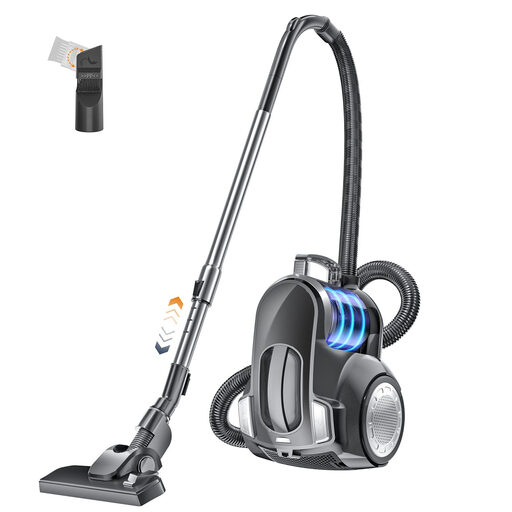
Bagless vacuum cleaner, 1200 W, 2.5 l container
For anyone looking for a bagless model for hard floors and carpet, with a crevice tool for narrow spaces.
The product information lists a 2.5 l dust container, a 5.5 m cord and a 14 m working range. Check which measurement is relevant to your route.
The description mentions an integrated 2-in-1 crevice tool and use on hard floors and carpet.
View at Joybuy
 No image available
Philips 2000 Series XD2142/12
For anyone looking for a bagged vacuum cleaner with a crevice tool for cleaning several areas in one round.
The product information lists a power rating of 800 W, a 3 l dust bag and a 9 m operating radius.
The description mentions an integrated crevice tool, an upholstery tool and two dust bags included. The stated noise level is below 77 dB(A).
View at Joybuy
 No image available
Rowenta RO3927 Compact Power
For anyone looking for a bagged vacuum cleaner with a crevice tool for picking up dry debris from hard floors.
The product information lists a power rating of 750 W, a 3 l dust bag and an 8.8 m operating radius.
The description mentions a metal telescopic tube, a crevice tool and a two-position floor head.
View at Joybuy
 No image available
Miele Guard S1 Parquet Flex
For domestic use indoors, when a flexible crevice tool and a 10 m operating radius suit your cleaning route.
The product information lists a 3.5 l dust bag, a power rating of 890 W and a 10 m operating radius.
The description mentions a flexible XL crevice tool and a parquet floorhead. It is intended for domestic use indoors; don’t assume it is suitable for commercial cleaning tasks.
View at Joybuy
Frequently asked questions
Does the whole vacuum cleaner need to fit under the seating?
No. With a canister vacuum cleaner, you use the hose, tube and floor head to clean underneath the seating. Measure the clearance and check that the floor head and tube you plan to use can reach the back edge.
How do I get the vacuum ready for the next cleaning round?
After each round, check whether the dust bag needs replacing or the dust container needs emptying. Follow the instructions for the exact model when dealing with filters and accessories, and have the right tool ready.
What ongoing running costs and warranty terms should I check?
Bagged vacuum cleaners need replacement bags, so include these in your running costs. For private purchases, Dutch consumer law entitles you to a product that is fit for purpose. Consumer protection does not automatically apply to predominantly business use, according to ACM ConsuWijzer; in that case, check the agreed business warranty and service terms.
Does a canister vacuum cleaner in the Netherlands need an energy label?
Don’t use the former European energy label for vacuum cleaners as a current buying requirement: the Consumers’ Association reports that it has been declared invalid, and the European Commission says the associated energy labelling regulation has been withdrawn. Ecodesign rules are separate.
Can I also use the same vacuum cleaner for construction or wood dust under the seating?
Don’t assume so. Dutch government guidance on Arboportaal recommends using an industrial vacuum cleaner to pick up wood dust. Follow the relevant requirements for that material too, and check which filter is needed. Ordinary dry debris left by visitors is not automatically the same as wood dust.


