
People dealing with dirt in gaps around thresholds
You want to reach dry dirt along thresholds and clean the adjoining hard floor too. Philips describes a crevice tool for hard-to-reach places; also check which floorhead comes with the model.


Choose a model with a crevice tool that can reach the gap along your threshold, and check that the floorhead is suitable for the adjoining floor. If your housemates are concerned about noise or dust when emptying the vacuum, compare the noise level and dust collection method: according to the Consumentenbond, you generally come into less contact with dust when changing a dust bag than when emptying a dust container. Also check the operating radius, weight and which tools are included with the exact model.
You want to reach dry dirt along thresholds and clean the adjoining hard floor too. Philips describes a crevice tool for hard-to-reach places; also check which floorhead comes with the model.
You vacuum while other people are at home and want to consider noise alongside cleaning performance and ease of use. In its noise tests, the Consumentenbond assesses factors including how loud the noise is and how disruptive it sounds.
You pay attention to what happens when the dust container is full. According to the Consumentenbond, you come into less contact with dust when changing a dust bag than when emptying a dust container.
| What to consider | What to look for | Who is this important to? |
|---|---|---|
| Dirt in the gap and on the floor | Check whether a crevice tool is included and which floorhead is suitable for the adjoining floor. | I don’t want to need a separate cleaning session for the adjoining floor after doing the threshold; around 39% of consumers give cleaning gaps and floors top priority. |
| Noise while cleaning | Compare noise data for the exact models and, where available, independent assessments of noise and ease of use. | If my housemates are at home while I vacuum, keeping things quiet matters in my choice; around 23% of consumers put noise first. |
| Dust when emptying | Compare changing a dust bag with emptying a dust container, and check the instructions for bags and filters. | I want the person emptying the dust container to come into as little contact with dust as possible; around 23% of consumers make this their top priority when choosing. |
| Reach and manoeuvrability | Check the operating radius and weight separately for the exact model; a long reach doesn’t tell you how easily the canister moves over a threshold. | If I’m cleaning several rooms or need to lift the canister, both reach and ease of handling matter; around 15% of consumers put this trade-off at the top of their list. |
According to the European Commission, a higher electrical input power doesn’t always mean a vacuum cleaner cleans better. For dirt along a threshold, it also matters whether the tool you choose fits the gap.
Check which tools are included and, where available, look for independent reviews covering the type of floor you have.
With a bagged vacuum, the exact type matters: a poorly fitting bag can leak. A full dust container or blocked filter can affect performance. A bagless model needs emptying and its filters need maintaining.
Check the bag type and the model’s maintenance instructions. In a shared home, agree on who will empty the dust container too.
Noise, weight and manoeuvrability are different things. The stated operating radius doesn’t tell you whether you can easily lift the canister over a threshold.
Compare these features separately and think about how you’ll move the vacuum around your home.
The RO7457EA is a bagged canister vacuum supplied with crevice tools, including a flexible XXL crevice tool.
The BGL8HYG0L is a bagged canister vacuum supplied with a crevice tool; Bosch states that it has a 15 m operating radius.
The FC9332/09 PowerPro Compact is a bagless canister vacuum. Philips describes the TriActive nozzle as designed for both hard and soft floors.
The Complete C3 125 Edition Petrol is a bagged model for which Miele lists a crevice tool.
Joybuy product picks for dry dirt in gaps around thresholds and on the adjoining floor.
 No image available
The included crevice tool is designed for deep gaps; the Parquet Twister is designed for hard floors.
890 W; 3,5 l dust bag; stated operating radius of 10 m; four suction settings; stated noise level of 76 dB.
Uses HyClean Pure TU dust bags; check the correct type when replacing. Not designed for liquids, hot ash or fine dust such as plaster or cement.
 No image available
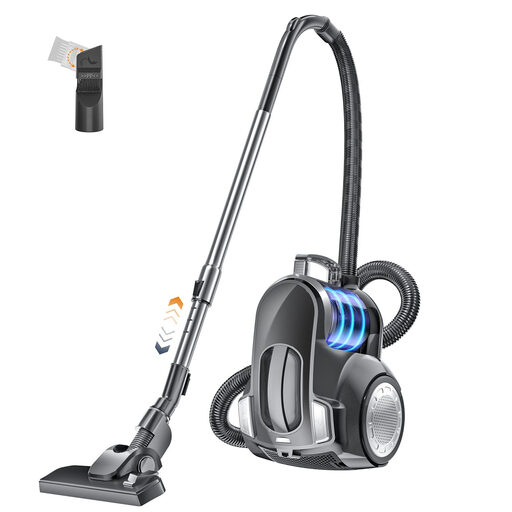
The product description mentions an integrated 2-in-1 crevice tool and a floorhead that switches between hard floors and carpet.
2,5 l dust container; 5,5 m cord; stated operating radius of 14 m; stated noise level below 70 dB.
According to the Consumentenbond, it’s harder to avoid contact with dust when emptying a dust container than when changing a dust bag.
No, not necessarily. First check that you have a suitable crevice tool for the edge and a useful floorhead for the adjoining floor. According to the Consumentenbond, a parquet brush isn’t automatically necessary; a clean standard nozzle may work too.
Follow the model’s instructions: replace a full dust bag or empty the dust container, and check the filters, nozzle and hose for dirt or blockages. Let a cleaned filter dry completely before putting it back.
Yes, a bagged model needs compatible replacement bags; check the type number, as a poorly fitting bag can leak. In the Netherlands, contact the retailer if a product is faulty. According to the Dutch Government, there is no fixed statutory two-year guarantee period for all products.
No. According to the European Commission, the former energy labelling scheme for vacuum cleaners no longer applies; ecodesign requirements for mains-powered vacuum cleaners are a separate matter. Don’t judge cleaning performance by wattage alone.