
Cleaning thresholds and crevices
You want to remove dry dirt from a narrow or hard-to-reach transition. Pay particular attention to a suitable crevice tool and test results for dust in crevices.


Choose a canister vacuum cleaner with a crevice tool suited to the shape and accessibility of your threshold, and compare its performance on crevices rather than looking only at motor power. A bag helps limit contact with collected dust when you dispose of it, while a bagless model means you won’t need to buy bags but will need to empty the dust container. If you have delicate parquet flooring, the floor tool included also matters. The Dutch Consumers’ Association generally found in its tests that bagged vacuum cleaners perform better on hard floors, but this is no guarantee for every individual model.
You want to remove dry dirt from a narrow or hard-to-reach transition. Pay particular attention to a suitable crevice tool and test results for dust in crevices.
You also want to protect the floor around the threshold. Check whether a suitable parquet tool is actually included, and compare how well the vacuum picks up dirt from the floor.
You want to minimise contact with dust when disposing of vacuumed-up dirt, so you’re comparing a dust bag with a dust container.
Start with the tool and how accessible your threshold is. Then compare floor protection and how you dispose of the collected dust.
| What to consider | What should you check? | Who should pay particular attention? |
|---|---|---|
| Removing dry dirt from a crevice | Check that the crevice tool suits the shape and accessibility of your threshold, and compare test results for dust in crevices. | If I want to remove dirt from a narrow threshold gap, the tool needs to reach it. Around 36% of consumers say access to crevices is their top priority when buying. |
| Protecting the floor around the threshold | Check the floor finish and make sure a suitable parquet tool is included. Compare separate results for hard floors and crevices. | If I have delicate parquet flooring, I want to protect it without overlooking the crevice. Around 29% of consumers put floor protection first. |
| Disposing of collected dust | Compare the type of dust bag and its availability with the process for emptying a dust container. | If I want to limit contact with dust when disposing of it, the way it is emptied matters. If I don’t want to buy bags, a dust container may be a better option. Around 21% of consumers give dust disposal top priority. |
| Moving between rooms | Compare the stated operating radius with the distance to your sockets, and check the weight and accessories. | If I regularly move the vacuum cleaner to another room, its reach and any follow-up tasks matter. Around 14% of consumers put moving and maintenance at the top of their list. |
According to the European Commission, higher power consumption does not automatically mean better cleaning performance.
For this task, compare results for hard floors, crumbs and dust in crevices, and check that the included tool can reach your threshold.
A parquet tool and the ability to remove dirt from a crevice are separate things to consider.
Check floor protection and crevice pick-up separately; don’t judge by the type of floor tool alone.
Dust disposal works differently: you throw away a full dust bag, whereas you have to empty a dust container yourself.
Choose the option that suits the way you prefer to dispose of dust, and check which bags are compatible if you opt for a bagged model.
For the Serie 4 BGB41RD3H, Bosch lists a dust bag, crevice nozzle, parquet brush and an 11 m operating radius.
For the Guard S1 Parquet Flex, Miele lists a dust bag, flexible crevice brush and Parquet Twister brush.
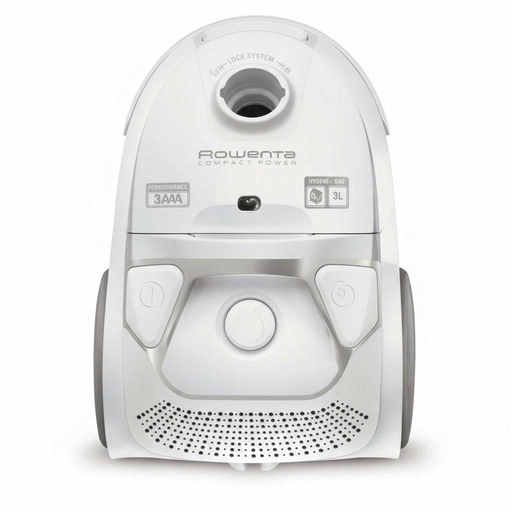
The Swift Power Cyclonic RO2913EA is a bagless canister vacuum cleaner; Rowenta lists a 2-in-1 crevice nozzle.
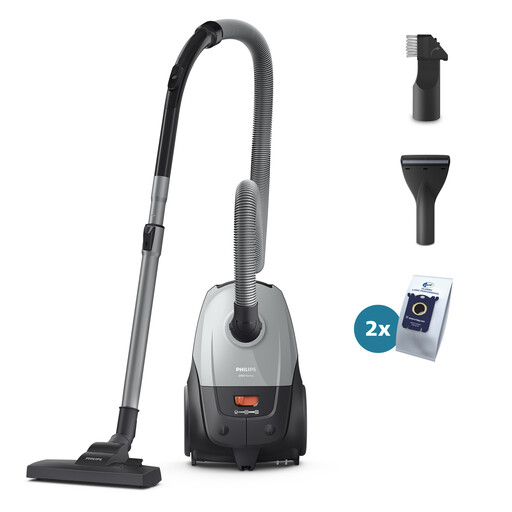
For the Performer Silent FC8780/09, Philips lists a dust bag, TriActivePro floor nozzle and a noise level of 66 dB.
For the VX6-2-IW-5, AEG lists a dust bag, DustPro standard nozzle and a separate crevice nozzle.
These Joybuy products are bagged canister vacuum cleaners for dry dirt around thresholds. The listed crevice and floor tools may help you choose, but they don’t prove how well a model cleans crevices.
 No image available
The product information lists an included crevice tool, which is useful for dry dirt in a threshold gap.
750 W motor; 3 l dust bag; stated operating radius of 8,80 m; telescopic metal tube and automatic cord rewind.
This is a bagged model; the bag needs to be replaced.
 No image available
The product information lists a flexible XL crevice tool and a Parquet Twister, which may be worth considering if you need to clean both a threshold gap and a hard floor.
890 W; 3,5 l dust bag; stated operating radius of 10 m; four-stage suction control.
This is a bagged model; the bag needs to be replaced.
 No image available
The product information lists an integrated 2-in-1 crevice tool for tight spaces.
800 W; stated reach of 9 m; two dust bags included.
This is a bagged model; the dust bag needs to be replaced.
No. A parquet brush alone doesn’t prove that a vacuum cleaner can remove dirt from a threshold gap. Compare separate test results for dust in crevices too, and check whether a suitable crevice tool is included.
Compare the stated operating radius with the distance to your sockets, and check which accessories are included with the version you’re considering. Replace the dust bag when needed on a bagged model; a dust container needs to be emptied regularly.
Yes. You won’t need to buy dust bags, but you will need to empty the dust container regularly. With a bagged model, you throw away the full bag, which means less contact with the collected dust during disposal.
Your statutory guarantee applies alongside any manufacturer’s guarantee and depends on what you can reasonably expect from the product with normal use, as ACM ConsuWijzer explains. For many eligible online consumer purchases, the Dutch government allows a 14-day cooling-off period.
The Netherlands Food and Consumer Product Safety Authority (NVWA) states that electrical products must carry a CE mark. The former EU regulation on energy labels for vacuum cleaners has been annulled, so don’t treat an old vacuum cleaner label as a current mandatory comparison measure. The European Commission also sets out separate ecodesign requirements for mains-powered household vacuum cleaners.