
Anyone with a hard-to-reach staircase
Consider the reach and the weight you’ll need to move with the accessories in use. The Consumers' Association points out that the stated weight may apply to the vacuum cleaner alone.


For ordinary dry debris from a move, start by choosing a floorhead to suit the surface and the edges of your stairs. Then check that the reach and weight are suitable for your staircase. A bagged or bagless vacuum could work, but fine building dust, coarse grit and potentially asbestos-containing material need to be treated differently from everyday crumbs and dust, as the Consumers' Association also points out.
Consider the reach and the weight you’ll need to move with the accessories in use. The Consumers' Association points out that the stated weight may apply to the vacuum cleaner alone.
You need a floorhead that suits both the stair carpet and the edges and corners of each step. The Consumers' Association emphasises that your choice of floorhead depends on the surface.
Think about how you’ll empty the collected dirt, and how filters and dust emissions factor into your choice. The Consumers' Association covers these considerations for bagged and bagless vacuum cleaners.
Start with your stairs and the right floorhead, then compare the reach, weight and how the vacuum collects and disposes of dirt.
| What to consider | What should you check? | Who will find this important? |
|---|---|---|
| Reach and ease of handling | Compare the working reach from the socket to the floorhead, and the weight with the accessories you’ll use. | If I need to move the vacuum while cleaning, I want to reach every step without putting it down somewhere unsafe. Around 33% of consumers give reach and ease of handling on stairs top priority. |
| Floorhead for steps and edges | Check which crevice, upholstery or carpet tool is included and whether it suits hard or carpeted stairs. | On carpeted stairs, I want to lift dirt from the carpet and reach the edges. Around 27% of consumers prioritise a suitable floorhead for steps, corners and upholstery. |
| Dust collection and maintenance | Check how to replace a dust bag or empty the dust container, and what information is available about filters and dust emissions. | If I want to avoid contact with collected dust as much as possible after vacuuming, I focus on emptying and maintenance. Around 20% of consumers make dust collection and maintenance their top priority. |
| Running costs | For a bagged model, check the type of replacement bag it needs; for a bagless model, find out what maintenance is required. | If you’ll keep using the vacuum after the move, you may want to factor in recurring purchases and maintenance. Around 20% of consumers give running costs after the move top priority. |
According to the Consumers' Association, fine building dust and coarse grit are not suitable for an ordinary vacuum cleaner. Potentially asbestos-containing material should not be treated as an ordinary vacuuming job.
Identify the type of dirt before choosing a machine for the job.
The distance from the socket to the floorhead is not the same as the cord length. In addition, the stated weight may exclude accessories, according to the Consumers' Association.
Compare working reach and weight on a like-for-like basis, and think about where you can safely place the vacuum while you work.
A wide floorhead won’t necessarily reach the edges of a step. The usefulness of a brush also depends on whether the stairs are hard or carpeted; the Consumers' Association notes that a turbo brush offers no added benefit on hard floors.
First consider the stair covering and the width of the steps, then check which smaller tools are included.
The Guard S1 Parquet Flex is a bagged model with accessories for hard floors and tight spaces.
The Serie 6 BGL6HYG1L is a bagged vacuum cleaner you can compare for reach and dust collection.
The Silence Force RO7457EA is a bagged model with small tools included, which may be useful for edges and furniture.
The Performer Silent FC8781/09 is a bagged model with a standard floorhead and an allergy filter.
These Joybuy picks are suited to dry dirt on stairs. Consider a bagless dust container or a dust bag, and check for each model whether the included floorhead is right for your staircase.
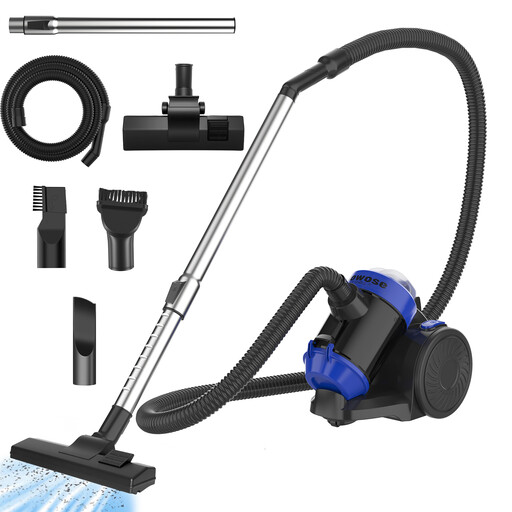 No image available
The description mentions hard floors, carpet and a crevice tool; check that the included tools suit your stairs.
Dust container: 1,5 l. Cord: 4 m; this is not the same as the working reach to the floorhead.
 No image available
The description mentions a flexible crevice tool and floorheads for hard floors and carpet; check which ones are suitable for your stairs.
Dust bag: 3,5 l. Operating radius: 10 m. The product description warns against vacuuming fine dust such as plaster or cement.
Choose a floorhead that suits the surface, and check that you also have a small tool for edges and corners. A turbo brush can sometimes help on carpet, but according to the Consumers' Association it isn’t always better than a standard floorhead and offers no added benefit on hard floors.
Measure the route from a suitable socket to the furthest step and compare it with the stated working reach to the floorhead, not just the cord length. Also consider where you can safely place the canister vacuum while cleaning.
First assess what’s there. The Consumers' Association lists fine building dust and coarse grit as types of dirt that an ordinary vacuum cleaner is not designed to handle. Don’t treat potentially asbestos-containing material as an ordinary vacuuming job.
No. According to ACM ConsuWijzer, the statutory guarantee applies alongside any manufacturer’s or seller’s warranty; what you can expect from a product depends, among other things, on normal use. If a fault develops too soon, the seller is your point of contact.