
Cleaning under a low bed
You want to know whether the floor head can reach under your bed and stay in contact with the floor while you vacuum. The Consumers’ Association highlights the importance of floor contact when cleaning under low furniture.


First, choose a floor head that fits under your bed and stays in contact with the floor when you lay the tube flat; power alone won’t tell you whether it will. Then compare the canister’s dimensions and cleaning range with your home, and choose between a dust bag, which reduces contact with dust when you dispose of it, and a dust container that you empty yourself.
You want to know whether the floor head can reach under your bed and stay in contact with the floor while you vacuum. The Consumers’ Association highlights the importance of floor contact when cleaning under low furniture.
You want to manoeuvre the canister through narrow gaps and find somewhere to store it after use. So compare its dimensions and cleaning range; the Consumers’ Association notes that compactness matters for storage and moving the vacuum around.
Your decision comes down to how you dispose of collected dust and whether you’d rather replace dust bags or empty a dust container. According to the Consumers’ Association, you don’t have to empty a dust bag yourself, so you have less contact with dust when disposing of it.
| What to consider | What to look for | Who is this important for? |
|---|---|---|
| Reach under the bed | Measure the clearance and how far you can reach. Check whether the floor head can move while the tube is flat and the head stays on the floor. | If I want to remove fluff from under a low bed, I need to know whether the floor head fits and stays in contact with the floor; around 36% of consumers prioritise reach under the bed. |
| Maneuvrability and storage | Compare the canister’s dimensions with your doorways and storage space. Also check the stated cleaning range against the distance from a power socket. | For me, it matters whether the canister can get through narrow gaps and be stored away after use; around 29% of consumers prioritise space and manoeuvrability. |
| Disposing of dust | Choose between a dust bag and a dust container. Check which bags or filters the model needs and how to empty the container. | If I want to minimise contact with collected dust, how it’s disposed of matters; around 21% of consumers prioritise low-dust emptying. |
| Maintenance and recurring supplies | Check how to replace the bag or empty the container, and what filter maintenance the manual recommends. | I want to know in advance which recurring supplies and maintenance tasks come with my choice; around 14% of consumers prioritise maintenance and ongoing costs. |
A higher power consumption doesn’t automatically mean the vacuum cleaner will reach fluff under a low bed effectively. It also matters whether the floor head stays in contact with the floor when the tube is held at a low angle.
Measure the clearance under your bed and check the shape and movement of the specific floor head before comparing models by power.
The dimensions of a compact canister don’t automatically tell you whether there’s enough height or room for the floor head to move.
Measure the clearance under the bed and check the floor head separately from the canister’s dimensions.
Bagless models still need emptying and may need filter maintenance. A full dust container or a filter that needs attention can affect performance.
Follow the model-specific instructions for emptying the container and cleaning or replacing filters.
Allow time to empty the dust container and carry out the recommended filter maintenance.
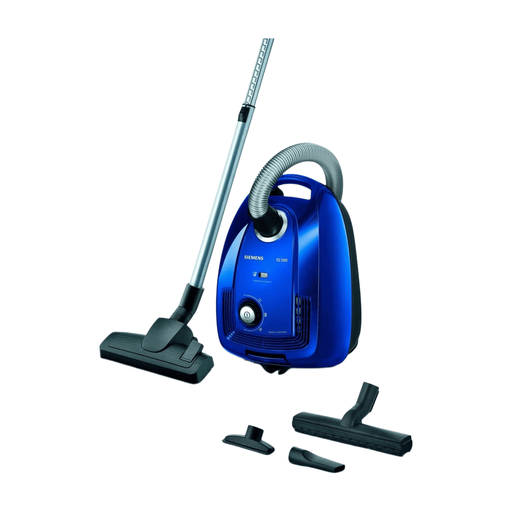
The Serie 2 BGBS2LB1 is a compact bagged model for anyone looking for a canister vacuum with a crevice tool included.
The 1000 Series XB1142/10 is a bagless option for anyone who doesn’t want to buy dust bags.
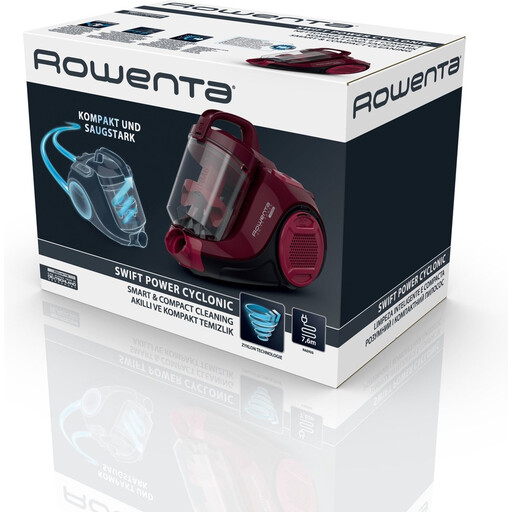
The Swift Power Cyclonic RO2913EA is a compact, bagless option with a 2-in-1 crevice tool included.
These Joybuy products include both a bagless canister vacuum cleaner and a bagged model. Before using either under a bed, check separately whether the floor head fits and stays in contact with the floor.
 No image available
A bagless model for anyone who doesn’t want to buy dust bags and is looking for a crevice tool for narrow edges.
The product description lists a 1,2 l dust container, a telescopic metal tube and a 7,6 m operating radius. It also mentions a crevice tool and three 360° wheels.
 No image available
A bagged model for anyone who prefers this way of disposing of dust and wants to compare a stated working radius of up to 10 m.
The product description lists a washable 4 l dust bag, a telescopic tube and hose, and an included crevice tool. The working radius is up to 10 m.
A crevice tool is mainly designed for narrow edges and areas around bed legs. For the wider floor area, check whether the floor head can move under the bed and stay in contact with the floor when the tube is held flat.
Empty the dust container or replace the dust bag in good time, and clean or replace filters according to your model’s manual. A full dust container or a clogged filter can reduce suction.
For online consumer purchases, you generally have a statutory 14-day cooling-off period after delivery, with some exceptions. You’re also entitled to a statutory guarantee if a product doesn’t perform as you could reasonably expect under normal use; ACM ConsuWijzer states that this guarantee doesn’t have a fixed two-year term.
No, vacuum cleaners no longer have an EU energy label. The European Commission states that the rules for this energy label have been withdrawn; ecodesign requirements are separate.
If you buy a new, similar appliance, the retailer must take back your old one under the take-back scheme, according to the Dutch government. This also applies to online purchases; ask the retailer how the take-back will be arranged when your order is delivered.