What should you look for?
First, choose the right nozzle for the skirting board and the gap. Then decide whether you’d rather use a bag or empty a dust container, and check that the vacuum’s size and reach suit your flat.
| What to consider |
What to look for |
Who is this important for? |
| Reaching skirting boards and narrow gaps |
Check that the model includes a soft brush and a crevice tool, and that they fit the handle or tube. |
If I want to remove dust from both the skirting board and the narrow gap without unnecessarily touching the finish, both attachments matter. Around 36% of consumers give top priority to reaching skirting boards and crevices. |
| Contact with dust when emptying |
Weigh up a dust bag against a dust container that you need to empty yourself; also check the filter maintenance requirements. |
I want as little contact as possible with collected dust when disposing of it. Around 29% of consumers prioritise minimising contact with dust. |
| Moving and storing the vacuum |
Compare the dimensions, weight and reach of the exact model; measure your storage space beforehand. |
If my flat has limited storage space, I want to know whether the body, hose and tube will fit, and whether the reach is suitable for my home. Around 21% of consumers give compact storage top priority. |
| Noise |
Compare the noise rating for the exact model and check which small attachments are included. |
If keeping noise down is my main concern while cleaning, I don’t want to compromise on the skirting-board nozzle I need. Around 14% of consumers prioritise low noise. |
Canister vacuums at Joybuy
This selection includes bagged and bagless canister vacuum cleaners for picking up dust along skirting boards. Check which brush and crevice tool are included with each model, and whether its size and reach suit your home.
 No image available
Rowenta RO3927 Compact Power
The crevice tool is designed for narrow gaps along skirting boards; check separately whether you also need a brush for the visible surface.
With a 3 l dust bag, a reach of 8.8 m and a telescopic metal tube.
This compact model is listed as measuring 28.1 × 23.3 × 41.4 cm; the dust bag needs replacing.
Power: 750 W.
View at Joybuy
 No image available
Miele Guard S1 Parquet Flex
The listed dusting brush and flexible XL crevice tool are suited to cleaning a skirting-board surface and a narrow gap; check that the brush is suitable for your finish.
With a 3.5 l dust bag and a listed reach of 10 m.
The product name mentions a Parquet Twister Brush.
Power: 890 W. The dust bag needs replacing.
View at Joybuy
 No image available
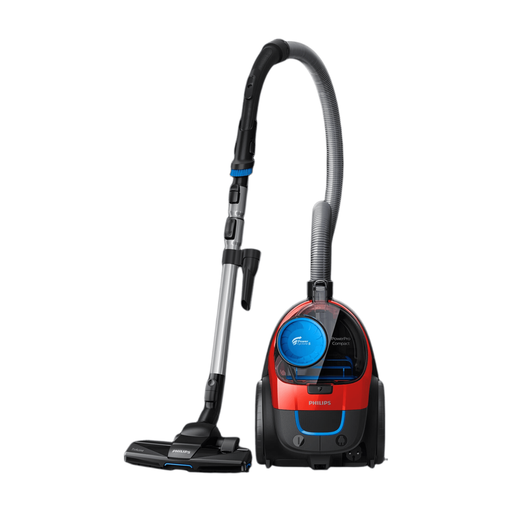
Philips PowerPro Compact FC9330/09
The product details list an integrated soft brush on the handle for surfaces; check whether a crevice tool is also included for the gap along the skirting board.
Bagless design with a listed reach of 9 m.
Listed dimensions: 41 × 27.5 × 24.7 cm.
Power: 900 W. The dust container needs emptying.
View at Joybuy
Frequently asked questions
Which nozzle should you use on the skirting board and which in the gap?
Use a suitable soft brush for dust on the visible surface and a crevice tool for a narrow gap. Check which nozzles are included with the exact model. If the finish is delicate, test carefully in an inconspicuous spot first. vtwonen recommends using an attachment to remove dust from seams and tight corners.
Is a bagged or bagless vacuum cleaner better for this job?
A bagged model is a better fit if you want to minimise contact with collected dust when disposing of it. A bagless model means you don’t need dust bags, but you will have to empty the container. The Consumentenbond explains this difference and also highlights the maintenance needed for filters and dust collection.
What should I look out for when maintaining the vacuum?
Empty the dust container or replace the bag in good time, check the filters and nozzles, and follow your model’s instructions for cleaning and replacement. The Consumentenbond warns that a blocked filter can affect performance.
Is CE marking required for a new mains-powered canister vacuum cleaner?
Electrical equipment within the scope of Directive 2014/35/EU, including equipment with a rated AC voltage of 50 to 1,000 V inclusive, must meet conformity requirements and carry CE marking before being placed on the EU market. Whether a specific model meets these requirements must be established separately; a product title is not proof. This scope is set out in the information provided by EUR-Lex.


