
Cleaning beneath low shelves
You mainly want to know whether the nozzle and tube will fit beneath your shelves. The stated operating radius won’t tell you that, so check the clearance and the attachment’s dimensions.


First, measure the clearance beneath your shelves and check that the supplied nozzle will fit. Then make sure the hose, tube and working range will let you reach the area easily. A bagged vacuum cleaner disposes of dust along with the bag, while you have to empty the dust container on a bagless model. The Consumentenbond points out that emptying a bagless container can mean more contact with dust; the stated operating radius alone tells you nothing about the height of the nozzle.
You mainly want to know whether the nozzle and tube will fit beneath your shelves. The stated operating radius won’t tell you that, so check the clearance and the attachment’s dimensions.
You want to clean several visible areas in one go, with as few interruptions as possible. Check which attachments you’ll need, the working range and how easy the vacuum is to move around.
Let how much contact you’ll have with dust when emptying the vacuum help you choose between a dust bag and a container. The Consumentenbond explains that a full dust bag is thrown away, while emptying a bagless container can mean more contact with dust.
For a quick clean before guests arrive, access beneath the shelf, moving around the house and how you dispose of dust are separate things to consider.
| What to consider | What should you check? | Who is this important for? |
|---|---|---|
| Reaching beneath shelves | Measure the available height and depth, then compare them with the dimensions of the supplied nozzle. | If I want to clean beneath my shelves, the nozzle has to physically fit. Around 42% of consumers prioritise access beneath shelves. |
| Cleaning without interruption | Compare the stated operating radius of each model and check the route from the socket to the areas you want to clean. | When I want to clean several areas before guests arrive, I don’t want to keep changing sockets. Around 25% of consumers say uninterrupted cleaning is important. |
| Contact with dust | Check how the exact model is emptied or how its dust bag is replaced. | If I want to minimise contact with the dust I’ve vacuumed up, disposal matters. Around 17% of consumers prioritise limited contact with dust. |
| Maintenance and parts | Check which dust bags or filters fit the full model number, and follow the maintenance instructions. | If you mainly want to know which parts and tasks you’ll need to deal with later, look beyond the first clean. Around 16% of consumers prioritise maintenance and supplies. |
The operating radius and the dimensions of a nozzle answer different questions. A model might have a wide working range, but its nozzle may not fit through the gap beneath your shelf.
Measure the available space and compare it with the nozzle supplied with the exact model. Then check the working range to see how easily you can move around your home.
You have to empty a bagless dust container. The Consumentenbond points out that this can mean more contact with dust than throwing away a full dust bag.
Take the way dust is disposed of into account when choosing. For a bagged model, also check which replacement bags fit that version.
A stated power rating or a description of a nozzle won’t automatically tell you whether the attachment will fit through the gap beneath your shelf.
Check the attachments supplied with the exact model and their dimensions. Measure the space at home before you decide.
Bosch Netherlands lists the Serie 4 BGB41HYG1H as a bagged vacuum cleaner with an integrated crevice and upholstery nozzle and an 11 m operating radius.
Rowenta lists the Compact Power XXL RO4B30 as a bagless vacuum cleaner with a 2,5 L dust container, an 8,80 m operating radius and a 2-in-1 crevice nozzle.
AEG lists the 6000 AB61C1WP as a bagged vacuum cleaner with separate crevice and upholstery nozzles and a 12 m operating radius.
Miele lists a dust bag and crevice and upholstery accessories for the Complete C3 in Mango Red.
Philips describes the PowerPro Compact FC9332/09 as a bagless model with an integrated brush for furniture and surfaces.
These Joybuy products are suited to cleaning dust from beneath shelves and around several areas. Before choosing, check that the supplied nozzle will fit the available space at home.
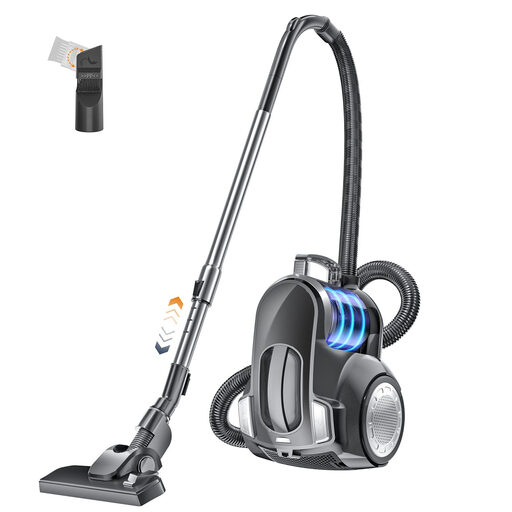 No image available
The product description mentions an integrated 2-in-1 crevice nozzle and use beneath furniture. Measure the gap beneath your shelf to check whether the attachment will fit.
The product name specifies a 2,5 L dust container. As this is a bagless model, the container has to be emptied; the Consumentenbond points out that this can mean more contact with dust.
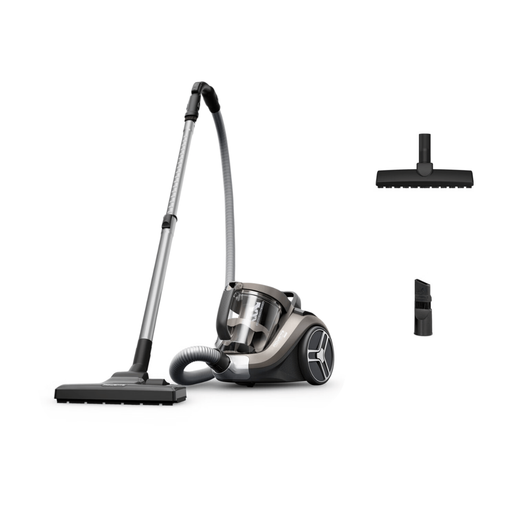 No image available
The supplied 2-in-1 crevice nozzle is useful for narrow gaps. Check its dimensions against the space beneath your shelf.
Rowenta lists a 2,5 L dust container, a parquet brush and an 8,80 m operating radius. The dust container has to be emptied.
 No image available
The product name specifies a parquet nozzle. Check the available space beneath your shelves and whether the supplied attachment will fit.
The product name specifies a 3,5 L dust bag, 890 W and a 10 m operating radius. Replace the dust bag when it’s full.
Measure the available space beneath the shelf and compare it with the dimensions of the nozzle supplied with the exact model. Also check whether the tube or a crevice nozzle will reach the area you want to clean. The stated operating radius doesn’t tell you the height of the nozzle.
Before use, check which nozzles are supplied and how they attach to the model. Read the instructions for that version; a nozzle bought separately won’t necessarily fit every tube.
A full dust bag is thrown away, while a bagless container needs to be emptied regularly. Check the full model number when looking for filters and replacement parts, and follow the maintenance instructions for that version.
No. According to the Dutch government, there is no fixed statutory guarantee period in the Netherlands; what matters is what you can reasonably expect from the product. If a product is faulty, contact the seller. A manufacturer’s guarantee or an extended guarantee you’ve purchased is in addition to your statutory rights.