For everyday dry household dirt, a canister vacuum is a practical choice if the appliance, hose and attachments all fit in your shared cupboard. Next, check the floor head and crevice tool, then choose between a dust bag, which means less direct contact with dust when emptying but needs replacing, and a dust container, which needs emptying and maintenance. A standard canister vacuum isn’t automatically suitable for construction dust or heavy-duty jobs.
Who is this buying guide for?
Unpacking with a mix of floor types
You want to clear dry dust and crumbs from floors and crevices. Check which floor head and crevice tool come with the exact model. For delicate wooden floors, a parquet brush with soft bristles may be suitable; the Consumers’ Association explains how brushes like these can help prevent scratches.
Sharing a small cleaning cupboard
You share storage space with others and want to know whether the whole set will fit. So check not only the vacuum body, but also the space needed for the hose, tube and accessories. Compact models are available with or without a dust bag.
Sharing with someone who is mindful of dust
You want to minimise contact with collected dust when emptying the vacuum. The Consumers’ Association explains that changing a dust bag involves less direct contact with dust than emptying a dust container.
What should you look for when buying?
| What to consider |
What should you look for? |
Who should pay particular attention? |
| Floors and crevices |
Check that the floor head suits your floor type and that a crevice tool is included. Distinguish between everyday household dirt and construction dust. |
If I want to clean both the floor and edges after unpacking, I check which attachments are included; around 36% of consumers prioritise cleaning floors and crevices. |
| Cupboard space |
Measure the available space and compare it with the dimensions of the appliance. Leave room for the hose, tube and separate attachments too. |
If I share the vacuum with others, I want to be able to put the whole set away easily; around 29% of consumers prioritise whether it fits in the cupboard. |
| Emptying and dust contact |
Compare how a dust bag is changed with how a dust container is emptied. For a bagged model, check which type of bag fits. |
If several people use the vacuum, I want emptying it to involve as little contact with dust as possible; around 21% of consumers put this first. |
| Running costs and maintenance |
Weigh up the cost of buying replacement dust bags against emptying a dust container and carrying out the prescribed filter maintenance. Check the model’s instructions. |
If I want to plan for repeat purchases and maintenance, I check the bag type and maintenance routine; around 14% of consumers make this their top priority. |
Common buying mistakes
-
Measuring only the vacuum body
The stated appliance dimensions don’t tell you how much space the complete set takes up, including the hose, tube and attachments.
Measure the cupboard and decide where each part will be stored after use.
-
Treating unpacking debris and construction dust as the same job
A standard vacuum isn’t automatically designed for construction dust. Miele says that large amounts of fine dust, such as drilling or plaster dust, can quickly clog the pores of a dust bag.
Keep everyday dry household dirt separate from DIY waste, and check the manual to make sure the model is designed for the specific material.
-
Assuming a bagless model is maintenance-free
Not having to buy dust bags doesn’t mean you won’t need to empty the dust container and maintain the filter as instructed.
If you share the vacuum, agree who will check the dust container and follow the model’s maintenance instructions.
Brands to consider
Rowenta
The Compact Power RO3923EA is a bagged model. Rowenta lists a 3-litre dust bag and an included 2-in-1 crevice tool.
- The stated dust bag capacity and accessories can help when comparing storage space and the attachments included.
- The manufacturer gives a working radius of 8,80 m. Treat this as a specification for this model, separate from any conflicting information about other versions.
Bosch
For the Serie 4 BGL38BA2H, Bosch lists appliance dimensions of 265 × 295 × 410 mm, a 4,0-litre dust bag capacity and a working radius of 10 m.
- The body dimensions give you a useful first check for cupboard space.
- These dimensions don’t show how much room the hose and tube need together. Capacity and working radius are specifications, not a comparison of cleaning results.
Philips
The PowerPro Compact FC9332/09 is a bagless model. Philips lists a TriActive floor head and an integrated brush.
- A bagless dust container means you don’t need to buy replacement dust bags.
- You’ll still need to empty the dust container. A brand’s claim about dust pick-up doesn’t, in itself, tell you what emptying it is like in practice.
Miele
The Guard S1 Parquet Flex Brilliant White is a bagged model. For this version, Miele lists a parquet brush, flexible crevice tool, 3,5-litre dust bag and 10 m working radius.
- The listed brushes are useful features to check for when cleaning hard floors and tight spaces.
- Check that the accessories are included with the exact version. Miele warns that large amounts of fine dust can clog the pores of a dust bag prematurely.
Canister vacuums at Joybuy
These Joybuy products are canister vacuums for everyday dry household dirt, with bagged and bagless options and attachments for floors and crevices.
 Image unavailable
Rowenta RO3927 Compact Power bagged vacuum cleaner
The included standard brush and 2-in-1 narrow nozzle are useful for cleaning floors and crevices.
Dust bag: 3 litres. Body dimensions: 28,10 × 23,30 × 41,40 cm. Metal telescopic tube and automatic cord rewind.
As a bagged model, this version needs replacement dust bags.
View at Joybuy
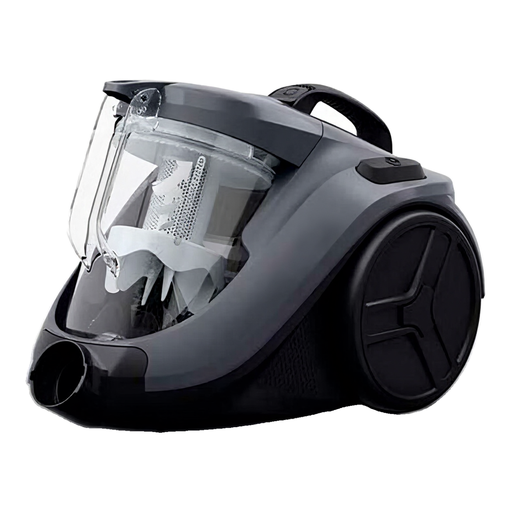 Image unavailable
Rowenta RO3726EA Compact Power cyclone vacuum cleaner
The dust container and included narrow 2-in-1 nozzle are useful if you’d rather not buy dust bags and also want to clean crevices.
Dust container capacity: 1,5 litres. The description also lists a floor and furniture nozzle, and storage space for accessories.
The dust container needs emptying after use.
View at Joybuy
Frequently asked questions
Can you use a standard canister vacuum to pick up construction dust?
Not without first checking that the model is suitable for the material. The Consumers’ Association says that a multi-purpose vacuum is suitable for heavy-duty jobs such as clearing construction dust; Miele warns that large amounts of fine drilling or plaster dust can quickly clog the pores of a dust bag. Check the manual for the specific material.
How do you leave a shared vacuum ready to use?
After use, check whether the dust bag or container needs emptying, and follow the filter maintenance instructions. For a bagged model, use the correct type of bag; you can check which one you need using the model number.
Are you always entitled to exactly two years’ guarantee on a vacuum cleaner in the Netherlands?
No. The statutory guarantee isn’t simply limited to a fixed period of two years. According to ACM ConsuWijzer, if you use a product normally, you’re entitled to one that lasts as long as you can reasonably expect. Any manufacturer’s guarantee is separate.
Can you return a vacuum cleaner after it’s been delivered if you bought it online?
According to ACM ConsuWijzer, online purchases generally come with a statutory cooling-off period that ends 14 days after delivery. Check the terms that apply to your purchase, and distinguish your statutory right from any more generous returns policy the retailer may offer.
Does a new canister vacuum need a European energy label?
No. The European Commission states that the former energy labelling scheme for vacuum cleaners no longer applies. This is separate from ecodesign requirements, which may apply within their scope. What’s more, higher power consumption doesn’t automatically mean better cleaning.


