
For people dealing with tight spaces
You mainly want to reach fluff behind and between chairs, so you’ll first look at the crevice tool, hose and reach.


Start with a narrow crevice tool and check that the hose, tube and reach are suitable for the space behind your chairs. Then choose between a bag, which means less direct contact with dust when you dispose of it, and a bagless bin that needs to be emptied regularly. Also check that the floor head and storage size are right for your flat.
You mainly want to reach fluff behind and between chairs, so you’ll first look at the crevice tool, hose and reach.
You want to clean behind chairs while choosing a floor head that’s suitable for surfaces such as parquet or laminate.
You want to dispose of collected dust with as little contact as possible, so you’re weighing up a dust bag against a bagless bin.
First check that the tool and reach are suitable for the space behind your chairs. Then compare the floor head, dust collection system and storage space required.
| What to consider | What to look for | Who it matters to |
|---|---|---|
| Access to tight spaces | Check whether a crevice tool is included and compare the vacuum’s reach with the distance to the socket. | If I want to reach fluff behind chair legs without having to keep moving the vacuum, a narrow tool and suitable reach are my first concerns. Around 31% of consumers prioritise access to tight spaces. |
| Floor head | Check that the supplied floor or parquet brush is suitable for your flooring. | I also want to clean the floor around the chairs with a suitable brush, for example on parquet or laminate. Around 23% of consumers put their choice of floor head first. |
| Noise | Compare noise levels only when they use the same dB(A) basis, and look for independent noise tests where available. | If noise is a major concern in my flat, I don’t want to look only at reach and tools. Around 16% of consumers rank noise above their other buying concerns. |
| Dust collection | Weigh the reduced direct contact with dust offered by a bagged model against having to empty the bin on a bagless model. | I want to decide in advance whether I’d prefer to have as little contact with dust as possible when disposing of it, or would rather avoid using a dust bag. Around 15% of consumers make dust collection their top priority. |
| Storage and moving the vacuum | Check the dimensions and weight of the model, and consider where the hose, tube and separate tools will go. | If my cupboard space is limited, I want to know whether I can put the vacuum and accessories away after use. Around 15% of consumers prioritise storage and moving the vacuum. |
Motor power alone doesn’t tell you how well a tool will pick fluff out of the gap behind a chair.
First check which tools are included and, where available, look for independent cleaning tests for your type of flooring.
You’ll need to empty the bin of a bagless vacuum regularly; it’s a recurring task.
Decide in advance whether you’d rather empty a bin or replace a dust bag, and follow the model’s instructions for its filters and assembly.
Products in the same range can have different model numbers or come with different accessory sets.
Compare the full model number and check which tools are included with that exact version.
The Serie 2 BGBS2RD1H is a bagged model to consider if you’re looking for a crevice tool and a separate parquet brush.
The Compact Power XXL RO4B50EA is a bagless model that Rowenta says comes with a 2-in-1 crevice tool.
Miele describes the Guard S1 Obsidian Black as a lightweight, compact bagged model.
The PowerPro Compact FC9332/09 is a bagless model; check the full model number when comparing it with others.
The VX6-2-IW-5 is a bagged model for which AEG lists a crevice tool and upholstery nozzle.
This selection focuses on bagless canister vacuums with tools for crevices and hard floors.
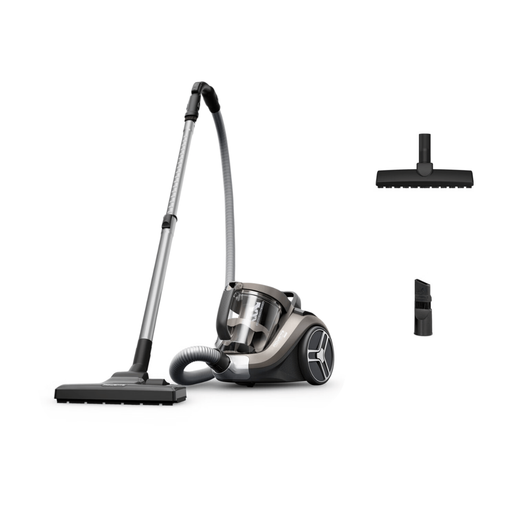 No image available
This bagless model is a good fit if you don’t want to use dust bags; bear in mind that you’ll need to empty the bin.
The product name mentions a parquet brush. Check that the included tools and reach are suitable for the gap behind your chairs.
Start with a crevice tool that fits the narrow space, and use a brush suitable for your type of flooring on the surrounding floor. Check which tools are included with the exact version.
You’ll need to empty the bin of a bagless model regularly; follow the chosen vacuum’s instructions for its filters and assembly. For a bagged model, check which replacement bag type it uses.
No, an extended warranty isn’t a requirement for your statutory warranty rights. According to the Dutch government, the seller must provide a solution if a product is faulty; check what any additional cover offers beyond your existing rights.
According to the Dutch government, online purchases from a business are often covered by a 14-day cooling-off period. Check the terms and legal exceptions that apply to the specific purchase.
According to the European Commission, the former EU energy-labelling regulation for vacuum cleaners has been annulled. This is separate from the ecodesign requirement for power consumption: since 2017, vacuum cleaners within its scope have been subject to a maximum of 900 W.