
Reflection photographer
You want to preserve reflections of bridges and façades, so you pay attention to your viewpoint and exposure. Canon Europe describes camera height as a way to make a reflection stand out more clearly.


First decide whether you want to preserve the reflection, capture a wide view of the canal or frame details on the opposite bank. This will determine which lens and controls suit you. In cloudy weather, pay particular attention to the lens’s maximum aperture and exposure controls. A longer zoom gives you more reach, but it isn’t automatically the better choice in low light.
You want to preserve reflections of bridges and façades, so you pay attention to your viewpoint and exposure. Canon Europe describes camera height as a way to make a reflection stand out more clearly.
You take photos under cloudy skies and compare lens speed, sensor size and handling before opting for extra zoom. The Consumers’ Association points out that sensor size is relevant when comparing cameras.
You want to frame both a wide view of the canal and details of distant façades or bridges. It’s worth weighing up the zoom range against the lens and sensor of the specific model.
First decide whether you want to preserve the reflection or emphasise the movement of the water. These aims call for different choices of filter and shutter speed. Then consider your viewpoint and the range you actually need, and assess the camera’s lens speed and sensor too.
| What to consider | What should you look for? | Who is this important for? |
|---|---|---|
| Preserving the reflection | Decide whether you want a mirror image or to see through the water. A polarising filter can reduce reflections, so try the effect before buying one. Nikon USA explains that these filters can reduce unwanted reflections. | If you want to see bridges and façades reflected in the water, pay attention to your camera height and use of filters. Around 36% of consumers say preserving the reflection is their main concern when buying. |
| Taking photos in low light | Compare the sensor size and maximum aperture at the zoom setting you use. Canon lists f/1.8–2.8 for the G7 X Mark III; the Consumers’ Association names sensor size as a relevant factor when comparing cameras. | If you often take photos under grey skies, you’ll want to know how the lens and sensor suit the way you use the camera. Around 29% of consumers prioritise photography in low light. |
| Wide view or distant detail | Compare the equivalent wide-angle and telephoto focal lengths, not just the zoom factor. Sony lists a 24–200 mm equivalent for the RX100 VII; Panasonic lists a 24–720 mm equivalent for the TZ99. | If you want to frame both the whole canal and a distant façade from the same spot on the bank, the usable range matters. Around 21% of consumers say reach and framing are their main considerations. |
| Longer exposures | Check whether you can set the shutter speed manually and how to keep the camera steady. Fujifilm lists a built-in four-stop ND filter for the X100VI. This type of filter reduces light, but it won’t stabilise the camera. | If you want to capture the movement of water with a longer exposure, pay attention to the settings and how to keep the camera steady. Around 14% of consumers put this creative control above their other buying concerns. |
A polarising filter can actually reduce reflections on water. That may work against you if you want to capture reflections of buildings.
First decide whether the reflection or seeing beneath the water’s surface matters more to you. Try the filter effect before buying one.
A powerful zoom doesn’t automatically deliver the photo quality you want in low light. The Consumers’ Association points out that cameras with a high zoom range typically have a small sensor, and framing can be difficult at high magnification.
Compare the focal lengths you need from your usual viewpoint with the sensor size and lens speed.
An ND filter reduces the amount of light and can help you take a longer exposure, but it won’t keep the camera or water still.
Check whether you can set the shutter speed and how to keep the camera steady while taking the photo.
A manufacturer’s warranty is not the same as your statutory rights if a product is faulty. The Dutch government states that there is no fixed statutory warranty period in the Netherlands.
Read the terms and conditions of any additional warranty, and contact the seller if you have a problem with the product.
The RX100 VII is an option if you’re looking for a compact camera with a 24–200 mm equivalent optical zoom.
The X100VI is suited to a fixed angle of view and gives you extensive control over your shots.
The G7 X Mark III has a shorter, faster zoom, while the SX740 HS Lite Edition focuses on a wide optical zoom range.
The Lumix TZ99 is a compact travel zoom camera for situations where you switch between a wide frame and distant subjects.
The GR IIIx is a fixed-lens option with a 40 mm equivalent angle of view, for those who prefer to choose their own framing without zoom.
The Q3 is a fixed-lens camera for those who are happy to choose a larger model within the compact camera category.
This selection includes digital cameras with zoom, mainly for framing distant subjects. For the pink Songdian model, check that the stated 16X zoom is digital, not optical.
 No image available
The stated 12X optical zoom could suit you if you want to frame details on the opposite bank.
The product name lists 4K, 64MP and Wi-Fi; the description mentions autofocus.
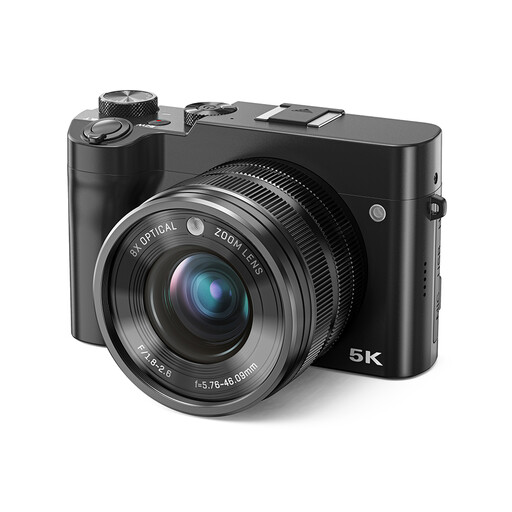 No image available
The stated 8X optical zoom is useful if you want to frame distant subjects.
The product name lists 5K, 64MP and a dual lens; the description mentions manual zoom and focusing via the lens ring.
 No image available
The product name lists 10X optical zoom for framing distant details.
It also lists 5K, 56MP and front and rear cameras.
 No image available
The product name describes a pocket camera for everyday photos and videos.
The description lists 16X digital zoom, not optical zoom, so bear that in mind if you want to frame distant details. The product name lists 4K and 44MP.
Not necessarily: a polarising filter can reduce or remove reflections on water. If you want to preserve the reflection, try a different viewpoint or filter setting first, and assess the effect before buying a filter.
Try different camera heights and, if possible, take photos when the water is calmer. Canon Europe describes camera height as a way to show a reflection more clearly, but the technique doesn’t guarantee a particular result.
No. An ND filter reduces the amount of light and can make a longer exposure possible, while a polarising filter can reduce reflections. If you’re buying a separate filter, also check that it fits your camera.
Check whether the memory card, spare battery or filter you want is included with the version you’re buying. According to the Dutch government, there is no fixed statutory warranty period in the Netherlands. Your statutory rights exist alongside any additional warranty, and the seller is your point of contact if there’s a problem with the product.
It depends on the circumstances and how you share the photo. The Dutch Data Protection Authority considers recognisable people to be personal data and states that the exception for personal or household use does not automatically apply when sharing publicly. You may need a lawful basis under the GDPR.