
Photographers of façades and details
You want to frame both an entire canal house and a distant detail from a limited vantage point. So compare the wide-angle and telephoto ends of the optical range.


Choose based on the framing you need from where you’re standing: the wide-angle setting determines how much of the façade fits in the frame, while the optical telephoto range lets you frame a more distant subject larger. A bridge camera combines both in one device; a mirrorless camera gives you more choice of lenses. A very high zoom range isn’t automatically the best choice in changing light: the Consumentenbond notes that cameras with a lot of zoom generally have a smaller image sensor.
You want to frame both an entire canal house and a distant detail from a limited vantage point. So compare the wide-angle and telephoto ends of the optical range.
You photograph brickwork and distant subjects in overcast conditions or later in the day, too. Consider the sensor and lens as well as the zoom range.
You carry your camera for longer periods and want to weigh up whether a fixed zoom lens is more convenient than carrying and changing lenses.
| What to consider | What should you check? | Who is this important for? |
|---|---|---|
| Bringing a distant subject closer | Compare the optical telephoto range in 35 mm equivalent millimetres, and check the viewfinder and image stabilisation. | If you can’t get any closer from the same quayside, you’ll want to frame the subject larger. Around 29% of consumers put optical telephoto range first. |
| Fitting the whole building in the frame | Compare the shortest focal length in 35 mm equivalent millimetres. Consider whether you want to capture both types of framing with one lens. | When you want to capture the entire façade from a limited distance, the wide-angle framing is key. Around 29% of consumers give this façade framing their highest priority. |
| Details in changing light | Consider the sensor size and lens of the exact model, and assess sample images taken in similar lighting. | If visible brickwork details matter in overcast conditions or later in the day, you’ll want to consider more than just the maximum range. Around 24% of consumers put image quality in changing light first. |
| Taking your camera on a walk | Compare weights on the same basis, for example including the battery and memory card, and see which lenses you’ll need to carry. | On a longer walk around the city, you’ll want to be able to carry your camera comfortably. Around 18% of consumers name portability as their top priority. |
The zoom factor doesn’t tell you how wide the shortest setting is, and on its own it doesn’t say how a camera performs in the light you’re shooting in.
Compare the shortest and longest focal lengths in 35 mm equivalent millimetres, the sensor size and sample images taken in similar lighting conditions.
Digital zoom doesn’t add to the optical range. The Nikon COOLPIX P1100 has a stated optical telephoto reach of 3000 mm; magnification up to 6000 mm with Dynamic Fine Zoom is digital.
Compare distant details using the optical range first.
A lens must fit the lens mount, and what’s included varies by kit. A body on its own won’t necessarily give you the range you need for both façades and distant subjects.
Check the exact kit contents and mount. You may need to buy an additional lens or other items that aren’t included.
The LUMIX DC-FZ82D is a bridge camera with a fixed lens, for anyone who wants one device to go from a wide façade view to a distant subject.
Canon offers a bridge camera with a fixed zoom and a mirrorless camera kit with an interchangeable lens: the PowerShot SX70 HS and EOS R50 with an RF-S 18–150 mm lens, respectively.
According to Sony, the RX10 V combines a 1.0-type sensor with a fixed 24–600 mm zoom.
Nikon offers both a bridge camera with an exceptionally long optical telephoto range and a Z50II mirrorless camera kit with an interchangeable lens.
This Joybuy selection includes compact handheld and vlogging cameras, as well as a digital camera. For brick façades and more distant subjects, it’s important to check both the wide-angle view and the optical telephoto range for each model. Stabilisation or a wide-angle lens alone won’t tell you whether both types of framing are possible.
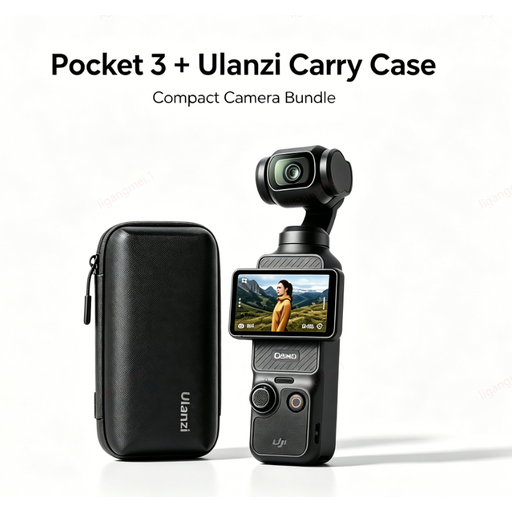 No image available
The product name mentions the DJI Pocket 3 and a Ulanzi storage case; the product information lists stabilisation for handheld recording.
For framing façades and distant subjects, check the optical range of the exact model.
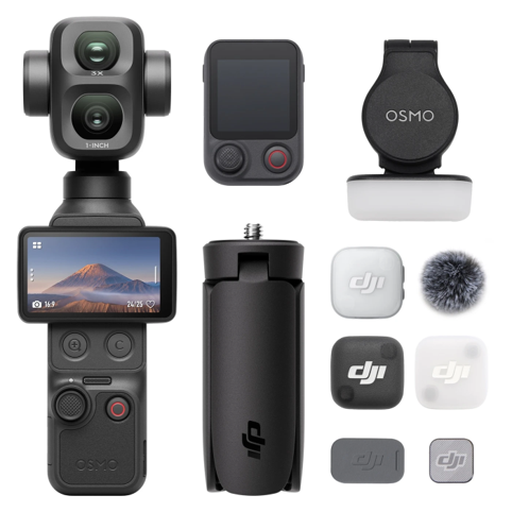 No image available
The listed features include a 1-inch CMOS sensor and a 20 mm f/2.0 wide-angle lens.
For distant subjects, check the optical telephoto range too; 20 mm describes the wide-angle end here.
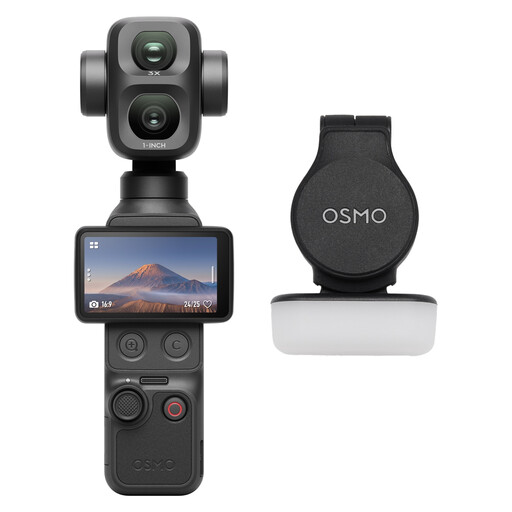 No image available
The listed features include a 1-inch CMOS sensor and a 20 mm f/2.0 wide-angle lens.
For this scene, compare the optical telephoto end of the exact model with the framing you want at a distance.
 No image available
The product name lists 3-axis stabilisation and 2× lossless zoom; the product information also mentions a 1-inch CMOS sensor.
Check what optical range is available for framing a distant subject.
 No image available
The listed features include 8× optical zoom, electronic image stabilisation and autofocus.
Compare the focal lengths at both ends with the façade and distance you want to capture.
Compare both the shortest and longest focal lengths in 35 mm equivalent millimetres, not just the magnification factor. The wide-angle setting helps determine how much of the façade fits in the frame; the telephoto setting determines how large the distant subject appears.
Image stabilisation can help, but it doesn’t replace careful aiming or sufficient light. Check whether the exact model has stabilisation; the Consumentenbond notes that it can be difficult to keep a subject in the frame when zoomed in very far.
Store your camera somewhere protected and remove dust carefully. For the lens and viewfinder, the Consumentenbond recommends using a microfibre cloth and a blower brush, among other things. Apply lens cleaner to the cloth first, not directly to the lens.
According to the Rijksoverheid, the retailer must provide a solution if a product is faulty. The Netherlands has no fixed statutory warranty period; an additional warranty is most relevant if its terms offer something beyond your existing rights.
Not automatically: the rules depend in part on how you share and use the photo. The Autoriteit Persoonsgegevens distinguishes between private use or sharing with a very limited group and wider publication. Before publishing, check which privacy rules apply to your use.