
Detail-focused square photographer
Wants to be able to crop details in paving, ornaments or façades later, or make large prints. Fujifilm and Sony publish specifications for the X-T5 and α7R VI that can help you compare resolution options.


First, choose a lens that captures the part of the square and façades you want from your chosen position. Then decide how much resolution you need to crop details or make large prints. A high resolution can help, but it can’t make up for the wrong lens or an unsteady shot. If you’ll be walking around or people are moving in the scene, a lighter kit or a single shot may be more practical than a mode that combines multiple images.
Wants to be able to crop details in paving, ornaments or façades later, or make large prints. Fujifilm and Sony publish specifications for the X-T5 and α7R VI that can help you compare resolution options.
Wants to frame buildings and the square from a chosen position. Consider the field of view you need and check that the lens is compatible with your camera. The Consumers’ Association, for example, discusses usability, size and image quality when choosing a camera.
Changes position or shoots handheld, balancing portability with detail and stability. OM SYSTEM describes features including Handheld High Res Shot for the OM-1 Mark II, while Fujifilm lists a composite Pixel Shift mode for the X-T5.
| What to consider | What should you check? | Who should prioritise this? |
|---|---|---|
| Fine detail and cropping | Compare the effective resolution for a standard shot and the compatible lens, and consider the complete kit. | If I want to crop paving or ornaments later, or make large prints, I’ll consider both resolution and lens choice. Around 36% of consumers put detail and cropping at the top of their list when buying. |
| Field of view and perspective | Decide where you’ll be shooting from and check the field of view you need, the lens mount and whether you’ll need an adapter. | If I want to frame the buildings and square from one spot, I’ll focus on the field of view and choosing a suitable lens. Around 29% of consumers prioritise perspective and lens choice. |
| Light and moving people | Check whether you can use a tripod and whether your chosen mode requires one shot or several images. | If the light changes or people walk through my frame, I want to assess camera shake and subject movement separately. Around 21% of consumers make light and movement their main priorities when buying. |
| Portability and complete kit | Compare the camera body with the lens you actually want to take with you, and check which cards or accessories are included with that version. | If I’m moving between different positions, I want a kit that suits how I’ll use it without requiring unnecessary extras. Around 14% of consumers give portability and kit contents top priority. |
The lens also affects which part of the square you capture from your chosen position. High resolution won’t make the wrong field of view suitable.
Compare complete, compatible kits based on the crop you actually want to make.
Fujifilm describes its X-T5 Pixel Shift mode as taking multiple shots that are then combined using software. This works differently from taking a single shot, and may be less suitable if people are moving in the scene.
First compare the resolution and usability of a single shot, especially if people are walking through the square.
Canon Netherlands warns that diffraction at very small apertures, such as f/22, can reduce sharpness.
Check detail in both the foreground and background, and find the right balance between depth of field and sharpness.
An extra manufacturer’s or retailer’s warranty doesn’t replace your statutory rights if a product is faulty. The Dutch government advises contacting the retailer to find a solution.
Keep your proof of purchase and check what any additional warranty covers.
The X-T5 is an APS-C model worth comparing if you want to combine plenty of detail with shooting from different positions.
The α7R VI is a full-frame model worth comparing if high effective resolution is important for cropping or making large prints.
Canon describes the EOS R5 Mark II as a full-frame camera with an RF mount.
The Z 7II is a full-frame model to consider if you want to compare detail resolution and the lenses available.
The OM-1 Mark II is a Micro Four Thirds option worth comparing if you shoot handheld and want to weigh up different shooting modes.
These digital cameras are options for capturing and framing details in a square. Check the specifications and version listed for each model.
 No image available
The title lists 44 MP for photography and 16× zoom. Check that this combination suits the crop and field of view you want.
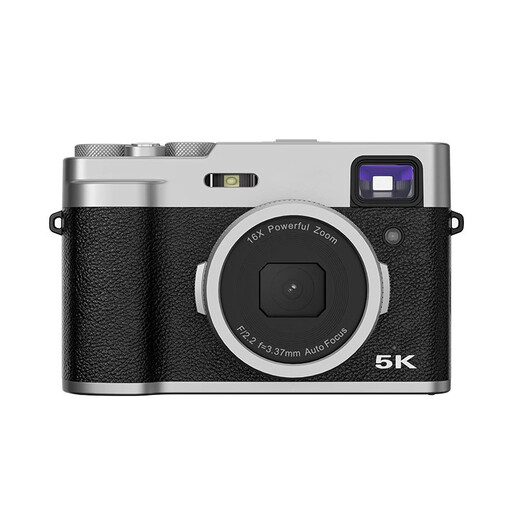 No image available
The title lists 48 MP and autofocus, while the product description mentions an LCD screen and optical viewfinder. Compare these controls with how you want to frame the square on location.
 No image available
The product description lists 64 MP for photos, 8× optical zoom, and both autofocus and manual focus. Compare the zoom and focusing controls with the framing you need from your chosen position.
Start with the crop you want to make from your chosen position, then check which compatible lens will suit it. Extra resolution can help when cropping or making large prints, but it won’t compensate for the wrong lens or a blurred shot.
No. Image stabilisation helps reduce camera shake, not movement by people. Consider your shutter speed and the effect you want to create with their movement. A tripod can keep the camera still, but it won’t freeze passers-by.
Not without taking the process into account. Fujifilm describes a series of shots that are combined using Pixel Shift Combiner. If you can’t rely on taking multiple shots and editing them afterwards, compare the resolution of a standard single shot instead.
When you buy as a consumer in the Netherlands, you’re entitled to a product that works as it should. The Dutch government says the retailer is your point of contact if there’s a fault. It also states that many distance purchases come with a 14-day cooling-off period. This is separate from your rights if a product is faulty, so check the terms and any exceptions that apply to your purchase.
Not automatically. The Dutch Data Protection Authority distinguishes between images kept private and those shared more widely or used for business. The GDPR may apply if people are identifiable; the assessment depends on how the images are used and the circumstances.