First, make sure the shutter release matches your exact camera model. A compatible cable works well with a fixed tripod setup, while wireless control or a supported camera app can give you more freedom to move around. Taking photos remotely means you don’t have to touch the camera, but it’s no substitute for a steady tripod, precise focusing or control over the lighting.
Who might need a camera shutter release?
Creator with a fixed photography table
You photograph watch faces from a tripod and want to leave the camera and composition undisturbed when taking a shot. Canon Netherlands and Nikon Netherlands describe wired options for cameras with a compatible connection.
Creator who adjusts the lighting and watch
You move around your setup during a shoot and want to take photos remotely. Which wireless controls will work depends on support for your camera model; Canon Netherlands and Nikon Netherlands list model-specific options.
Creator shooting detailed sequences
You take close-ups at different focus points and want to keep the camera in the same position throughout the sequence. Canon Netherlands explains why close-ups may require precise focusing and how focus stacking combines multiple focus distances.
What should you look for when choosing?
Canon Netherlands lists several connections for wired shutter releases, while Nikon Netherlands limits the cables and wireless controls it mentions to specific cameras. So check your full camera model and its corresponding connection or wireless support.
| What to consider |
What should you check? |
Who is this important for? |
| Camera compatibility |
Check the full camera model, the connection required for a cable, and the supported pairing for wireless control. |
When I buy a shutter release, I want to be sure it works with my camera. Around 33% of consumers prioritise compatibility. |
| Taking photos without touching the camera |
Check that the shutter release operates your camera’s shutter, and use a stable setup. |
When taking close-ups from a tripod, I want to take photos without touching the camera. Around 27% of consumers say this is their top priority. |
| Freedom to move around |
Think about where you’ll be standing while taking photos, and check whether a cable, wireless control or camera app suits the way you work. |
If I regularly adjust the watch or lighting, I want to be able to take photos from another position. Around 20% of consumers put this freedom to move first. |
| Detailed sequences |
Check separately whether your camera supports the focus sequence you want, and keep your setup steady throughout the sequence. |
When I photograph multiple focus points, I want to keep the composition the same between shots. Around 20% of consumers say this is their top priority. |
Common buying mistakes
-
Assuming the camera brand is all that matters
The brand name alone doesn’t tell you whether a shutter release will fit. Canon distinguishes between E3 and N3 connections, for example, while Nikon describes the cables and wireless controls it mentions as being for specific cameras.
Look up your full camera model and check the required connection or wireless function before you buy.
-
Assuming a wireless flash trigger is a universal shutter release
Pixel describes the Pawn TF-364 as a set for certain Olympus and Panasonic setups, with flash and shutter control. This doesn’t confirm compatibility with every individual camera model.
Check whether the shutter function works with your camera and which parts and connections your setup requires.
-
Expecting the shutter release to solve focus and reflections
A shutter release lets you take a photo without touching the camera, but it won’t focus accurately by itself or correct exposure or reflections. Canon Netherlands explains that close-ups can have a shallow depth of field.
Assess focus, framing and lighting separately, and check whether your camera model supports the focus sequence you want.
Brands and useful control options
Canon
Canon describes wired, wireless and app-based controls for supported cameras.
- The RS-60E3 is designed for EOS cameras with an E3 connection; the BR-E1 is a Bluetooth option for the compatible models listed. Canon also describes shutter control via Camera Connect.
- The options aren’t universally interchangeable. Check support for your exact camera model.
Nikon
Nikon lists options including the wired MC-DC2 and the ML-L7 Bluetooth remote for specific cameras.
- According to Nikon, the MC-DC2 can operate the shutter without you touching the camera body directly. The ML-L7 has separate photo and video buttons.
- The functions listed aren’t automatically available on every Nikon camera, so check compatibility with your model.
Sony
Sony describes the RMT-P1BT Bluetooth remote and remote control via Imaging Edge Mobile for certain cameras.
- With a compatible camera, the RMT-P1BT works with the built-in Bluetooth receiver, according to Sony, without a wired connection or extra receiver.
- Check which controls and functions are supported for each camera model; the app doesn’t automatically make a separate shutter release unnecessary.
Pixel
Pixel describes the Pawn TF-364 as a wireless set for certain Olympus and Panasonic setups.
- According to Pixel, the set combines wireless shutter control with flash activation.
- The camera systems listed don’t automatically confirm that it will work with every camera model or that the connection cable you need is included.
Panasonic
For specific LUMIX models, Panasonic describes the DMW-SHGR2, a grip and mini tripod with shutter control.
- This control is part of a grip with a mini tripod, making it different from a standalone remote shutter release.
- Check Panasonic’s list of compatible models and any firmware requirements. If you use the grip for support, its stated maximum load of 1,2 kg applies to the camera, lens, battery and all other accessories combined.
Products for smartphone photography
This product selection is for a smartphone camera setup with remote control, for example on a table. If you want to control a separate camera, check its compatibility with the shutter release separately.
 No image available
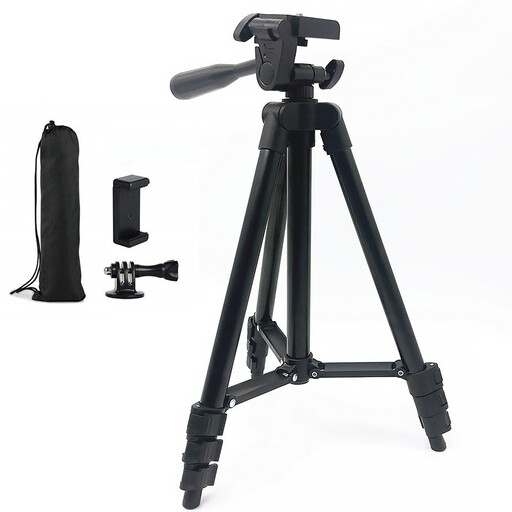
KINSI smartphone tripod with Bluetooth remote control
Suitable for a smartphone setup when you want to control the camera remotely. Check that your phone and camera app work with this remote.
The product title describes a folding smartphone tripod with adjustable height and a Bluetooth remote, for use on a table or outdoors.
View at Joybuy
Frequently asked questions
Do you need to buy a separate shutter release to photograph watch faces?
Not necessarily. If your camera offers shutter control through a supported app, you can first see whether that works for you. Canon and Sony describe control via their apps; check which functions work with your exact camera model.
How can you take a series of photos with more of the watch face in focus?
If your camera or workflow supports it, take shots at different focus distances and combine them using suitable camera or editing functions. Keep your setup steady; a separate shutter release won’t provide focus stacking on its own.
What should you check if a wireless shutter release doesn’t respond?
First, check that your camera model is supported and follow the pairing and operating instructions for that combination. Also check the shutter release’s power source. Using the same camera brand doesn’t automatically mean the devices are compatible.
What cooling-off period and warranty apply to an online purchase in the Netherlands?
For an online purchase by a consumer covered by Dutch rules, there is generally a cooling-off period of up to 14 days after delivery; ACM ConsuWijzer lists some exceptions. If a product is faulty, consumers have rights against the seller under the statutory guarantee, such as repair, replacement or a refund. Different rules may apply to business purchases.
Where can you take used batteries or a shutter release you no longer need?
Take used batteries to a designated collection point; the Dutch government lists shops and supermarkets that sell batteries among the options. Discarded equipment that runs on mains electricity or batteries can be handed in at designated collection points. The take-back scheme for old equipment when buying a new item applies to household equipment, not businesses.


