
Soap maker with a fixed tabletop setup
Takes individual product photos from a tripod and wants to keep the framing consistent while adjusting the soap and dark backdrop. Canon Europe recommends using a tripod to keep the background consistent.


Choose a shutter release that is confirmed to work with your exact camera model. A wired button may be enough for a fixed tabletop setup, while Bluetooth gives you more freedom to move around if your camera supports it. A timer is most useful for delayed or repeated shots; Canon UK also describes shutter control via Camera Connect for supported cameras. A shutter release lets you take a shot without touching the camera, but it won’t replace a stable tripod or careful exposure settings.
Takes individual product photos from a tripod and wants to keep the framing consistent while adjusting the soap and dark backdrop. Canon Europe recommends using a tripod to keep the background consistent.
Moves lights or props between shots and doesn’t want a cable running through the setup. Wireless control is only an option if your camera model supports the remote you’ve chosen; Nikon and Sony specify compatibility by model.
Wants to take delayed or repeated shots as well as individual product photos. JJC describes timer functions for the TM-F2, but you’ll need a version that matches your camera’s connector.
First, check that the shutter release works with your camera model. Then decide whether a cable, wireless control or timer best suits the way you take photos.
| What to consider | What to look for | Who it matters to |
|---|---|---|
| Compatibility | Check your camera’s full model name and connector, or confirm official support for the Bluetooth shutter release you’ve chosen. | I don’t want a shutter release that won’t work with my camera; around 36% of consumers put compatibility first. |
| Sharpness and framing | Choose a remote for individual shots and use a stable tripod as well; assess exposure separately. | For tripod-mounted product photos, I don’t want to touch the camera and disturb the composition; around 29% of consumers focus mainly on sharpness and consistent framing. |
| Freedom to move | Check that your camera model supports wireless control and find out what pairing is required. | When I’m moving lights and props, I don’t want a cable running through the setup; around 21% of consumers prioritise freedom to move. |
| Timer functions | Check whether the shutter release offers a delay or intervals, and whether the specific version is compatible with your camera. | If I want to take delayed or repeated shots, I look for timer functions that suit the way I work; around 14% of consumers give this top priority. |
Suitable if: you’re standing next to a tripod-mounted camera and want to take a shot without touching it; check the connector. Canon, for example, distinguishes between E3 and N3 connectors.
Trade-off: the cable may run across props or lighting, and a simple button won’t necessarily offer interval shooting.
Suitable if: you move around the setup and your exact camera supports the remote you’ve chosen. Nikon lists the ML-L7 for specific cameras; Sony requires support for Bluetooth remote control.
Trade-off: compatibility and pairing vary by camera model; the range quoted by Sony is an estimate, not a guarantee for every setup.
Suitable if: you need a delay, intervals or long exposures. According to JJC, the TM-F2 offers these functions for cameras with a Sony Multi Connector.
Trade-off: timer functions add little if you only take individual photos of soap; this version isn’t universally compatible.
Suitable if: your camera model supports control via its companion app and you don’t need a separate shutter release. Canon describes shutter control via Camera Connect for supported cameras.
Trade-off: check which functions are available for your model and whether using your phone suits the way you work.
Even products from the same brand can have different connectors. Nikon limits the ML-L7 to specific cameras, while Sony requires support for Bluetooth remote control.
Note down your camera’s full model name and check it against the connector or the official compatibility information for the exact shutter release.
Not touching the camera can help avoid movement caused by pressing the shutter, but a shutter release won’t stabilise the camera or determine the exposure.
Set up your tripod, soap, background and lighting first; then choose a suitable way to take the shot remotely.
A programmable shutter release may offer delays and intervals, but you won’t necessarily need these functions for individual product photos.
Decide in advance whether you’ll actually be taking a timed sequence or using a long exposure, and check that the version is compatible with your camera.
Canon offers wired EOS shutter releases for different connectors and describes app control for supported cameras.
The ML-L7 is a wireless remote for specific Nikon cameras.
The RMT-P1BT is a Bluetooth option for Sony cameras that support control via a Bluetooth remote.
JJC offers programmable wired shutter releases for different camera connectors, including the TM-F2 for Sony Multi Connector.
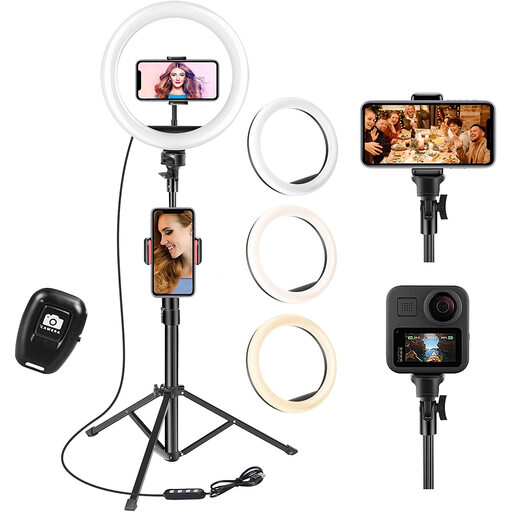
The product below is for lighting and controlling phone photography. Don’t consider this ring light kit a substitute for a shutter release confirmed to work with a standalone camera.
 No image available
This kit is designed for phone photography with adjustable lighting; the description mentions a phone holder and remote control.
The ring light is 10 inches and the tripod is 63 inches. The kit offers three colour temperatures and ten brightness levels.
No. You won’t need to touch the camera to take a shot, which can help avoid movement caused by touching it. Use a tripod, and carefully set the exposure and composition of the soap against the dark background too.
First, check that your camera model supports the remote you’ve chosen. Sony describes how to switch on Bluetooth and pair the camera with the remote; the exact process depends on the model.
Not necessarily: Canon describes shutter control via the Camera Connect app for supported Canon cameras. Check your model’s capabilities if you want to use your phone.
If you buy online from a business as a consumer, you’ll often have a 14-day cooling-off period, according to the Dutch government. You’re also entitled to a product that is fit for purpose; according to the Dutch government, the Netherlands has no fixed statutory warranty period. Check the rules that apply separately if you’re buying for a business.