
Photographers checking model compatibility
You already own a camera and want to know which release, connection or pairing method works with your model before you buy.


Start with your exact camera model: a compatible cable release, Bluetooth remote or camera app can trigger the shutter without you touching the camera. Wireless control leaves more room around a small table, while a cable needs no wireless pairing and a supported app could save you buying a separate accessory. None of these options is a substitute for a stable setup or careful framing.
You already own a camera and want to know which release, connection or pairing method works with your model before you buy.
You photograph book covers from above and want to take the shot without touching the camera or disturbing your framing, with as little cable around the book as possible. Canon describes remote control for flat-lay photography.
You want to find out whether your existing phone and camera can already trigger a shot remotely before buying an accessory. Canon, Nikon and Sony describe app control for supported cameras.
Choose this if: your camera supports the specific connection and you can route the cable away from the book and your shooting setup.
Bear in mind: the plug, cable routing and any adapter you may need. Compatibility with one model does not automatically mean it will work with other cameras.
Choose this if: your exact camera model supports the remote and you want to work beside the table without a cable. Canon lists the BR-E1 for the EOS R10; Nikon limits the ML-L7 to specific cameras.
Bear in mind: compatibility and pairing. Sony gives the RMT-P1BT a range of around five metres, depending on conditions; this is not a guarantee for your setup.
Choose this if: your camera and smart device support remote control and you want to see whether you need a separate release. Canon, Nikon and Sony describe this option for supported cameras.
Bear in mind: available features and performance depend on the combination of camera, app and smart device.
| What to consider | What should you check? | Who is this important for? |
|---|---|---|
| Compatibility | Check the full camera model name, the supported connection and, for a cable, the connection type and any adapter you may need. | If I already own a camera, I want to know whether the release will actually work with it. Around 36% of consumers put model compatibility first. |
| Taking a shot without touching the camera | Check that the supported control can trigger the shutter, then test the complete setup with a book. | For a fixed shot, I don't want to touch the camera when I take the picture. An estimated 29% of consumers prioritise triggering the shutter without moving the camera. |
| Table space | Think about where the camera, book, your hand and any cable will be while you frame and take the shot. | At a small table, I want to position the book without a cable getting in the way. Around 21% of consumers give free table space top priority. |
| Do you need a separate accessory? | First, see whether the official app offers the shooting function you need with your camera and smart device. | If I already have a suitable phone and camera, I want to try the existing app control first. An estimated 14% of consumers mainly want to avoid an extra purchase. |
Manufacturers sometimes limit remote compatibility to specific camera models and connections. A plug that looks like it fits does not confirm that it will work with your camera.
Check your camera's full model name against the manufacturer's compatibility information. If you're using a cable, also check whether your camera needs an adapter.
For supported combinations, manufacturers already describe control from a smart device.
Before choosing a separate release, test whether the official app can trigger the shutter remotely with your own camera and phone.
Sony describes the RMT-P1BT's range as an estimate that depends on conditions.
Test the pairing and shutter release where you take your book-cover photos.
Canon describes app control for a range of cameras and lists the BR-E1 as a Bluetooth option for the EOS R10.
Nikon offers wired and Bluetooth remotes and also describes control through SnapBridge.
Fujifilm lists the wired RR-100 for X Series and GFX Series cameras featured on its Dutch product page.
Sony describes the RMT-P1BT Bluetooth remote and remote control through Imaging Edge Mobile.
Panasonic lists the separately available DMW-RS2 for the Dutch LUMIX DC-G97H.
This selection includes smartphone tripods with remotes, a Bluetooth controller for the Osmo models listed and a smartphone gimbal. These products are not interchangeable with a shutter release for every camera, so check whether each one is suitable for your device and shooting setup.
 No image available
For smartphone photography at a table when you want to control the camera remotely without touching your phone.
The tripod is foldable and adjustable, and can stand on a flat surface. Check that it is compatible with your smartphone.
 No image available
For remote control with one of the Osmo models listed in the product title.
The title lists Osmo Action 4, Osmo Action 5 Pro, Osmo 360 and Osmo Action 6 as compatible models. The description says you can take photos without touching the camera.
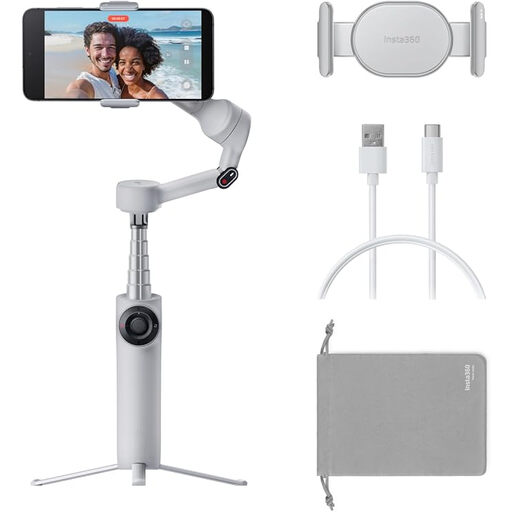 No image available
For smartphone photography when you want to control your phone hands-free, rather than using a separate release with an existing camera.
The product title describes a smartphone gimbal with an integrated tripod. The description mentions control using a second phone screen and taking a photo with a gesture.
No. First, check your exact camera model and the connection it supports. For some cameras, Fujifilm lists a separate adapter for the RR-100; Nikon says the ML-L7 is compatible with specific cameras.
Position the camera and book first, then test a cable, paired remote or app supported by your camera. For the MC-DC3, Nikon explains that pressing halfway focuses and pressing fully takes the shot.
Not necessarily: Canon, Nikon and Sony describe app control for supported cameras. Before buying an accessory, check whether the required shooting function works with your camera model and smart device.
According to the Dutch government, you are entitled to a product that meets the expectations you can reasonably have of it; the Netherlands has no fixed statutory warranty period. If a product is faulty, the seller must provide a solution. A manufacturer's or seller's guarantee may also apply.
According to the Dutch government, when you buy from a business at a distance, you will often have a 14-day cooling-off period. Check the terms that apply to your purchase; the distance-selling rules mentioned do not apply in the same way when you buy from a private individual.