
Photographers with a fixed tripod setup
Want to operate the shutter without touching the camera when taking close-ups of medals.


For medal photos under artificial light, choose a shutter release that’s compatible with your exact camera model. A compatible cable can be handy with a fixed tripod setup, while a supported wireless release or camera app can give you more freedom to move around. A shutter release lets you take the photo without touching the camera, but it won’t adjust the medal’s focus or exposure for you.
Want to operate the shutter without touching the camera when taking close-ups of medals.
Want to take photos remotely while keeping the camera and lighting in place; the camera must support the wireless control you choose.
Take multiple close-ups and want to keep the composition consistent. Focus and depth of field still need to be considered separately.
Choose this option: if your camera has a compatible socket and you’re using a fixed setup.
Bear in mind: the cable limits where you can stand, and sockets vary between camera models.
Choose this option: if your camera supports the specific wireless control and you don’t want to stand next to it.
Bear in mind: compatibility and pairing must match your exact camera model.
Choose this option: if your camera’s manual confirms that app control is supported and you also want to adjust settings remotely.
Bear in mind: available features vary by camera model, so check the manual.
First, check the socket or wireless support for your exact camera model. Then consider where you want to stand in relation to the camera and lighting while taking photos.
| What to consider | What should you check? | Who is this important for? |
|---|---|---|
| Compatibility | Check the exact camera model, socket and the manufacturer’s compatibility information. | I want to check that a shutter release fits my camera before choosing one; around 36% of consumers put compatibility first. |
| Movement when taking the photo | Set up the camera securely and assess test shots separately for movement and focus. | I don’t want to touch the camera when taking close-ups; around 29% of consumers prioritise minimising movement. |
| Freedom to move around | Check whether your camera supports the wireless control you’ve chosen and how to pair it. | When I’m working around the lighting, I want to be able to take photos from another spot; around 21% of consumers prioritise this flexibility. |
| Repeat shots | Check whether the specific shutter release has features that suit the way you take photos. | For multiple close-ups, I want to keep the setup in place and operate the shutter release comfortably each time; around 14% of consumers make this their main priority. |
Even within a single brand, sockets and wireless compatibility can vary between camera models.
Before buying, check the full camera model and the official socket or compatibility information.
Taking photos remotely means you don’t touch the camera as you press the shutter, but you still need to pay attention to focus and close-up details.
Take a test shot with the camera securely set up and assess movement, focus and lighting separately.
A Bluetooth label alone doesn’t tell you whether a specific camera can be operated with the shutter release.
Check the manufacturer’s documentation for the combination of your camera model and the control you’ve chosen.
Canon lists wired shutter releases for EOS cameras with an E3 or N3 socket, as well as a wireless option for compatible models.
Nikon describes the MC-DC3 as a wired shutter release for its Z-series mirrorless cameras.
Sony describes the RMT-P1BT as a Bluetooth remote control for supported Sony cameras.
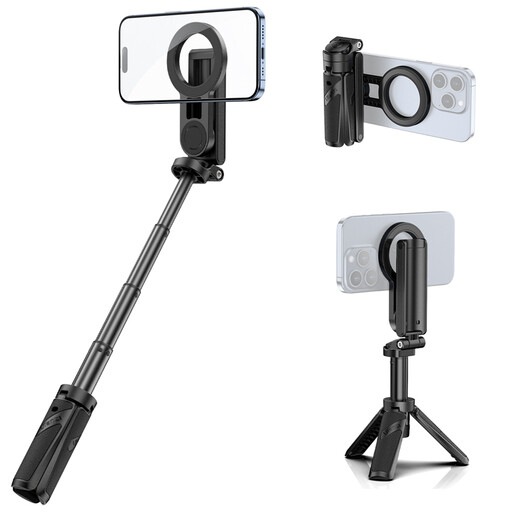
This Joybuy pick is suited to a fixed setup with remote control; check that the shutter release is compatible with your camera.
 No image available
The Bluetooth remote control and tabletop tripod are designed for remote operation from a fixed setup. Check that the shutter release works with your camera model.
The product name lists a remote control range of 10 m, a 360° rotating magnetic holder and a tabletop tripod.
The holder contains strong magnets: keep the product at least 15 cm away from pacemakers, defibrillators and medical implants. Test the magnetic attachment before use on vertical or overhead surfaces, and secure the camera firmly.
No. It lets you take a photo without touching the camera, but for close-ups you’ll still need to assess focus and depth of field separately using test shots.
First, look up your exact camera model in the manual or the manufacturer’s compatibility information. For example, Canon distinguishes between E3 and N3 cable sockets; for a wireless option, the camera must support the relevant control.
For an online consumer purchase, ACM ConsuWijzer says you generally have a statutory cooling-off period of up to 14 days after delivery, with some exceptions. Your statutory rights for a faulty product are separate from any manufacturer’s warranty; in the Netherlands, the statutory guarantee period is not automatically two years for every product.
Radio equipment placed on the market in the EU must meet the applicable requirements of the Radio Equipment Directive and carry the required CE marking, as explained by the Dutch Authority for Digital Infrastructure. Any additional cybersecurity requirements depend on the device’s features, so check the information for the specific product.