
Creator with a fixed photo table
If you photograph your pouches from the same tripod position each time, you can use a remote release to take pictures without touching the camera. Canon Netherlands describes this as an option for remote shooting.


You may not need a separate camera shutter release: first try a camera app that supports your camera model. If you want a separate control, a cable suits a fixed setup, while a compatible wireless release can be handy if you move around the set. With a tripod and a slower shutter speed, releasing the shutter without touching the camera can help prevent camera shake, but a shutter release won’t correct the white balance or any banding caused by artificial light.
If you photograph your pouches from the same tripod position each time, you can use a remote release to take pictures without touching the camera. Canon Netherlands describes this as an option for remote shooting.
If you move the pouches, background or lighting during a session, controlling the camera from another position may be more practical. In its product photography guide, MPB explains how a tripod helps you keep the framing consistent while you adjust props or lighting.
Want to check first whether you can take pictures remotely without an extra accessory? Canon Netherlands describes control via Camera Connect for many, but not all, cameras, so check whether your model is supported.
First check that the control is compatible with your camera model, then choose what works best for where you’ll be standing while you take pictures.
A good fit if: your camera stays in one place and its port matches the shutter release.
Bear in mind: the cable limits where you can stand, and connections aren’t interchangeable.
A good fit if: you want to take pictures from another position while adjusting the pouches or lighting.
Bear in mind: your camera must support that specific wireless shutter release.
A good fit if: you can release the shutter remotely using your camera’s companion app and want to avoid buying an extra accessory for now.
Bear in mind: compatibility and available features depend on your camera model and app.
| What to consider | What should you check? | Who is this important for? |
|---|---|---|
| Compatibility | Note the full camera model and check the connection or explicit support for the exact type of shutter release. | If I want to avoid choosing a shutter release that doesn’t work with my camera, I’ll check the model first; around 36% of consumers prioritise compatibility above all else. |
| Taking pictures without touching the camera | Check that the control activates the camera shutter; a lock is only relevant if you need that feature. | When shooting with a tripod, I want to take pictures without touching the camera; around 29% of consumers are mainly looking to avoid camera shake when releasing the shutter. |
| Freedom to move | Check whether your camera supports a wireless connection, or whether the cable is long enough for your setup. | If I move between the pouches and the lighting while styling, I want to be able to take pictures from another position; around 21% of consumers are mainly looking for freedom to move. |
| Camera app | Check whether your camera model lets you release the shutter remotely via the app, and try the feature before buying an accessory. | If I want to start by using the camera and phone I already have, I’ll check whether the app controls the shutter; around 14% of consumers are mainly looking to avoid an extra purchase. |
Connections and supported wireless features can vary even within the same brand. So the brand name alone doesn’t confirm that a shutter release will work with your camera.
Compare the full camera model and exact model number with the manufacturer’s compatibility information.
A shutter release operates the shutter; white balance and possible flicker from LED lighting need to be dealt with separately. Canon Netherlands explains how artificial light can cause a colour cast if the white balance isn’t set appropriately. Nikon Netherlands describes banding caused by certain flickering light sources and shutter speeds.
Take some test shots first and check the colour of the fabric and for any banding before photographing a whole batch.
Some cameras let a compatible app operate the shutter remotely, so you may not need a separate accessory.
Check that your exact camera model supports the app controls you want, and try them first.
Canon offers several types of remote control, including the BR-E1 Bluetooth remote, E3 cables for compatible EOS cameras and Camera Connect.
Nikon describes the ML-L7 Bluetooth remote and the wired MC-DC3 for cameras that support these models.
Sony offers the wired RM-VPR1 for compatible cameras with the required connection, and the wireless RMT-P1BT for supported cameras.
The wired LUMIX DMW-RS2 is worth considering if your camera supports this model.
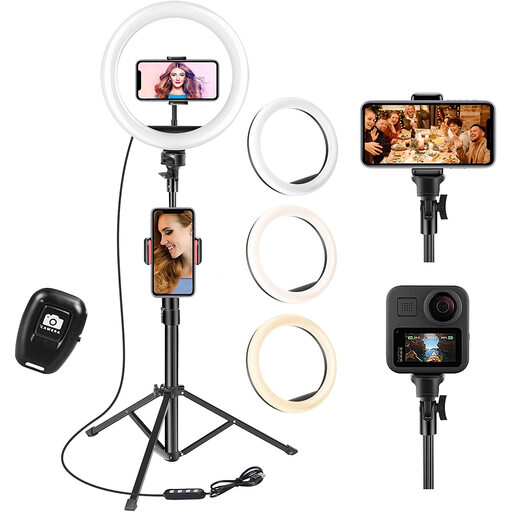
This Joybuy selection features ring lights for product photography, not a confirmed shutter release for the camera.
 No image available
Could be useful if you’re looking for extra lighting for product photos. The product title mentions a remote control, but doesn’t confirm that it operates the camera shutter.
The product title specifies a 10-inch ring light and a 63-inch tripod.
The product title specifies 3 colours and 10 brightness levels.
Not necessarily: first check whether you can release your camera’s shutter remotely using a compatible app. With a tripod and a slower shutter speed, taking pictures without touching the camera can help prevent camera shake when releasing the shutter.
First, check the connection for your exact camera model in the manufacturer’s documentation. For example, Canon distinguishes between E3 and N3 connections, so don’t connect a cable based on the camera brand alone.
No. A shutter release operates the shutter; it won’t set the white balance correctly for you. Canon Netherlands explains that artificial light can cause a colour cast if the settings aren’t suitable. Take a test shot and check the colour of the pouch.
Certain flickering LED light sources and shutter speeds can cause banding. Nikon Netherlands describes a model-specific feature that lets a compatible camera fine-tune its shutter speed to reduce this effect; a shutter release alone won’t fix it.
In the Netherlands, statutory warranty applies if a product is faulty; the retailer is your point of contact, and there is no fixed statutory warranty period. For distance purchases, you’ll usually also have a 14-day cooling-off period, although there are exceptions. The Dutch government outlines these rights; check which terms apply to your purchase.