For dried flowers on a small table, you don’t need an extra shutter release if the self-timer or a supported camera app does the job. Choose a wired release if you want to take the shot straight away and can keep the cable out of your workspace; choose wireless if you want to move around the table and your exact camera model is compatible. A remote release helps prevent camera shake from touching the shutter, but it won’t fix incorrect focus or moving flowers.
Who is a camera shutter release suitable for?
Photographers who want to keep their set-up in focus
If you’re photographing flowers with your camera on a stable surface or tripod, you can take the shot without touching the composition. Canon Netherlands describes the self-timer and a remote release as options for a camera placed on a stable surface.
Photographers working with limited table space
If you want to work around the flowers without running a cable through a cramped space, wireless control may be worth considering. Check that the manufacturer lists support for your exact camera model: Canon Netherlands and Nikon Netherlands both specify compatibility by model.
Photographers who want to get started simply
If you want to see whether shooting without touching the camera is enough, try the self-timer or a supported camera app first. Canon Netherlands lists the self-timer as an alternative when the camera is on a stable surface.
What should you look for?
Self-timer or camera app
Choose this if: your camera is stable, you can wait and the timer or app is supported by your camera model.
The trade-off: the timer means waiting, while an app requires a compatible camera and a configured connection.
Wired shutter release
Choose this if: you want to take the shot straight away, can stay close to the camera and have a connector that fits your model.
The trade-off: the cable needs space and can tug on the set-up if it’s touched.
Wireless shutter release
Choose this if: you want to work around the table without a cable and the manufacturer lists your camera as compatible.
The trade-off: check the pairing and power requirements. Any stated range applies only to that specific model and compatible cameras.
For a small table-top set-up, your choice mainly comes down to compatibility, taking the shot without touching the camera, room to move and whether you need an extra accessory.
| Consideration |
What to look for |
Who is this important for? |
| Compatibility |
Check the full camera model, connector and whether an adapter is needed. |
If I’m not sure whether the release will fit my camera, I want to check the model and connector details first. Compatibility is the top priority for around 33% of consumers. |
| Taking the shot straight away |
Compare a direct shutter button with the delay of the self-timer. |
I don’t want to touch the camera when I release the shutter, but I’ll need to set the focus correctly myself. Around 27% of consumers prioritise taking the shot straight away without touching the camera. |
| Room to move |
Check whether a cable can run along the table without tugging on the camera or flowers; otherwise, check for wireless support. |
If I want to move my hands around the flowers, I need to consider cables in my small workspace. Around 20% of consumers give room to move top priority. |
| Avoiding an extra accessory |
Try the existing self-timer or a supported app first. |
I don’t want to buy a separate release if the timer or app already works well enough for me. Around 20% of consumers want to make use of their camera’s existing controls first. |
Common pitfalls
-
Assuming a shutter release works with every camera
Connectors and wireless support vary by camera model, and some combinations also require an adapter.
Compare the full model number with the manufacturer’s compatibility information and check the connector before choosing.
-
Choosing a cable without considering the space on your table
A cable running through your workspace can get in the way or tug on your camera set-up.
Decide where the camera, flowers and your hands will go. Choose a wired release only if the cable can be kept safely out of the way; otherwise, check for a compatible wireless option.
-
Expecting a shutter release to fix every blurry photo
Taking the shot without touching the camera can help prevent a jolt when pressing the shutter, but it won’t correct incorrect focus or moving flowers.
Check the focus and make sure your set-up is stable. If needed, try the self-timer first.
Brands to consider
Canon
For selected EOS cameras, Canon offers options including wired and Bluetooth control.
- Canon Netherlands lists an N3 connector and an 80 cm cable for the RS-80N3; for the BR-E1, Canon Netherlands specifies Bluetooth control up to 5 metres.
- Check which remote release is supported by your camera model. These are model specifications, not the results of an independent performance test.
Nikon
Nikon offers the wired MC-dc2 and wireless ML-L7 for selected cameras.
- Nikon Netherlands describes the MC-dc2 as a way to release the shutter without touching the camera body. The ML-L7 has separate buttons for taking photos and recording video.
- These features don’t confirm that either model works with every Nikon camera; check your camera’s compatibility.
Fujifilm
Fujifilm says the RR-100 is designed for the listed X and GFX models.
- Fujifilm lists a shutter button that can be half-pressed and a right-angle plug extension included in the box.
- Some camera models require a separate adapter; check the model notes before choosing the release.
Sony
The RMT-P1BT is a Bluetooth option for cameras supported by Sony.
- Sony Netherlands describes control via the camera’s built-in Bluetooth receiver, with no wired connection or separate receiver needed.
- Check whether your exact camera model is supported. Sony’s claims about performance and reliability are manufacturer claims.
Panasonic
Panasonic lists the separately available DMW-RS2 for the LUMIX DC-G97.
- This pairing gives you a specific starting point for checking remote control with that camera model.
- This doesn’t confirm compatibility with every LUMIX camera. The DMW-RSL1E is listed for the DMC-L1 and FZ50.
Joybuy products for remote control
The products below are remote control options for compatible smartphones and Osmo cameras, plus a smartphone gimbal controlled remotely using a second phone. They are not universal shutter releases for cameras.
 No image available
KINSI Selfie Stick with Tripod, 170 cm, Bluetooth Remote
For a set-up with a compatible smartphone that you want to trigger remotely.
The title lists a 170 cm extendable selfie stick, a tripod, a 360° rotating phone holder and compatibility with smartphones from 4.7 to 6.0 inches.
View at Joybuy
 No image available
KINSI Smartphone Tripod with Bluetooth Remote Control
For anyone who wants to set up a smartphone on a table or outdoors and control the camera remotely.
The product title lists a foldable design and a height-adjustable tripod for use on a table or outdoors.
View at Joybuy
 No image available
Osmo Action GPS Bluetooth Remote Controller
For remote control with a compatible Osmo camera from the listed range.
The product title lists Osmo Action 4, Osmo Action 5 Pro, Osmo 360 and Osmo Action 6 as compatible models.
View at Joybuy
 No image available
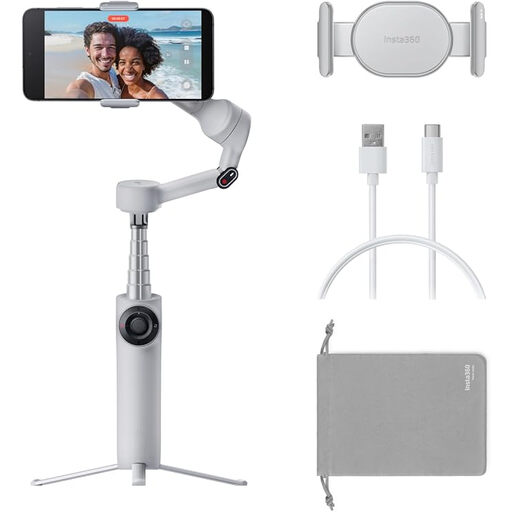
Insta360 Flow 2 Gray Gimbal for Smartphones
For anyone who wants to use a second phone for the remote control and recording described.
The product description lists control via the screen of a second phone; this product is a smartphone gimbal.
View at Joybuy
Frequently asked questions
Do I need to buy a remote release for still dried flowers?
Not necessarily: set the camera up securely and try the self-timer first. For a stable set-up, Canon Netherlands suggests a two-second timer or a remote release; a supported camera app may also be an option. A separate release is mainly useful if you want to take the shot more immediately.
How do I connect a wired shutter release?
First, check the connector and exact camera model in the manufacturer’s information. According to Canon, the Canon RS-80N3 has an N3 connector; Fujifilm lists a separate adapter for the RR-100 with certain cameras. Position the cable so it doesn’t run through the flowers or tug on the camera.
What can I do if my flower photo is still blurry with a remote release?
Check the focus and see whether the flowers themselves are moving. Taking the shot without touching the camera can help prevent a jolt when pressing the shutter, but it won’t automatically focus on the right detail or prevent your subject from moving.


