
Maker of highly detailed pendants
You want to show tiny inclusions or edges clearly. So, check the magnification of the actual lens, not just the camera’s resolution. Nikon and Canon specify magnification for their individual macro lenses.


A compact camera with a close-up mode may be enough for general product shots. For tiny inclusions that need to fill the frame, a mirrorless camera with a suitable macro lens gives you more options. The magnifications quoted apply to specific lenses, not automatically to the camera body or a kit lens. Diffused light and the right white balance are also important when photographing glossy resin under artificial light.
You want to show tiny inclusions or edges clearly. So, check the magnification of the actual lens, not just the camera’s resolution. Nikon and Canon specify magnification for their individual macro lenses.
You photograph several pendants under artificial light and want to keep colours and reflections consistent from one shot to the next. Nikon highlights diffused light and setting the white balance as important considerations when photographing jewellery.
You want to photograph pendants and details without having to piece together a camera body, macro lens and extra accessories straight away. The OM SYSTEM TG-7 has a built-in lens, while the close-up setup for a mirrorless camera depends on the lens you choose.
First, decide how small a detail needs to appear large in the frame. Then consider your lighting setup and exactly what the camera kit includes.
| What to consider | What should you check? | Who should pay particular attention? |
|---|---|---|
| Tiny details | Check the magnification of the exact lens or the capabilities of the close-up mode. Nikon specifies 1:1 magnification for the NIKKOR Z MC 50mm f/2.8; Canon specifies up to 1:2 for the RF 35mm F1.8 Macro. | If I want tiny inclusions to fill the frame, I prioritise magnification. Around 31% of consumers put detail reproduction first. |
| Reflections | Check whether you can position diffused light around the pendant and keep the camera steady. Nikon describes a light tent as one way to soften light. | When reflections hide details on glossy resin, I want to be able to adjust my lighting setup accordingly. Around 25% of consumers prioritise controlling reflections. |
| Colour under artificial light | Check whether you can set the white balance, and compare test shots taken under the light you actually use. Nikon describes using a white card to assess mixed lighting. | If I’m taking a series of pendant photos, I want the colours to remain consistent under the same artificial light. Around 25% of consumers prioritise colour consistency. |
| Complete setup | Check the exact kit contents and lens mount. The EOS R50 kit reviewed includes an RF-S 18–45mm lens; the RF 35mm F1.8 Macro is a separate lens. | I want to know in advance whether the camera is ready for the close-ups I have planned, or whether I’ll need another suitable lens. Around 19% of consumers prioritise having a complete setup. |
A macro lens’s magnification is not a feature shared by every lens that fits the same camera body. A body-only version is not automatically ready for close-up photography either.
Check the exact kit contents, the lens mount and the magnification of the lens actually supplied.
A glossy pendant can show bright spots and reflections that hide details; a new camera won’t change the way light falls on it.
Take test shots and adjust the position and spread of the artificial light before choosing a camera based on reflections.
According to OM SYSTEM, the TG-7’s close-up mode can focus as close as 1 cm. That is not the same as the 1:1 magnification Nikon specifies for a particular macro lens.
Compare test images of the smallest detail you want to show, rather than looking at distance figures alone.
The Z50II can be paired with a separate Z-mount macro lens for detailed shots.
The EOS R50 is an APS-C mirrorless camera that you can pair with a suitable separate lens.
The Tough TG-7 has a built-in zoom lens and a mode for shooting from very close up.
The ZV-E10 is a mirrorless camera with interchangeable lenses; the version reviewed is body only.
Below are cameras and camera versions from the Joybuy product range. Check each version to make sure the lens and close-up capabilities suit the smallest details you want to photograph.
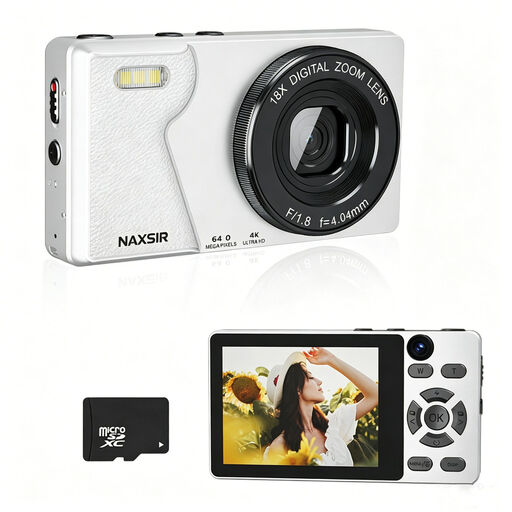 Image unavailable
Autofocus may be worth considering for general pendant photos; test it with your own pendant to see whether it captures the details you want clearly.
The product title lists 4K, 64 MP, 18x digital zoom, autofocus and an included 32 GB memory card.
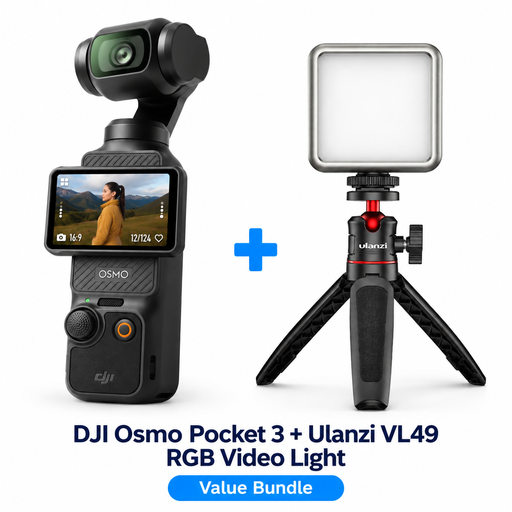 Image unavailable
This bundle is an option if you’re looking for a camera supplied with an LED video light. Check whether you can position the light to keep reflections under control when photographing pendants.
The product title lists the Osmo Pocket 3 and the Ulanzi VL49 RGB LED video light.
 Image unavailable
The product title describes this version as a vlogging camera. For tiny pendant details, check separately whether its close-up capabilities suit your photography.
The title lists a 1-inch CMOS sensor and 4K/120fps video.
 Image unavailable
A pocket camera is a compact option to consider for general photography. Take a test shot to check whether tiny inclusions appear large enough.
The product title lists 4K, 44 MP, 16x zoom and the pink version.
 Image unavailable
This mirrorless camera version includes a zoom lens. Check which lens you’ll need if you want greater magnification for details later on.
The product title lists a 16–50mm zoom lens and the black version.
No. The number of megapixels alone doesn’t determine how large a tiny detail appears in the frame. Check the lens or close-up mode in particular. For example, Nikon specifies 1:1 for the NIKKOR Z MC 50mm f/2.8; this is a specification for that lens, not the camera body.
Start with test shots and soften the light if reflections are hiding details on the pendant. Set the white balance to suit the light you’re using, then compare the photo with the resin’s actual colour.
Not the Dutch EOS R50 kit reviewed, which comes with an RF-S 18–45mm lens. Canon lists the RF 35mm F1.8 Macro as a separate lens that is compatible with the EOS R50. Check the contents of the specific offer.
For eligible distance purchases from a business, you generally have 14 days to change your mind, although exceptions apply. According to the Dutch government, the seller is your point of contact if a product is faulty; the Netherlands does not have a fixed statutory warranty period that applies to all products. This information does not necessarily apply to a business purchase or a purchase from a private individual.