
Photographer using a tripod
You’re photographing still jars in changing window light and don’t want to touch the camera when taking the shot. Canon UK lists a two-second self-timer or a remote release as options when using a stable setup.


You don’t always need a separate remote: if your setup is stable, try the self-timer first. If you want to take the shot straight away while arranging your jars, choose a cable release, wireless remote or camera app that suits your camera model and the features you need. Canon UK points out that a tripod allows you to use slower shutter speeds; a remote release is no substitute for a tripod.
You’re photographing still jars in changing window light and don’t want to touch the camera when taking the shot. Canon UK lists a two-second self-timer or a remote release as options when using a stable setup.
You’re moving jars or props around and want to take the shot from your workspace, without having to keep going back to the camera.
You want to check the framing on your phone. Check that your camera supports the app features you need; Canon UK notes that not all Camera Connect features are available on every camera model.
Choose this option: your camera is stable and you don’t need to take the shot at an exact moment.
Trade-off: the photo is taken only after the set delay.
Choose this option: you’re working close to the camera and the exact model has the right socket.
Trade-off: the cable limits how far you can move, and you’ll need the right type of connection.
Choose this option: you want to take the shot from further away and the manufacturer lists your camera model as compatible.
Trade-off: check that it’s compatible with your model and which camera functions the remote can control.
Choose this option: you want to view the live image on your phone screen and your camera supports that app feature.
Trade-off: available features vary by camera model; Canon UK makes this limitation clear for Camera Connect.
| What to consider | What should you check? | Who is this important for? |
|---|---|---|
| Compatibility | Make a note of the full camera model and check the compatibility list. For cable releases, Canon UK distinguishes between E3 and N3 connections, among others. | If I want to make sure the release fits my camera, I check the model and socket in advance; around 36% of consumers put compatibility first. |
| Taking a shot without touching the camera | First, test the self-timer on a stable surface; Canon UK lists a two-second delay. | If I don’t want the camera to move when I take the shot, I start with a stable setup and a self-timer; around 29% of consumers mainly want to avoid camera shake when taking a photo. |
| Taking a shot while arranging things | Decide where you’ll be standing and whether you only want to take the shot or also view the live image on your phone. | If I’m moving jars or props around, I want to be able to take the shot from my workspace; around 21% of consumers want to take photos while arranging their setup. |
| Avoiding an extra device | Try the built-in self-timer before buying a separate remote. | If a delayed shot works for my usual setup, I don’t need to buy an extra control straight away; around 14% of consumers mainly want to avoid an additional purchase. |
Even within the same brand, compatible camera models and connections can vary. An E3 connection is not the same as an N3 connection.
Compare the full camera model and, for a cable, the connection type with the specifications for that exact release.
With a stable setup, the built-in self-timer may be all you need to take a photo without touching the camera at the time.
Try the self-timer first. Choose a remote only if you want to take the shot straight away or control the camera from somewhere else.
A remote operates the shutter, but it doesn’t provide stable support for the camera when using slower shutter speeds.
Consider the tripod and remote release as separate parts of your setup.
For selected cameras, Canon offers wired releases, a wireless remote and control via Camera Connect. The right option depends on your exact camera model and the feature you need.
The ML-L7 Bluetooth remote is designed for specific Nikon cameras. SnapBridge also offers phone control on supported equipment.
The RMT-P1BT is a Bluetooth option for cameras that Sony lists as compatible.
The wired DMW-RSL1E is an example of a remote release that’s compatible with specific LUMIX models.
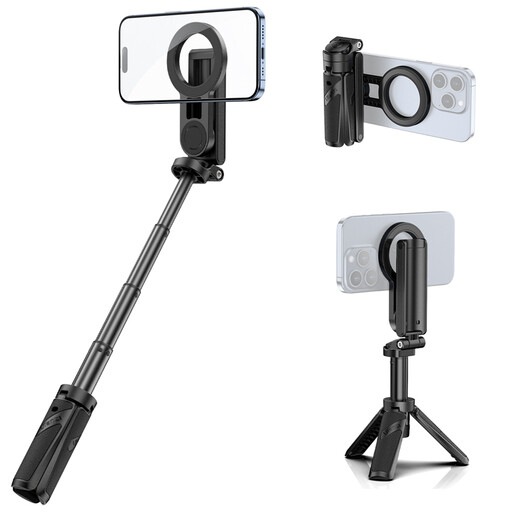
These product choices combine a tripod or selfie stick with remote control for a phone setup. If you want to control a separate camera, check in advance that the remote works with your exact camera model.
 No image available
The tripod and remote combination may suit a phone setup where you don’t want to keep going back to your device; check which device the remote controls.
The product name lists a 10 m range, a rotating magnetic mount and a table-top tripod.
Keep the strong magnet at least 15 cm away from pacemakers, defibrillators and other medical implants. Test the mount before using it above or beside a surface. The remote contains a button-cell battery; keep it out of reach of children.
 No image available
This combination may suit you if you want to position your phone hands-free and take a photo remotely; check how it works with your phone.
The product description lists Bluetooth camera shutter control up to 10 m away and compatibility with iPhone and Android. The title mentions an extendable mini tripod and two cold shoe mounts.
The remote contains a button-cell battery; keep it out of reach of children. The stated phone compatibility doesn’t in itself confirm support for a separate camera.
Not necessarily. For a stable camera setup, Canon UK lists a two-second self-timer as an alternative that lets you take a photo without touching the camera at the time.
First, check whether your camera model supports the app feature you want. For compatible cameras, Canon Camera Connect offers remote shooting with Live View; Canon UK notes that not all app features are available on every model.
With a still subject, a tripod can allow you to use slower shutter speeds. Canon UK explains that this lets you use a lower ISO; a remote doesn’t stabilise the camera itself.
According to the Dutch government, if there’s a problem with a product, you should ask the seller to put it right. Any additional warranty is separate from your statutory rights.
The Dutch government lists shops and supermarkets that sell batteries as drop-off points for used batteries. Check which type of battery your remote uses.