
Photographer with a fixed tripod setup
You photograph small stones from a tripod and want to avoid touching the camera when you take a picture. Canon Netherlands describes remote operation as a way to avoid touching the camera.


First, choose a remote release that’s compatible with your exact camera model and its connection or wireless features. If you’re shooting from a fixed tripod position, a compatible cable may be enough; wireless control or a supported camera app gives you more freedom to move around. A remote release won’t eliminate reflections on polished stones, so consider the position and diffusion of your artificial light too.
You photograph small stones from a tripod and want to avoid touching the camera when you take a picture. Canon Netherlands describes remote operation as a way to avoid touching the camera.
You move stones, backgrounds or lights between shots and don’t want to keep returning to the camera to take a picture. A compatible wireless remote may be more practical than a cable.
You take lots of close-up shots and want to know whether half-pressing, locking or using a timer suits the way you work. Nikon describes these controls for specific accessories; an interval timer won’t change the focus automatically.
First, check that the remote release works with your camera. Then decide whether a fixed cable, wireless control or a camera app suits the way you arrange your stones and lighting.
Best suited to: shooting from a fixed tripod position, provided your camera supports the cable connection.
Bear in mind: the cable limits where you can stand. Nikon and Canon describe a lock function for specific models; connections aren’t interchangeable.
Best suited to: moving around your setup while taking photos, provided your camera model supports the remote you choose.
Bear in mind: support and pairing vary by camera and accessory, so check compatibility with your model.
Best suited to: cameras and phones that support remote operation, especially if you’d like to try using equipment you already own.
Bear in mind: the available controls and performance depend on the combination of camera and phone.
| What to consider | What to look for when buying | Who is it for? |
|---|---|---|
| Compatibility | Check the full camera model, connection or wireless features, and compatibility with the exact accessory. | I want to know in advance whether the remote release will work with my camera; choosing one from the same brand isn’t a guarantee. Around 36% of consumers name compatibility as their main buying concern. |
| Taking pictures without touching the camera | Check whether a simple, compatible remote release will do; you’ll still need a stable tripod setup. | When taking close-up shots from a tripod, I want to take pictures without touching the camera. Around 29% of consumers prioritise avoiding movement when taking a picture. |
| Freedom to move around | Compare wireless control with a supported camera app, and check which features your camera offers. | If I move stones or lights during a shoot, I want to take pictures without being tethered to the camera by a cable. Around 21% of consumers value having room to move around their setup above all. |
| Sequences and timer | Check whether the remote release has the lock or timer function you want; don’t confuse interval control with focus stacking. | For longer or repeated shoots, I only want to pay for features I’ll actually use. Around 14% of consumers name sequence control as their main buying concern. |
Connections and wireless support vary by camera and accessory. So a remote release from the same brand won’t necessarily be compatible.
Compare your full camera model with the compatibility information for both the camera and the remote release.
A remote release operates the shutter without you touching the camera, but it won’t control reflections on shiny stones.
Consider the position and diffusion of your artificial light too.
A timer sets when pictures are taken; it doesn’t mean the focus will change automatically between shots.
Check your camera’s focus bracketing function separately from the remote release’s timer features.
Canon describes wired and wireless accessories for specific EOS cameras; Camera Connect can also offer remote control with supported combinations.
Nikon describes wired and wireless remote releases for a range of specific cameras; SnapBridge can offer phone-based control with supported combinations.
Sony describes the RMT-P1BT as a Bluetooth remote control for supported cameras.
JJC describes the wired TM-F2 as a timer remote release for the camera models listed with the product.
The Panasonic references listed here are for separate remote controls designed for specific LUMIX models.
This selection includes a smartphone gimbal and a magnetic tabletop tripod with remote control. Check that the controls suit your phone and the type of shots you want to take; these accessories won’t necessarily replace a model-specific shutter release cable for a camera.
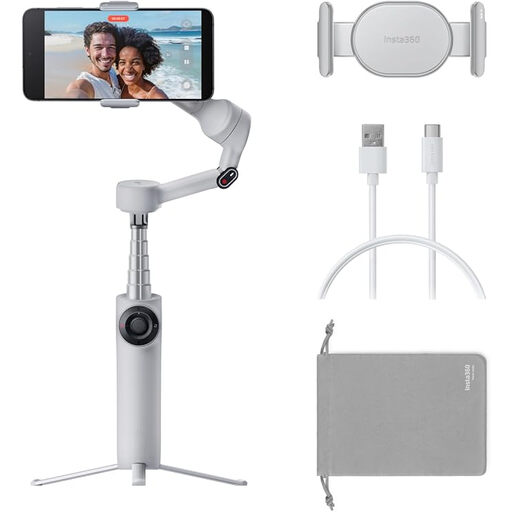 No image available
An option if you’re looking for a smartphone gimbal with remote control; check that its features suit your phone and the way you take photos.
The product name mentions an integrated tripod and a selfie stick.
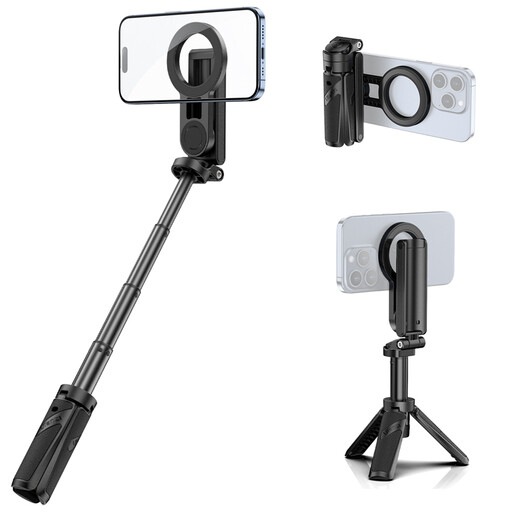 No image available
An option if you’re looking for a magnetic tabletop tripod and selfie stick as well as remote control; check beforehand that it suits your device and setup.
The product name lists a remote control with a range of 10 m and a 360° rotating design. The strong magnets may pose a risk to pacemakers, defibrillators and medical implants: keep at least 15 cm away. Test the magnetic grip before use on vertical or overhead surfaces, and keep the button-cell battery remote out of children’s reach.
Not necessarily. If your camera and phone support it, you may be able to use a camera app to take pictures without touching the camera; check your camera model first. A remote release won’t eliminate reflections on a shiny surface, so consider the position and diffusion of your artificial light too.
Only use a cable that fits the remote control connection on your exact camera model. Nikon describes half-pressing, fully pressing and locking for the MC-DC3; don’t assume every cable has the same features.
No. Setting an interval between shots doesn’t mean the focus will change between them. Focus stacking uses images taken at different focus points; check separately which features your camera and software support.
When you buy online from a business, you generally have a 14-day cooling-off period, subject to exceptions explained by the Dutch government. If a product is faulty, the seller must provide a solution. According to the Dutch government, there is no fixed general statutory warranty period in the Netherlands.