Who can benefit from a remote shutter release?

Photographers unsure about compatibility

You already have a camera, but aren’t sure which connection or wireless controls it supports. Canon, Nikon and Sony list compatibility by accessory and camera model, so check the details for your exact camera.

Photographers with a fixed macro setup

You photograph stationary minerals on a tripod and want to take a picture without touching the camera body. A compatible cable release can help, as long as the cable doesn’t cross your work area. Canon, Nikon and Sony list wired options for supported cameras.

Photographers who rearrange their setup

You regularly move minerals, backgrounds or lights and want to take pictures without a cable getting in the way. Canon lists a Bluetooth range of up to 5 m for the BR-E1; Nikon describes the ML-L7 as a wireless controller for specific cameras. For small details, you may also need to take a series of photos at different focus points.

What should you look for when buying?

What to consider What to check before buying Who this matters to
Compatibility Check your full camera model and the connection or wireless pairing it supports. If you’re unsure whether an accessory will work with your camera, first check compatibility with your model; around 36% of consumers put compatibility at the top of their list when buying.
Taking photos without touching the camera Compare a compatible cable release with your camera’s self-timer, and check that the cable is long enough for your setup. With a fixed close-up setup, you’ll want to take a picture without touching the camera or disturbing the tripod; around 29% of consumers make this their top priority.
Freedom to move Check that your camera model supports the wireless release and find out what pairing is required. If you move minerals or lights around your setup, a cable could get in the way; around 21% of consumers prioritise the freedom to move without a cable.
Series of detail shots Check which shutter and focus functions your camera supports; a shutter button doesn’t automatically mean your camera can perform focus stacking. If you want to use different focus points for detail shots, make sure the sequence you need suits your camera and workflow; around 14% of consumers make this their top priority when buying.

Pitfalls to avoid

  • Choosing a remote release based only on the camera brand

    Connections and wireless support can vary between models, even within the same brand. As a result, the wrong release may not work with your camera.

    Look up your full camera model and compare it with the manufacturer’s compatibility information before placing your order.

    Choosing an incompatible accessory can mean extra time spent returning or exchanging it.

  • Assuming any Bluetooth button can control a camera

    Bluetooth alone doesn’t confirm that a remote will work with your camera. Check which models it supports and what pairing is required.

    Don’t assume it’s compatible just because it says ‘Bluetooth’; check the information for your exact camera model.

  • Expecting a remote release to control focus and the white background too

    A remote release operates the shutter, but it won’t automatically set depth of field, white balance or exposure. Nikon describes focus stacking as combining separate shots taken at different focus points; white balance and bright details need separate attention.

    Consider focus, white balance and exposure separately from your choice of remote control.

    A series of detail shots may take extra time to capture and edit.

Relevant brands

Canon

Canon offers wired and wireless options for specific models, including the RS-80E3 and BR-E1.

  • Canon lists a 2.5 mm E3-type connection for the RS-80E3 and Bluetooth control with a range of up to 5 m for the BR-E1.
  • These details apply to the models listed; check that your camera supports the accessory.

Nikon

Nikon offers both a wired option and a wireless remote control for specific cameras.

  • The MC-dc2 provides wired shutter control through a compatible accessory socket; the ML-L7 has separate buttons for photos and video.
  • Neither accessory is automatically compatible with every Nikon camera.

Sony

Sony describes the RM-VPR1 as a wired option and the RMT-P1BT as a wireless Bluetooth option.

  • Sony specifies an 800 mm cable and shutter control for the RM-VPR1; the RMT-P1BT works wirelessly.
  • Check which remote controls and functions are supported by your camera model; these product descriptions are not an independent comparison.

Joybuy products

This Joybuy pick is a smartphone tripod with a Bluetooth remote control; check that the cameras listed suit your needs.
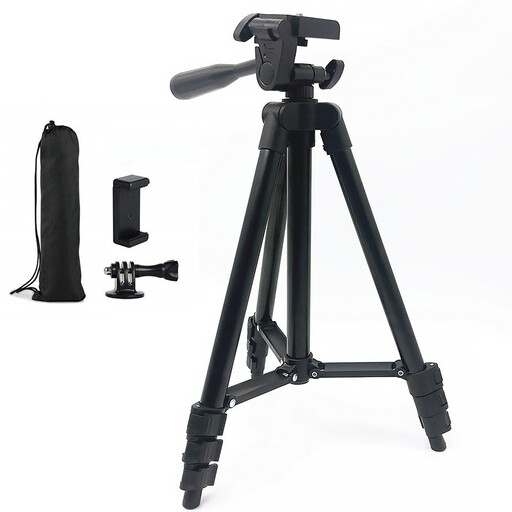
KINSI smartphone tripod with Bluetooth remote control

KINSI smartphone tripod with Bluetooth remote control

The product information lists remote control for Osmo Action 4, Osmo Action 5 Pro, Osmo 360 and Osmo Action 6; this doesn’t confirm compatibility with other camera models.

Shop at Joybuy

Frequently asked questions

Should I buy a remote shutter release first?

Not necessarily. First check whether your camera’s self-timer is enough. If you regularly take pictures from a tripod or want to trigger the shutter straight away, a compatible remote release could be more convenient; check which features your camera model offers.

How do I connect a wired remote release?

First check your full camera model and the corresponding connection. For example, Canon lists a 2.5 mm E3-type connection for the RS-80E3, while Sony describes a multi-terminal connection for the RM-VPR1. Follow your camera’s manual for connection and operation instructions.

Will a remote release automatically keep an entire mineral in focus and make the background white?

No. Nikon describes focus stacking as combining shots taken at different focus points. White balance affects how colours appear; check the exposure separately too, for example by using the histogram to spot lost highlight detail.

Who can help if a remote shutter release I buy in the Netherlands is faulty?

If a product is faulty, the seller must provide a solution. According to the Dutch Government, there is no fixed statutory guarantee period for all products; what you’re entitled to expect depends, among other things, on the product and the information provided at the time of sale. A manufacturer’s guarantee is in addition to your statutory rights.

What rules apply to wireless camera remote controls?

Radio equipment placed on the market in the Netherlands must meet European requirements, including those set out in the Radio Equipment Directive. The Dutch Authority for Digital Infrastructure states that manufacturers apply the CE marking to products that comply. A listing in an online shop does not, by itself, prove that a specific product meets these requirements.
