
Photographers using a tripod
If you photograph miniatures from a fixed position, taking the shot without touching the camera can help keep your setup undisturbed. Check whether your camera supports cable or wireless control.


First, check your exact camera model. A cable release is a straightforward option if the connection is right and the cable can be routed clear of your setup. Wireless control keeps a small table free, provided your camera supports that specific model. You could also try the self-timer or a compatible camera app first. Some cameras offer extra controls through an app, but a remote release alone won’t make a close-up completely sharp.
If you photograph miniatures from a fixed position, taking the shot without touching the camera can help keep your setup undisturbed. Check whether your camera supports cable or wireless control.
When your lighting, tripod and miniature already take up space, a cable can get in the way. A compatible wireless remote keeps the area between you and the camera clear.
If you want to assess small painted details or combine shots taken at different focus distances, check which app and focus features your camera offers. Canon Europe describes focus bracketing as a separate camera feature; a remote release does not replace it.
Choose this option: if your camera has the right connection and you can route the cable around your setup without it touching the miniature.
The trade-off: you won’t need a wireless connection, but you’ll need to check the port and whether an adapter is required.
Choose this option: if you want to keep the table clear and your exact camera supports the specific remote model.
The trade-off: you’ll need to check that pairing and any required camera settings are available.
Choose this option: if you want to try controlling the camera without buying a separate remote release.
The trade-off: app features vary by camera model, while a self-timer doesn’t offer the same remote control or image preview.
| What to consider | What should you check? | Who is this most relevant to? |
|---|---|---|
| Compatibility | Check the full camera model, connection or wireless support, and whether any adapters are needed. | If you first want to know whether the remote release will work with your camera, compatibility is the priority. Around 36% of consumers consider this their main concern. |
| Camera shake when taking a shot | Choose a release method supported by your camera, and also check the stability of your tripod and focus. | If you don’t want to touch the camera when taking a shot, focus on finding a suitable remote control. Around 29% of consumers prioritise this. |
| Space on the table | Think about where the cable, camera and your hand will go; if you’re using wireless control, check the pairing process too. | If there’s little room left once you’ve set up your miniature, tripod and lighting, you’ll want to make sure a cable doesn’t touch your setup. Around 21% of consumers are most concerned about the space they have to work in. |
| Extra camera controls | Check in advance which app and focus features your exact camera model supports. | If you also want to control the image or focus when capturing details, you’ll need more than just a shutter button. Around 14% of consumers prioritise these extra controls. |
A cable or wireless remote release from the same brand won’t necessarily work with every camera model. For example, Fujifilm lists an additional adapter for certain RR-100 combinations.
Before buying, look up your full camera model in the manufacturer’s compatibility information and check the connection and any adapter requirements.
Taking a shot remotely means you don’t have to press the button on the camera body, but it won’t automatically fix focusing or depth-of-field issues.
Check your setup is stable and that you’ve chosen the right focus point. For close-ups, see whether your camera supports focus bracketing.
If you buy from a seller based outside the Netherlands, you may also need to consider returns policies and delivery costs. ACM ConsuWijzer advises checking where the seller is based and what return costs apply.
Before paying, check who the seller is and which delivery and returns terms apply to your order.
Within its EOS system, Canon offers wired remote releases and control through Camera Connect for supported cameras.
Nikon offers the MC-DC2 cable and the ML-L7 Bluetooth remote for specific cameras, among other options.
The wired RR-100 is an option for camera models listed as compatible by Fujifilm.
The RMT-P1BT offers Bluetooth control for Sony cameras that support Bluetooth remote control.
These products are designed for use with compatible smartphones or the specified Osmo action cameras. They are not model-specific cable releases for mirrorless or DSLR cameras.
 No image available
A good fit if you use a compatible smartphone and want an extendable tripod setup with Bluetooth control.
The title lists a length of 170 cm, stainless steel construction, a 360° rotatable phone holder and support for smartphones from 4,7 to 6,0 inches.
 No image available
Suited to smartphone photography if you want to position your phone hands-free and control the camera remotely.
The title lists a foldable, height-adjustable tripod for use on a table or outdoors.
 No image available
Designed for remote control of the compatible Osmo cameras listed; check that your camera model is included.
The product title lists Osmo Action 4, Osmo Action 5 Pro, Osmo 360 and Osmo Action 6.
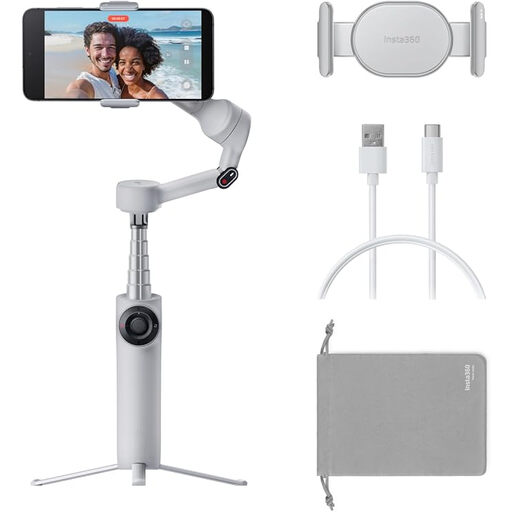 No image available
Suited to smartphone filming if you want to support your phone and use a second phone for remote control.
The product information lists a built-in tripod and selfie stick; a second phone can be used for preview and recording. Gesture control is also mentioned.
No. First check whether your camera has a useful self-timer or supports control through a compatible app. Some apps also offer image or focus control on certain camera models; available features vary by model.
Follow the instructions for your camera and remote combination. For compatible Sony Bluetooth remotes, Sony explains that Bluetooth and the camera’s Bluetooth remote control setting must be switched on, and the devices must be paired.
No, not on its own. Taking a shot remotely means you don’t have to touch the camera’s shutter button. For greater depth of field, Canon Europe discusses focus bracketing and combining shots taken at different focus distances.
When you buy online from a business, you generally have a legal cooling-off period of up to 14 days after delivery, subject to legal exceptions. ACM ConsuWijzer also explains that your statutory warranty applies alongside any manufacturer’s warranty if a product does not perform as you could reasonably expect under normal use.
Take spent batteries to a collection point, such as a shop that sells batteries, and don’t put them in general waste. For discarded electrical appliances, the Dutch Government lists options including collection points and the like-for-like take-back scheme for private purchases.