Who is this for?

Badge photographer with a fixed setup

You photograph small details on a tripod and want to operate the shutter without touching the camera body. It’s important to check that the connection is compatible and that the controls are easy to use. Canon and Nikon describe remote releases for compatible cameras and for tripod or macro photography.

Photographer who moves the lighting

You change position around the badge and lights while shooting, and want to avoid having a cable run across your workspace. Wireless control is only an option if your camera supports the relevant system; Nikon and Sony list compatibility by camera model.

Photographer shooting in sequences

You take repeated close-ups or use long exposures and need suitable features, such as a half-press or a lockable shutter button. Nikon describes these controls for the MC-DC3.

What should you look for?

Wired remote release

Choose this option: if you’re working from a fixed position and your camera has a compatible remote socket.

Bear in mind: the cable may restrict your movement or tug on the camera or tripod. Canon distinguishes between E3 and N3 connections; Nikon describes the MC-DC2 and MC-DC3 for different groups of cameras.

Wireless Bluetooth remote release

Choose this option: if you want to move around the badge and lights without a cable crossing your workspace, and the manufacturer confirms support for your camera model.

Bear in mind: wireless control isn’t universal. Check compatibility and how to pair the remote with your camera.

Camera app or self-timer

Choose this option: if your camera supports a suitable app, or you simply want to take a picture without touching the camera body. Canon describes Camera Connect for compatible cameras.

Bear in mind: an app requires a compatible camera and a connection. With a self-timer, you have less direct control over the exact moment the picture is taken.

What to consider What should you check? What matters to these shoppers?
Compatibility Check the full camera model, the compatibility list and, for a cable release, the connection and whether an adapter is needed. When I want to be sure a remote release will work with my camera, I check the model and connection before buying. Around 28% of shoppers make compatibility their top priority.
Taking pictures without touching the camera Compare a compatible remote release with your camera’s app or self-timer, and check that the rest of your setup is stable. When taking close-ups on a tripod, I don’t want to touch the camera as I take the picture and disturb the setup. Around 28% of shoppers put this first.
Freedom of movement Check that your camera supports the Bluetooth remote you’ve chosen and find out how to pair it. Also consider whether a cable would actually get in your way. When moving between the badge and lights while taking pictures, I don’t want to have to work around a cable. Around 17% of shoppers make freedom of movement their top priority.
Sequences or long exposures Check whether half-press, full-press and, if needed, a lock are available for your specific model. For repeated close-ups or long exposures, I want to operate the shutter in the way my shot requires. Around 16% of shoppers value this most.
Features you already have Try the supported app or self-timer first, then check whether you need a separate remote release or adapter for your camera. If my camera can already take pictures remotely, I don’t want to buy an accessory I don’t need. Around 11% of shoppers prioritise existing features and avoiding an unnecessary purchase.

Common buying mistakes

  • Assuming remote releases for the same camera brand are interchangeable

    A connection or feature that works with one model won’t necessarily work with another. For example, Canon distinguishes between E3 and N3 connections; manufacturers also specify model and adapter requirements.

    Check the full camera model and remote socket in the documentation for both the camera and the remote release. Also check whether you need an adapter.

  • Buying a wireless remote release without checking camera compatibility

    Wireless control doesn’t mean that every camera model can connect to it. For example, Nikon lists the ML-L7 for specific cameras.

    Check your camera’s full model name against the compatibility information before choosing a wireless remote release.

  • Expecting a remote release to fix poor lighting

    A remote release lets you operate the shutter without touching the camera body, but it won’t change how the light falls or remove reflections from a badge.

    Assess sharpness and lighting separately. Adjust the position of your artificial light if needed.

Brands to compare

Canon

Wired EOS remote releases with different connection types, useful if you know your camera model and remote socket.

  • Canon lists the RS-80E3 as suitable for compatible EOS cameras with a 2.5 mm E3 connection, and for macro and tripod photography.
  • E3 and N3 are different connection types, so check which one your camera uses.

Nikon

Offers wired remote releases and Bluetooth control for specific Nikon camera models.

  • Nikon says the MC-DC3 has a half-press function and a lock for features including bulb mode; the ML-L7 has separate buttons for shutter and video control.
  • The MC-DC2 is designed for certain DSLR cameras, while the MC-DC3 is for Nikon Z mirrorless cameras. Check your exact model.

Fujifilm

The wired RR-100 is suitable for supported X and GFX cameras.

  • Fujifilm lists an extension cable with a right-angle plug for a 2.5 mm connection.
  • Some of the camera models listed require a separate 2.5 mm to 3.5 mm adapter. Check whether your camera needs one.

Sony

The RMT-P1BT offers Bluetooth control for Sony cameras that support this remote.

  • Sony describes control via the camera’s built-in Bluetooth receiver, with no additional receiver required.
  • Check compatibility with your exact camera model.

Panasonic

LUMIX accessories with shutter controls; for the listed cameras, the DMW-SHGR2 combines controls with a grip and mini tripod.

  • Panasonic describes half-press and full-press functions, as well as the ability to disable sleep mode.
  • Compatibility may depend on the camera model and firmware. A grip isn’t automatically a substitute for a separate, stable macro tripod.

Joybuy products

These products are designed for smartphone photography with remote control and a tripod or gimbal setup. Before choosing, check which type of phone control and setup you need.
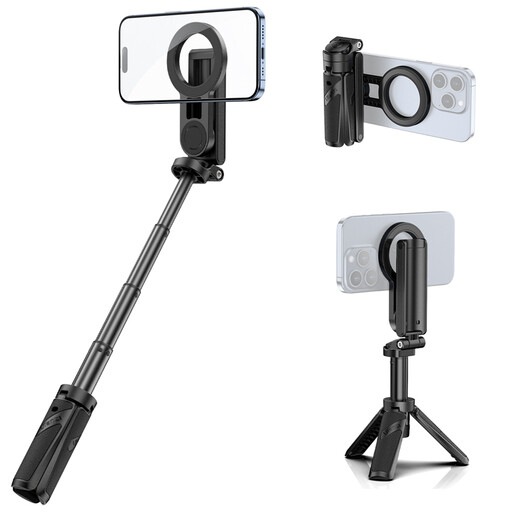
Ulanzi JJ03 3-in-1 Magnetic Tripod with selfie stick

Ulanzi JJ03 3-in-1 Magnetic Tripod with selfie stick

For smartphone photography when you want to control your phone remotely.

The product information lists compatibility with iPhone and Android, a Bluetooth remote control with a range of up to 10 m, and a built-in mini tripod.

The description also mentions 360° rotation and two cold-shoe mounts.

View at Joybuy

Ulanzi JJ02 Bluetooth selfie stick with tripod and remote control

Ulanzi JJ02 Bluetooth Selfie Stick with tripod

For smartphone photography when you want to control your phone remotely and need a tripod mode.

The product information lists iPhone and Android compatibility and a Bluetooth remote control with a range of up to 10 m.

The product information warns that the strong magnets should be kept away from pacemakers, defibrillators and other medical implants.

View at Joybuy
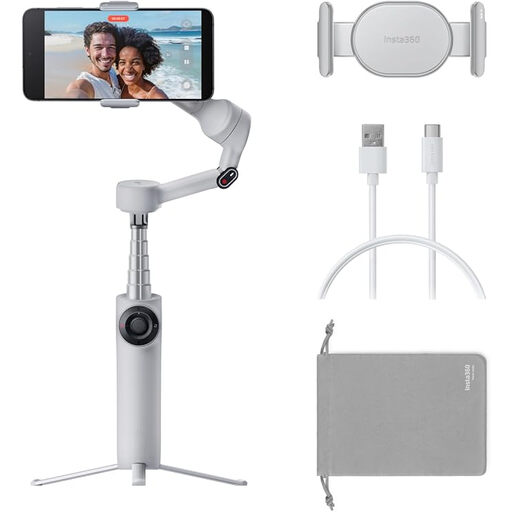
Insta360 Flow 2 Gray smartphone gimbal

Insta360 Flow 2 Gray smartphone gimbal

For smartphone photography when you want to use hands-free control or operate the gimbal via a second phone.

The product information describes a built-in tripod, plus control and preview via a second phone.

The description also mentions gesture control for taking a picture; this product is a smartphone gimbal.

View at Joybuy
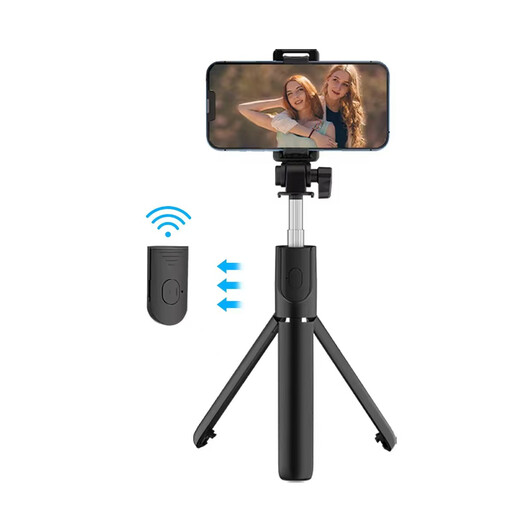
Verbex New K50 Black Remote Control Selfie Stick

Verbex New K50 Black Remote Control Selfie Stick

For smartphone photography when you want to control your phone remotely and use an extendable stand.

The product information lists iOS and Android compatibility, support for phones up to 6.0 inches, and a Bluetooth remote control with a range of around 10 m.

The description mentions an extendable stand for taking pictures with your phone.

View at Joybuy

Frequently asked questions

Do you always need to buy a remote control for photographing badges under artificial light?

No, not if your camera supports a suitable app or self-timer. Try taking a picture with one of these first, without touching the camera body. A remote release won’t change the position or quality of the light.

How can you stop a shutter release cable from disturbing your setup?

Route the cable so it won’t get pulled when you move the badge or lights, and check that the plug is compatible with your camera. Nikon describes the MC-DC3 as connecting to compatible cameras; other models may use a different type of connection.

Can a remote control remove shine or reflections from a metal badge?

No. A remote release operates the shutter without you touching the camera. Assess shine and reflections separately, and adjust the position or diffusion of the light if needed.

What are your options in the Netherlands if a remote release bought online isn’t suitable?

For online consumer purchases, you generally have a statutory cooling-off period of up to 14 days after delivery, with some exceptions, according to ACM ConsuWijzer. Your statutory guarantee is separate from any manufacturer’s warranty: if a product used normally doesn’t meet what you could reasonably expect, you can contact the seller.

Which product rules apply to a wireless remote release?

Radio equipment placed on the EU market is subject to the Radio Equipment Directive, the European directive for radio equipment. For a specific wireless product, check the relevant CE marking and product information; the directive does not apply on the same basis to every mechanical cable release.
