Start by checking your exact camera model: a remote shutter release must be compatible with your camera and, if it has a cable, with its connection. For a fixed tripod setup, a compatible cable may be all you need. Choose a wireless option if you want to trigger the shutter from a distance while arranging your scene, or first check whether a supported camera app can already do this. A remote release avoids touching the camera, but it won’t replace a stable setup or a separate focus check.
Who is this for?
Photographers using a fixed tripod setup
You’re photographing bowls from the same composition and want to take the shot without touching the camera. Check which type of connection your camera model uses; manufacturers such as Nikon, Canon and Fujifilm list compatibility by model.
Photographers who keep arranging the scene
You’re moving bowls or backgrounds around and want to trigger the shutter from elsewhere. A wireless remote is only an option if your specific camera supports it; Canon and Sony describe their features for compatible camera models.
Photographers who want to try a camera app first
You want to check whether your phone and camera already offer remote control before buying an accessory. Canon describes shutter control with Camera Connect for many, but not all, Canon cameras.
What should you look for when buying?
First, check compatibility with your exact camera model. Then decide whether your main priority is avoiding contact with a fixed setup, having more freedom to move around, or trying app control first.
| What to consider |
What should you check? |
Who is this important to? |
| Compatibility and connection |
Look up your full camera model in the manufacturer’s compatibility information. If you’re choosing a cable, check the plug and whether you need an adapter. |
When I buy a remote release, I want to be sure it works with my camera first. Around 36% of consumers make compatibility their top priority. |
| Taking the shot without touching the camera |
Check that the remote release controls your camera’s shutter and that you can use it from where you’re working. |
With a fixed composition, I want to take the shot without touching the camera. Around 29% of consumers prioritise triggering the shutter without disturbing the setup. |
| Freedom to move around |
Check support for your camera model, the pairing process and whether the stated range suits your workspace. |
If I want to stay by the bowls while arranging them, I don’t want to keep walking back to the camera. Around 21% of consumers put freedom to move around first. |
| App control |
Check the remote-control features for your exact camera model and try the supported app before buying a separate remote release. |
I want to check first whether my phone can already control the shutter. Around 14% of consumers do this before buying a separate remote release. |
Common buying mistakes
-
Choosing by camera brand instead of exact model
Compatibility and connection requirements vary between remote releases and camera models. Sharing a brand name doesn’t, by itself, prove that they’ll work together.
Before buying, check the full model name and, for a cable, the required plug and whether you need an adapter.
Some connections also require a separate adapter; for example, Fujifilm specifies one for the X-S10 and X-T200 when used with the RR-100.
-
Expecting a remote release to solve every focus issue
Taking the shot remotely avoids touching the camera body when you release the shutter, but it won’t guarantee a sharp image if the setup is unstable or the image is out of focus.
Set the camera up securely and check focus separately from your choice of remote release.
-
Confusing a phone selfie remote with a camera shutter release
A remote for a phone selfie stick doesn’t prove that it can operate the shutter of an interchangeable-lens camera.
Check the product details to see whether your intended camera model is actually supported.
Brands and their remote releases
Nikon
The MC-DC3 is a wired remote release for supported Nikon Z cameras; check compatibility with your exact model.
- Nikon describes a button that can be pressed halfway or fully, plus a lock to keep it pressed continuously.
- The connection and compatibility aren’t automatically suitable for every Nikon camera.
Canon
The BR-E1 is a wireless option for cameras on Canon’s compatibility list. Camera Connect is a separate option for supported models.
- Canon specifies Bluetooth control up to 5 metres and an AF start button for the BR-E1.
- These features apply to the BR-E1 and don’t prove that every Canon camera supports the remote or app.
Fujifilm
The RR-100 is a wired option for the X and GFX models listed by Fujifilm.
- Fujifilm lists a right-angle extension cable for the 2.5 mm plug as included.
- For the X-S10 and X-T200, Fujifilm specifies an adapter from another manufacturer; check your camera’s connection.
Sony
The RMT-P1BT is a wireless Bluetooth option for Sony cameras that support this model.
- Sony describes operation without requiring a line of sight and lists a status LED.
- These are Sony’s specifications for this model; they don’t confirm universal compatibility with Sony cameras.
Joybuy products for this photography setup
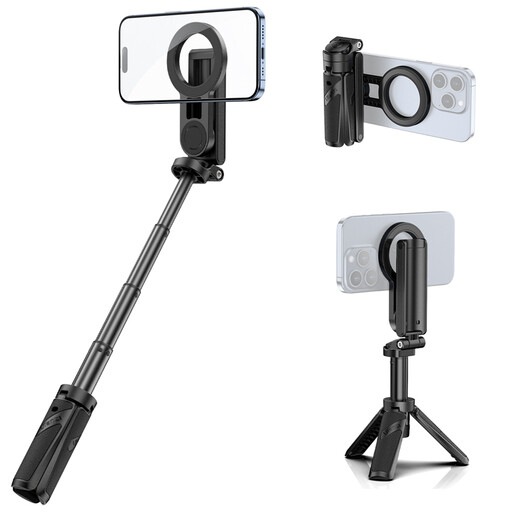
This product selection is a phone selfie stick with a tripod and remote; the information provided doesn’t confirm that the remote can trigger an interchangeable-lens camera.
 No image available
Ulanzi JJ03 3-in-1 Magnetic Tripod Selfie Stick with 10 m Remote Control
A phone selfie stick with a tripod and remote for taking photos with your phone; the product name doesn’t confirm control of a separate camera.
The product name lists a 360° rotating magnetic holder and a remote with a range of 10 m.
According to the product warning, the magnetic holder must be kept at least 15 cm away from pacemakers, defibrillators and other medical implants.
View at Joybuy
Frequently asked questions
Do I always need a separate remote release for photographing bowls in window light?
No, not if your camera supports control through an app. Canon describes shutter control with Camera Connect for many Canon cameras, but not every model; check your camera’s features before treating the app as an alternative.
How can I avoid choosing a wired remote release with the wrong plug?
Check your camera’s full model name and the type of remote-control port in the manufacturer’s information. Fujifilm lists a 2.5 mm plug for the RR-100 and specifies a separate 2.5-to-3.5 mm adapter for the X-S10 and X-T200.
What should I check if a wireless remote release doesn’t respond?
First check whether your camera model supports that specific remote, then follow the pairing and operating instructions for that combination. Sharing a brand name or using Bluetooth alone doesn’t prove that the camera and remote will work together.
Who can help if a remote release I bought online is faulty?
For a faulty product bought by a consumer in the Netherlands, the seller must provide a solution. Any manufacturer’s warranty doesn’t replace your statutory rights.
Can I return a remote release ordered online within 14 days?
For many distance purchases from a business, you have a 14-day cooling-off period. The Dutch Government lists exceptions and distinguishes these purchases from those made from a private seller; check which terms apply to your purchase.


