First, check that the remote release and its connection or wireless function are supported by your exact camera model. A wired release is handy when you’re working beside the tripod; a wireless remote gives you more freedom to move around if your camera supports it. For occasional shots, your camera app or self-timer may be enough. A remote release won’t correct colour casts or banding caused by artificial light, so check the white balance separately and, if banding appears, review your shutter settings.
Who is a camera remote for?
Photographer with an existing camera
You’re looking for a remote release that works with your exact camera model; a matching plug alone isn’t proof that it will. Check Fujifilm or Nikon’s compatibility information for your camera and the remote release in question.
Food photographer using a tripod
With a fixed composition, you may want to take the shot without touching the camera, especially if you’re taking more time to get it right. Canon Europe describes remote shooting as a way to avoid touching the camera when taking a picture.
Food stylist working around the table
You want to adjust the tart or the lighting, then take the picture from somewhere else. Check that your camera model supports your chosen wireless remote; Sony advises checking RMT-P1BT compatibility for each camera model.
What should you look for when choosing?
Start by checking compatibility with your camera. Then consider whether you mainly want to keep a fixed composition, move around the table or avoid buying a separate accessory.
Wired remote release
Best when: you’re working beside the tripod and your camera model supports the specific remote release and connection.
Bear in mind: the cable limits where you can stand around the table, and a matching plug size alone doesn’t guarantee it will work.
Wireless remote control
Best when: you want to step away from the camera while arranging or lighting the tart, and your camera supports your chosen remote.
Bear in mind: wireless doesn’t mean universally compatible. Sony’s stated range of around five metres depends on the conditions.
Camera app or self-timer
Best when: you occasionally photograph a fixed set-up and your camera already offers the control you need.
Bear in mind: features vary by camera model, so check that the controls are practical for the way you shoot.
| What to consider |
What should you check? |
Who is this important for? |
| Compatibility |
Check the exact camera model, the official compatibility information and, for a wired remote, what the connection is designed to do. |
If I’m looking for a remote release for my existing camera, I want to be sure it will work with my model. That’s why around 36% of consumers make compatibility their top priority. |
| Fixed composition |
Check that the remote release activates your camera’s shutter and, if it has a cable, that the cable is long enough for your set-up. |
When taking a picture of a tart on a tripod, I don’t want to touch the camera when I take the shot. Around 29% of consumers prioritise keeping a fixed composition. |
| Freedom to move |
Check that your camera supports your chosen wireless remote, and treat any stated range as dependent on conditions. |
If I want to step away from the camera while arranging or lighting the tart, it’s important to be able to take the shot from somewhere else. This is especially true for the around 21% of consumers who prioritise freedom of movement. |
| Built-in features |
First check which app controls or self-timer your camera model offers, and whether they suit the way you work. |
When I only take pictures occasionally, I first check whether my camera’s built-in controls are enough. Around 14% of consumers mainly want to avoid an extra accessory. |
Common pitfalls
-
Assuming a similar-looking connection means it’s compatible
Nikon says the MC-DC3 won’t work through a standard 3.5mm microphone input. For certain Fujifilm cameras, Fujifilm specifies a separate adapter for use with the RR-100.
Before buying, compare the official compatibility information, the function of the camera connection and any adapter requirements.
-
Buying a remote release to fix colour casts or banding caused by artificial light
A remote release operates the shutter from a distance, but it doesn’t control the white balance or how the camera captures flickering artificial light. Canon Europe warns that some fluorescent and LED lights can cause banding when using an electronic shutter.
Check a test shot for colour and banding. Check the white balance separately and, if you can see banding, review your shutter settings too.
-
Buying a separate remote without trying your camera’s built-in controls
For compatible cameras, Canon and Nikon describe control via an app or the self-timer; available features vary by model.
If you only occasionally take pictures from the same position, try your camera’s built-in features first. Choose a separate remote release if it solves a specific problem.
Brands to compare
Canon
For compatible EOS cameras, you could consider a wireless BR-E1 or control via Camera Connect, depending on your camera model and the way you work.
- Canon Europe describes taking pictures remotely without touching the camera.
- Not every Canon camera or camera function is automatically compatible with the BR-E1.
Fujifilm
The wired RR-100 is an option for cameras on Fujifilm’s compatibility list, including the X-T5.
- Fujifilm lists an L-shaped extension for the 2.5mm connection as included.
- The X-S10 and X-T200 mentioned require a separate 2.5mm-to-3.5mm adapter.
Nikon
Nikon describes the wired MC-DC3 and wireless ML-L7, among other options, for selected camera models.
- According to Nikon, the MC-DC3 supports a half-press for AE/AF and a full press to release the shutter.
- Nikon warns that the MC-DC3 won’t work through a standard 3.5mm microphone input; the ML-L7 only works with selected cameras.
Sony
The RMT-P1BT is a Bluetooth option for Sony cameras that support control with this remote.
- Sony lists a status indicator and operation without requiring a direct line of sight.
- Sony’s stated communication range of around five metres depends on the conditions; check that your camera model supports Bluetooth remote control.
Panasonic
The wired LUMIX DMW-RS2E may be an option for compatible LUMIX cameras; check support for your model.
- Panasonic lists half-press, full-press and lock controls, plus a connection cable and extension cable.
- These features and accessories don’t confirm that the DMW-RS2E works with every LUMIX camera.
Joybuy products
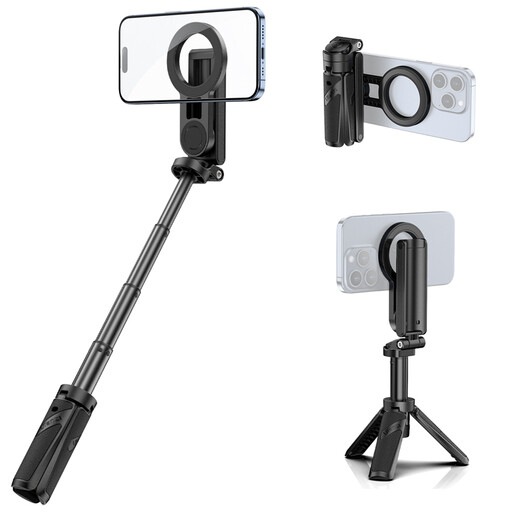
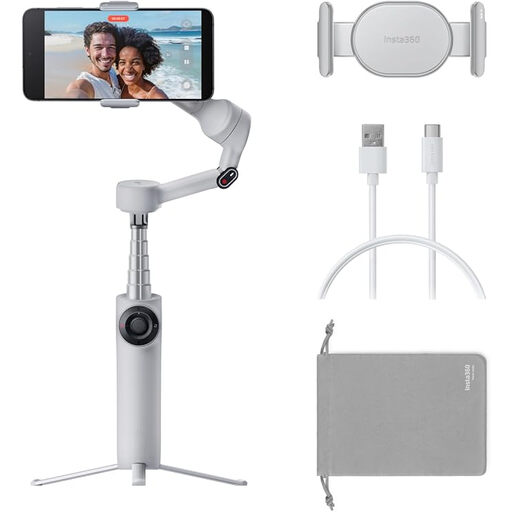
These options pair a smartphone set-up with remote control; they don’t confirm compatibility with any specific camera.
 No image available
Ulanzi JJ03 3-in-1 Magnetic Tripod
The product description mentions remote control for taking photos with a smartphone or camera; check whether your device is supported.
The product name lists a remote with a range of up to 10 m and a 360° rotating tripod.
Joybuy
 No image available
Ulanzi JJ02 Bluetooth Selfie Stick
This option is designed for a smartphone on a tripod with a separate Bluetooth remote release; the product description mentions iPhone and Android smartphones.
The product name lists an extendable mini tripod and dual cold shoe mounts.
Joybuy
 No image available
Insta360 Flow 2 Gray
This smartphone gimbal could suit a fixed phone set-up; the product description mentions control via a second phone and gestures.
The product description lists an integrated tripod. Check that the controls described suit the way you take pictures.
Joybuy
Frequently asked questions
Can I use any Bluetooth remote with my camera?
No, don’t assume that you can. Check that your exact camera model supports your chosen remote. Nikon and Sony describe their wireless remotes as suitable for selected or compatible cameras.
How can I make sure a wired remote release works?
Compare the compatibility information for your camera with the function of its connection and the requirements of the remote release. Nikon says the MC-DC3 won’t work through a standard 3.5mm microphone input; Fujifilm specifies that certain cameras require an adapter for the RR-100.
Will a remote control fix incorrect colours or banding under artificial light?
No. A remote release operates the shutter from a distance, but it won’t correct the white balance. Canon Europe says some fluorescent and LED lights can cause banding when using an electronic shutter, so check colour and shutter settings separately.
What are the returns and warranty rules for online purchases in the Netherlands?
According to the Dutch government, when buying at a distance you usually have a 14-day cooling-off period, although exceptions may apply. It also states that there is no fixed statutory warranty period covering all products in the Netherlands. Check which terms and conditions apply to your purchase.


