
Maker with a fixed photo setup
You photograph several flower arrangements from the same angle and don’t want to touch the camera when taking a shot. Canon UK highlights the importance of consistent composition in product photography.


For portfolio photos of dried flowers, a separate remote isn’t automatically necessary. If your setup is fixed, try the self-timer or an app that supports your camera model first. If you want to release the shutter straight away without touching the camera, choose a wired remote with the right connection or a wireless remote that works with your camera. A remote release is no substitute for a stable setup or precise focusing.
You photograph several flower arrangements from the same angle and don’t want to touch the camera when taking a shot. Canon UK highlights the importance of consistent composition in product photography.
You want to take a shot from your worktable while the camera stays at a distance. Check that your camera model supports the wireless remote you’re considering.
You want to see whether the self-timer or a compatible camera app will do the job before buying an accessory. The available app features may vary by camera model.
Choose this if: your camera is in a fixed position and you want to try shooting without an extra accessory first.
Bear in mind: a timer won’t release the shutter straight away, and app control and available features depend on your camera.
Choose this if: you’ll be staying by the tripod and the cable reaches your workspace.
Bear in mind: the cable limits your freedom of movement and needs to fit the connection; Canon, for example, distinguishes between E3 and N3.
Choose this if: you want to take a shot from your worktable while arranging flowers, and your camera supports the remote you’ve chosen.
Bear in mind: wireless systems vary. The Canon RC-6 uses infrared from the front of compatible cameras, while the Sony RMT-P1BT uses Bluetooth.
| What to consider | What should you check? | Who is this important for? |
|---|---|---|
| Compatibility | Compare the full camera model name with the stated compatibility. For a cable, also check the connection and whether an adapter is needed. | I want to be sure the remote will work with my camera before buying, including having the right plug. This is the top priority for around 36% of consumers. |
| Fixed framing | Check that you can operate the remote from your workspace without pulling on the tripod or disturbing the setup. | When photographing a series of flower arrangements, I want to keep the same framing and avoid touching the camera when taking a shot. Keeping the framing consistent is the top priority for around 29% of consumers. |
| Taking shots from your worktable | Check which camera models are supported, which wireless system is used and where you’ll be when you take the shot. | I want to rearrange flowers and take a shot from my worktable while the camera stays in place. Freedom of movement comes first for around 21% of consumers. |
| Existing features | Try the self-timer and check whether an app supports your camera model for the shot you want. | Before buying an accessory, I want to know whether the timer or a compatible app will do the job. Trying existing features first is the top priority for around 14% of consumers. |
Remote controls may depend on a specific camera connection or wireless support. A brand name alone doesn’t confirm that an accessory will work with your model.
Before ordering, check the full camera model name and the required connection or wireless link.
The adapter you need depends on the camera model. Fujifilm pages specify a separate 2.5 mm-to-3.5 mm adapter for some models.
Check the connection and adapter information for your exact camera before choosing the remote.
Some models may require a separate adapter.
The Canon RC-6 uses infrared from the front of compatible cameras, so you can’t necessarily use a wireless remote from every position.
Check how the specific model works against where you’ll be standing while taking photos.
Releasing the shutter without touching the camera can help prevent camera shake when taking a shot, but focusing and a stable setup still need attention. Precise focusing is important for close-ups.
Check your setup and take test shots before blaming the shutter release for blurring.
For supported EOS cameras, Canon offers wired E3 and N3 remotes, the RC-6 infrared remote for listed models, and Camera Connect for compatible cameras.
The MC-DC2 is a wired option for certain Nikon DSLRs, while the ML-L7 uses Bluetooth with specific Nikon cameras.
Sony offers the wired RM-VPR1, the wireless RMT-P1BT for compatible cameras, and app control for supported models.
The RR-100 is a wired option for certain cameras in the X and GFX series.
The LUMIX DMW-SHGR2 combines a mini tripod grip
This selection includes a Bluetooth remote for the listed Osmo models and a Fossibot FC360 action camera with a Bluetooth remote. Check that the product suits your camera and portfolio setup.
 No image available
Only relevant if you use one of the listed Osmo models and want to release the shutter remotely.
Bluetooth control; the product name lists compatibility with Osmo Action 4, Osmo Action 5 Pro, Osmo 360 and Osmo Action 6.
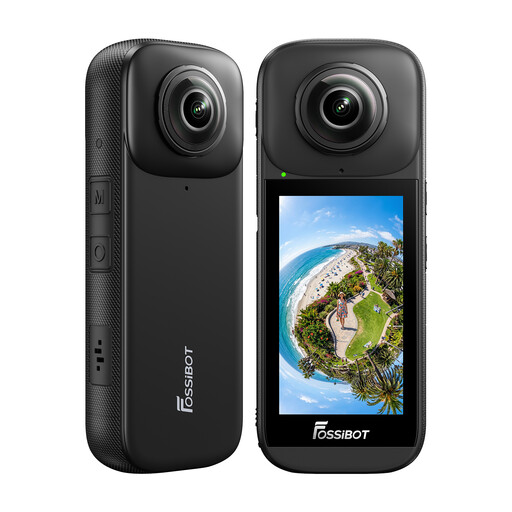 No image available
This is an action camera with a Bluetooth remote, not just a separate shutter release. Consider whether the camera itself suits your portfolio setup too.
The product name lists 6 GB built-in RAM, 8K video at 10 fps and IP68 water resistance.
Not necessarily. First, try the self-timer or an app that supports your camera model. A separate remote can be useful if you want to take a shot straight away without touching the camera, or work from another position.
First, look up the full camera model name, then check which connection the manufacturer specifies for that model. Canon distinguishes between E3 and N3; for some Fujifilm cameras, you should also check whether an adapter is needed.
First, check that your camera model supports the specific remote, then check the connection and your position when using it. The Canon RC-6 uses infrared from the front of compatible cameras; the Sony RMT-P1BT uses Bluetooth, and its range may vary depending on the conditions.
When you buy as a consumer, you’re entitled to a product that works as it should; according to the Dutch government, the seller must provide a solution if there’s a fault. The Netherlands has no fixed statutory warranty period. For many online purchases from a business, you have a 14-day cooling-off period, although terms and exceptions may apply.