Start with the smallest detail you want to photograph. For whole products, a compact camera or mirrorless camera with a kit lens may be enough, while fine veins or seeds call for a stated magnification and possibly a dedicated macro lens. For a cohesive portfolio, consistent lighting, white balance and camera positioning matter too. So always check the lens and what’s included in the kit, not just the camera body.
Who is this guide for?
Detail photographer
You want to capture veins, peel or small ingredients in close-up. Compare the magnification of the exact lens and check which focus mode it applies to. Canon Netherlands and Nikon Netherlands explain the role of magnification in macro photography.
Photographer creating a cohesive portfolio
You photograph products on different days and want to manage the effects of changing window light and camera position. Canon Netherlands points out that the direction of the window, the time of day and the weather all affect the light.
Beginner with a simple setup
You want to photograph whole products and a few close-ups without buying several lenses straight away. Pay attention to framing, ease of use and exactly what’s included in the kit. When choosing a camera, the Consumers’ Association also highlights factors such as ease of use, size and zoom range.
What should you look for when choosing?
| What to consider |
What should you check? |
Who is this important for? |
| Capturing small details |
Compare the maximum magnification of the exact lens and the focus mode required to achieve it. |
If tiny veins or seeds are your main subject, you’ll want to know how large they’ll appear in the frame. Around 33% of consumers rank capturing detail as their top priority. |
| Consistent portfolio images |
Check the exposure and white balance settings, and whether you can use the camera in a fixed position. |
If you photograph products on different days, you’ll want to reproduce the lighting, colours and setup as closely as possible. Around 27% of consumers prioritise consistency across their portfolio. |
| Framing whole products |
Try out the framing you want and check the focusing distance at the zoom setting you plan to use. |
If you want to show whole products or arrangements, your preferred composition needs to fit your workspace. Around 20% of consumers prioritise an overall view and framing. |
| Getting started easily |
Check whether you’re buying a fixed-lens camera or a camera body with a lens, and review exactly what’s included in the kit. |
If you want to start with a straightforward setup, you’ll want to know in advance which lens is actually included. Around 20% of consumers prioritise simplicity and a complete setup. |
Common buying mistakes
-
Focusing only on the minimum focusing distance
A short focusing distance alone doesn’t tell you how large the subject will appear in the photo. Panasonic lists AF macro from 3 cm at the wide-angle end for the LUMIX DC-TZ99, and 200 cm at the telephoto end.
Compare both the magnification and the focusing distance at the zoom setting and framing you actually plan to use.
-
Mistaking a mirrorless camera body for a complete macro kit
The Nikon Z50II kit with zoom lenses doesn’t include the separate NIKKOR Z MC 50mm f/2.8, for which Nikon specifies 1:1 magnification.
Check what’s included in the kit, then decide whether you’ll need a suitable macro lens to capture the details you want.
-
Expecting macro mode to deliver a consistent series
Window light changes with the direction, time of day and weather. At high magnification, the depth of field is also narrow, so small changes in focus have a greater effect.
As well as choosing a camera, plan a repeatable lighting setup and a fixed position for both the camera and product.
Brands to consider
Canon
The EOS R50 with an RF-S kit zoom is an option if you want to start with an interchangeable lens.
- Canon lists maximum magnification of 0,25× for the RF-S 18-45mm in MF mode.
- That lens specification isn’t a 1:1 macro specification, so check whether the magnification is suitable for your smallest subject.
Nikon
A Z-system camera can be used with zoom lenses, and also gives you the option of choosing a separate Z macro lens.
- Nikon specifies 1:1 magnification for the separate NIKKOR Z MC 50mm f/2.8 lens.
- This macro lens isn’t included in the Z50II zoom kit mentioned; depth of field is narrow at high magnification.
Panasonic
The LUMIX DC-TZ99 is a compact camera with a fixed lens, for anyone who doesn’t want to change lenses.
- Panasonic lists AF macro from 3 cm in wide-angle mode.
- At the telephoto end, Panasonic lists 200 cm, so the short wide-angle focusing distance doesn’t apply across the entire zoom range.
Sony
The ZV-E10 II lens kit is an interchangeable-lens option if you’re also considering making videos as well as taking photos.
- Sony lists the E PZ 16-50 mm F3.5-5.6 OSS II as the kit lens.
- Sony specifies maximum magnification of 0,215× for this lens. Don’t mistake the kit zoom for a dedicated macro lens.
Apple
A compatible iPhone could be a way to try things out if you want to start by using the equipment you already own.
- Apple describes macro photography using the Ultra Wide camera on supported iPhone models.
- Check that your own model supports the feature and try it out to see whether the framing suits your portfolio.
Cameras at Joybuy
Explore these cameras as possible options for product and portfolio photography. For each model, check its close-up capabilities and the specifications that matter for your setup.
 No image available
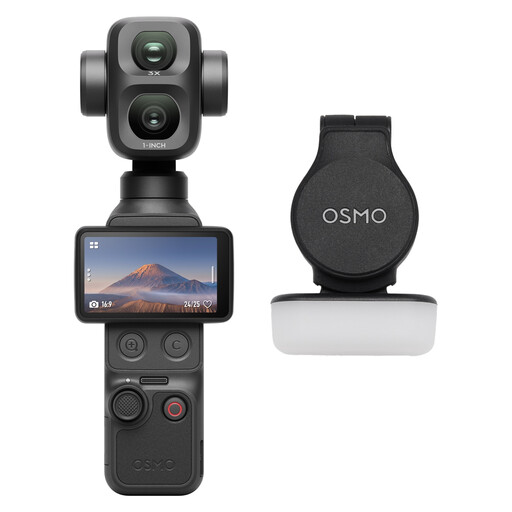
Osmo Pocket 4P Standard Combo, black
Worth considering if you’re looking for a compact camera setup. Check in advance that its close-up capabilities are suitable for your smallest subjects.
View at Joybuy
 No image available
KOMERY G7-A 4K camera, 80 MP, 18× zoom, pink
The listed zoom may be useful if you want to switch between wider product shots and other compositions. Check the focusing capabilities for small details.
The product name lists 4K, 80 MP and 18× zoom.
View at Joybuy
 No image available
KOMERY G7 5K camera, 80 MP, 18× zoom, white
The listed zoom may be useful if you want to switch between wider product shots and other compositions. Check the focusing capabilities for small details.
The product name lists 5K video, 80 MP and 18× zoom.
View at Joybuy
 No image available
DJI Osmo Pocket 3
Worth considering if you’re looking for a compact camera setup. Check in advance that its close-up capabilities are suitable for your smallest subjects.
The product name lists a 1-inch CMOS sensor, 4K/120fps video, 3-axis stabilisation and a rotatable 2-inch touchscreen.
View at Joybuy
 No image available
Songdian Pocket Camera, 4K, 44 MP, 16× zoom, pink
The listed zoom may be useful if you want to switch between wider product shots and other compositions. Check the focusing capabilities for small details.
The product name lists 4K, 44 MP and 16× zoom.
View at Joybuy
Frequently asked questions
Do I need a 1:1 macro lens for every seasonal product?
No, it depends on how large you need the smallest detail to appear in the frame. Canon lists maximum magnification of 0,25× in MF mode for the RF-S 18-45mm; Nikon specifies 1:1 for the separate NIKKOR Z MC 50mm f/2.8 lens. That magnification is most relevant when you want small structures to fill the frame.
How can you create a series of photos with a similar look?
Where possible, use the same position for the camera and product, and pay attention to the light at each session. Canon Netherlands explains how the direction of the window, the time of day and the weather affect natural light. A stable setup is also important at high magnification.
What should you check is included in the kit?
Check whether you’re buying a camera body, a kit with a lens or a fixed-lens camera. For example, the NIKKOR Z MC 50mm f/2.8 isn’t included in the Nikon Z50II zoom kit mentioned. Also consider what other equipment you’ll need for your own setup.
What are your rights when buying a camera online as a consumer in the Netherlands?
According to ACM ConsuWijzer, online purchases generally come with a cooling-off period of up to 14 days after delivery; exceptions and conditions may vary from one purchase to another. You’re also covered by the statutory guarantee if a product doesn’t do what you could reasonably expect it to under normal use. This is not the same as the manufacturer’s warranty alone.


