Who is this choice relevant to?

Photographer of fine details

You want to capture engravings, hands or individual components in sharp, enlarged detail. Lens magnification and, where needed, a series of shots taken at different focus distances both help determine which set-up is right for you. Nikon and Sony specify 1:1 magnification for the macro lenses discussed here.

Pocket watch seller

You want to show the whole watch clearly against a dark background. Consider how visible the details are and how light reflects off the dial, case and glass. Adobe highlights the importance of paying attention to product details in product photography.

Photographer with minimal extra equipment

You want to take close-ups without immediately having to put together a camera body and separate macro lens. So compare a camera’s built-in close-up capability with the framing you need at your preferred shooting distance. OM SYSTEM lists a Microscope mode for the TG-7.

What should you look for when choosing?

Start with the framing you want: a shot of the whole watch calls for something different from a full-frame engraving. Then consider the lighting set-up, focusing method and how much extra equipment you want to use.

What to consider What should you check? Who is this important for?
Magnifying small details Check the maximum magnification of the exact lens, its compatible mount and the framing you can achieve from a distance that allows you to light the watch. If I want to show engravings or small watch movement parts enlarged, lens magnification comes first; around 36% of consumers give detail magnification top priority.
Light and reflections Consider whether you can control the lighting, and test the position and spread of the light with the watch you plan to photograph. If I want to keep the dial and case clear against a dark background, I focus on light and reflections; around 29% of consumers put these first.
Keeping the watch in focus Check whether the chosen camera mode takes a series of shots, combines them, or does both. If I want both the dial and parts at different distances to be in focus, the focusing method is crucial; around 21% of consumers prioritise depth of field.
Size of the set-up Check exactly what’s included in the kit and which lens, lighting or stable support you need for your chosen framing. If I want to carry or buy as few separate items as possible, I compare a fixed-lens camera with a mirrorless camera and separate lens; around 14% of consumers prioritise a minimal set-up.

Common pitfalls

  • Assuming a kit zoom is a full-fledged macro lens

    Maximum magnification depends on the specific lens and setting. Canon lists a maximum of 0.26× at 45 mm with manual focusing for the RF-S 18-45mm; Nikon specifies 1:1 for the separate NIKKOR Z MC 50mm f/2.8.

    Compare the magnification of the lens actually included in the kit with the framing you need. You may need a separate macro lens to capture small details across the whole frame.

  • Replacing the camera alone to solve reflections

    In a dark product photo, both the watch and the background need to remain clear. The position and spread of the light also affect how the case and glass catch the light.

    Test the position and spread of the light with the actual watch before choosing a camera to address this issue. Canon describes light modifiers such as an umbrella or softbox for softening and spreading light.

  • Confusing focus shift with an automatically combined photo

    The Nikon Z50II manual describes focus shift as a series of shots that can be combined later. For the EOS R50, Canon describes an Advanced A+ mode that takes shots and applies depth compositing in the camera.

    Check whether each camera mode simply captures a series or also combines the final photo. With a series, you may need to combine the images afterwards.

Camera brands to consider

Canon

The EOS R50 is an APS-C mirrorless camera worth considering if you want to start with a kit zoom and explore close-up photography later.

  • Canon specifies 24.2 megapixels and describes automatic depth compositing in Advanced A+.
  • For the RF-S 18-45mm, Canon lists a maximum of 0.26× at 45 mm with manual focusing. That’s not the same as 1:1 magnification.

Nikon

The Z50II is a mirrorless camera option for anyone who wants to choose a NIKKOR Z macro lens separately.

  • Nikon specifies 1:1 magnification for the NIKKOR Z MC 50mm f/2.8.
  • The Z50II manual describes focus shift as a series of shots for combining later; the camera model name doesn’t mean the macro lens is included.

Sony

The α6400 is an APS-C camera with an E-mount. Sony also offers the separate E 30mm F3.5 Macro.

  • Sony specifies 1:1 magnification for the E 30mm F3.5 Macro. For the α6400 variant reviewed, Sony lists approximately 24.2 effective megapixels and RAW.
  • Check the exact kit: a standard zoom isn’t automatically the macro lens mentioned above.

OM SYSTEM

The Tough TG-7 is a fixed-lens alternative for anyone who wants to use a close-up mode without choosing a separate lens.

  • OM SYSTEM lists a Microscope mode, RAW shooting and a 12MP sensor for the TG-7.
  • A fixed lens doesn’t offer the same choice of lenses as a mirrorless camera. So check the framing and lighting at the distance you plan to use.

Cameras available on Joybuy

Joybuy product picks relevant to pocket watch photography.
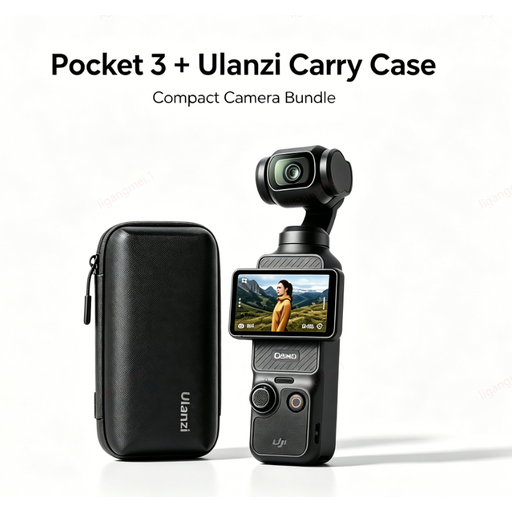
DJI Pocket 3 camera with Ulanzi storage case

DJI Pocket 3 camera with Ulanzi storage case

Before choosing this camera for small details, check that it can capture the close-up framing you need for a pocket watch.

The product name mentions a Ulanzi storage case.

Joybuy

Frequently asked questions

Do I need a 1:1 macro lens for every pocket watch detail?

No, it depends on the framing you want. Canon lists a maximum of 0.26× at 45 mm with manual focusing for the RF-S 18-45mm; Nikon and Sony specify 1:1 for the separate macro lenses discussed here.

How can I get more of the watch in focus?

Keep the camera and watch still, and compare a single shot with a series taken at different focus distances. The Nikon Z50II can use focus shift to create a series for combining later; for the EOS R50, Canon describes automatic in-camera depth compositing with Advanced A+.

What should I check when taking a series of product photos?

Before each series, check that the watch, background and camera position remain the same; any movement can make it harder to combine focus-stacked shots. Also check the reflections again if you change the lighting or camera position.

What are my rights when I buy a camera online?

According to the Dutch government, eligible consumer distance purchases often come with a 14-day cooling-off period, although there are exceptions. In the Netherlands, the statutory guarantee means you’re entitled to a product that works as it should; there is no fixed statutory guarantee period. If there’s a fault, contact the seller.

Can I use another seller’s photo in my listing?

Not without permission. According to the Dutch government, you can only use other people’s copyrighted photos for publication with the creator’s permission; using them privately is different.
