
Teacher giving demonstrations
You’re recording a lesson in which both your explanation and the camera controls need to be visible. Framing, focus and control over the light are important considerations.


For a recorded photography lesson where you switch between showing yourself and camera details, a mirrorless camera with a lens suited to your working distance is a sensible starting point. Test the focus, framing and audio in your own setup. A webcam may be more practical for a lesson delivered from a computer, while a camcorder offers built-in optical zoom and a gimbal camera suits demonstrations on the move. None of these camera options controls changing window light or automatically makes small details easy to see.
You’re recording a lesson in which both your explanation and the camera controls need to be visible. Framing, focus and control over the light are important considerations.
You’re in front of the camera without an operator and want to record and monitor your voice during longer sections of the lesson.
You teach using a computer and want to switch between showing yourself and demonstrating something on your desk.
Choose this option if: you’re filming solo and want to show both yourself and the camera controls from different distances.
The trade-off: the lens and your working distance both affect the angle of view; you may also need a stable mount or an external microphone.
Choose this option if: you want to frame yourself and a demonstration from one fixed position without changing lenses.
The trade-off: a wide zoom range doesn’t guarantee that small buttons or displays will look sharp and legible from your distance.
Choose this option if: you teach directly from a computer and sometimes want to show your desk.
The trade-off: check in your teaching software whether the selected tilt gives you the right framing; a desk-view mode doesn’t automatically provide a full overhead view.
Choose this option if: you want to film additional demonstrations while walking or shooting handheld.
The trade-off: for a fixed teaching setup, you’ll still need to check whether the lens can focus close enough and show details at a suitable size.
In natural window light, a test recording and the camera’s actual angle are more important than any single specification.
| What to consider | What to check | Who it matters to |
|---|---|---|
| Exposure and colour | Make a test recording in the window light you’ll be teaching in, and check whether you can adjust the exposure and white balance. | When the daylight changes, I want to check that both the teacher and subject remain clearly visible, and that colours don’t shift unexpectedly. That’s why around 33% of consumers give exposure and colour top priority. |
| Focus and framing | Test from your actual camera position to see whether your face, hands and relevant camera details fit together in the frame or need separate shots. | When I explain how to operate a camera, learners need to be able to make out what I’m doing without me or my hands disappearing from the frame. Around 27% of consumers prioritise sharp, well-framed demonstrations. |
| Speech and recording time | Check where a microphone can go, whether you can monitor the audio, and whether the power supply and storage are sufficient for a test recording of the right length. | When I film a lesson on my own, I want to remain easy to hear when I turn around and avoid having to stop halfway through a lesson section. Around 20% of consumers give audio and longer recordings top priority. |
| Computer-based workflow | Decide whether you’ll teach live using a computer, then test the connection, recording app and camera angle. | If I also want to show my desk during an online lesson, I want to switch between my face and the work surface without a complicated setup. Around 20% of consumers choose a camera primarily for a computer-based teaching workflow. |
Resolution doesn’t tell you whether the camera can achieve the framing and focus you want from your working distance. A wide shot can make demonstration details look small.
Before you choose, test the same camera controls and actions you plan to show in your lesson, from the position where you’ll actually set up the camera.
If details still look too small, you may need a different lens or a modified filming setup.
Camera specifications alone don’t determine your angle of view, sound quality or recording time.
Check exactly what’s included with each kit, then make a test recording with your intended lens, audio equipment and recording settings.
Depending on the kit and setup, you may also need a lens, microphone, mount, storage or power supply.
Logitech describes Show Mode for the MX Brio as a way to show desk work by tilting the webcam downwards. That won’t automatically determine which parts of your work surface are visible.
Check with your teaching software that the relevant buttons, hands and work area are all in view.
The Joybuy product listing is for a ZV-E10 with a 16–50 mm kit lens; Sony describes the ZV-E10 II as a separate model.
Check the full model name and kit contents before matching specifications to a camera.
The EOS R50 V is a video-focused mirrorless camera for lesson recordings, external audio and potential use as a webcam.
The ZV-E10 II is a video-focused APS-C mirrorless camera for lesson creators who want to use different angles of view with E-mount lenses.
The Z 30 is a mirrorless camera for solo filming, with a choice of lenses.
The HC-VX3 is a camcorder for a fixed setup where built-in optical zoom is important.
The MX Brio is a webcam for computer-based lessons where you sometimes show work on your desk.
The Osmo Pocket 3 is a compact gimbal camera for additional demonstrations on the move.
This selection includes compact gimbal cameras, a webcam for computer-based lessons and a mirrorless camera with a kit lens. The right option for you depends on your setup, the camera angle you want and the details you need to show.
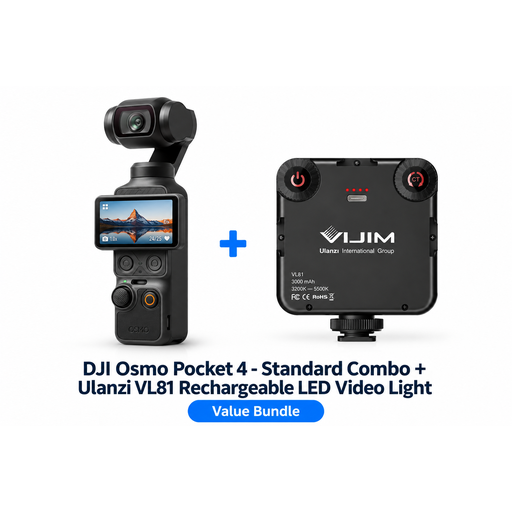 Image unavailable
A handheld gimbal camera paired with an adjustable fill light could suit demonstrations on the move.
The product description lists an adjustable colour temperature of 3200 K to 5500 K for the Ulanzi light.
 Image unavailable
This compact camera could suit solo filming on the move; check whether its fixed lens shows the demonstration details clearly from your working distance.
The product title lists a 1-inch CMOS sensor, 4K/120fps and 3-axis stabilisation. The bundle name mentions a microphone.
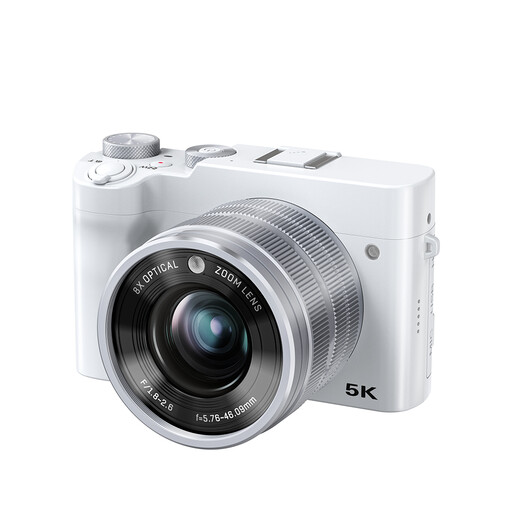 Image unavailable
The listed zoom could be useful if you want to frame your shot from a fixed position; test whether camera details remain legible in the final framing.
The product description lists 8× optical zoom, autofocus and manual focus, plus video up to 5K at 25 fps.
 Image unavailable
This webcam could suit a computer-based lesson where you also want to show work on your desk; check the framing in the software you use.
The product title lists a 4K webcam for PC and Mac with a 1/2-inch sensor. The product description mentions DeskView, Whiteboard Mode and Auto Framing.
 Image unavailable
A mirrorless camera with a kit lens could suit you if you want to switch between showing yourself and a demonstration; assess the angle of view from your own camera position.
This is the Sony ZV-E10 with a 16–50 mm lens, not the ZV-E10 II. The product description mentions 4K video and a vari-angle screen. According to the description, a memory card and adapter/charger are not included.
No. Start by checking whether the camera controls you show are legible in the final framing, and whether the exposure, focus and speech sound right. The manufacturers consulted offer 4K models, but resolution alone doesn’t prove that small details will appear clearly in the frame.
Make a test recording in the window light you’ll be using for your lesson and check the white balance as the light changes. Canon describes white balance as a way to control colours under different light sources; the right setting depends on your setup.
Beforehand, test the recording settings, available storage, power supply and audio with a recording that’s as long as the lesson you’re planning. Nikon specifies a maximum continuous recording time of 125 minutes for the Z 30; that model specification isn’t a general recording time for other cameras or conditions.
According to ACM ConsuWijzer, online purchases generally come with a statutory cooling-off period that ends 14 days after delivery, although there are exceptions. You’re also entitled to a product that meets what you could reasonably expect from it under normal use; a manufacturer’s warranty doesn’t replace these statutory rights.
Not without an applicable legal basis under the GDPR. The Dutch Data Protection Authority states that professional or commercial filming and publication of recognisable people requires a legal basis, such as consent. For a school filming and publishing footage of recognisable pupils, the regulator describes additional consent rules: pupils aged 16 or over give consent themselves; for pupils under 16, consent from their parents is required.