
Maker with limited shooting space
Wants to fit a whole jar and its background into the frame without moving the small table. Measure how much room you have for the camera beforehand.


First, measure how far you can position the camera from the jar and decide whether you mainly want to photograph the whole jar or capture small details. A compact camera keeps your set-up simple; a mirrorless camera gives you more choice of lenses, but make sure you consider the lens you’ll actually use. Soft lighting and a stable camera set-up remain important for close-ups of reflective glass.
Wants to fit a whole jar and its background into the frame without moving the small table. Measure how much room you have for the camera beforehand.
For example, wants to capture the texture of the contents or small details on their own. The lens and the distance between the lens and the jar are important considerations.
Wants to photograph several jars in similar lighting, so also considers a fixed camera position and manageable exposure.
| What to consider | What should you look for? | Who is this important for? |
|---|---|---|
| Fitting the whole jar in the frame | Measure the available distance for the camera and compare the lens’s angle of view or zoom setting. If possible, try framing the jar with its background. | If I want to photograph the whole jar with some space around it on a small table, framing is my first concern; around 36% of consumers say this is their main consideration. |
| Capturing small details clearly | Check the focusing distance, zoom setting and where that distance is measured from. Also check the magnification of the exact lens. | If I want to show the contents, texture or a label close up, I focus on detail reproduction; around 29% of consumers put this first. |
| Lighting and reflections | Check whether you can adjust focus and exposure. Leave some space beside the jar so you can soften or reposition the light. | When I want to present glass jars in similar lighting, control over the light and a stable set-up matter a great deal; around 21% of consumers name this as their main concern. |
| Keeping the complete set-up simple | Check which lens actually comes with the camera and whether it’s suitable for the details you want to capture. Only count the accessories you really need. | If I want to get started with as few separate pieces as possible and am happy to accept fewer upgrade options, simplicity is decisive; around 14% of consumers give this top priority. |
The closest focusing distance can vary depending on the zoom setting. Canon lists 5 cm at the wide-angle end and 40 cm at the telephoto end for the PowerShot G7 X Mark III; Sony gives approximately 8 cm at the wide-angle end and approximately 100 cm at the telephoto end for the RX100 VII.
Check the distance for the zoom setting you want to use, and see whether it’s measured from the front of the lens.
Canon lists 0.25× magnification for the RF-S 18-45mm when using manual focus. Nikon specifies a maximum of 0.67× for the separate Z DX MC 35mm f/1.7 lens; these specifications refer to different lenses.
Compare the magnification of the lens you’re actually buying with the smallest details you want to capture.
The direction and softness of the light, as well as the stability of your set-up, also play a part in food photography.
First, try a fixed camera position and lighting you can control. Then decide which camera feature, if any, you still need.
Worth considering if you’re looking at a compact camera with a fixed zoom lens, or a mirrorless camera with interchangeable RF or RF-S lenses.
Worth considering for a mirrorless camera set-up with a separate macro lens, such as pairing the Z50II with the NIKKOR Z DX MC 35mm f/1.7.
Worth considering if you’re looking at a compact camera with a built-in zoom lens, for example for a set-up where a wider zoom range could also be useful.
Below are camera options at Joybuy that could suit photographing homemade preserves on a small table. Check whether the stated features of each model match the shots you want to take.
 No image available
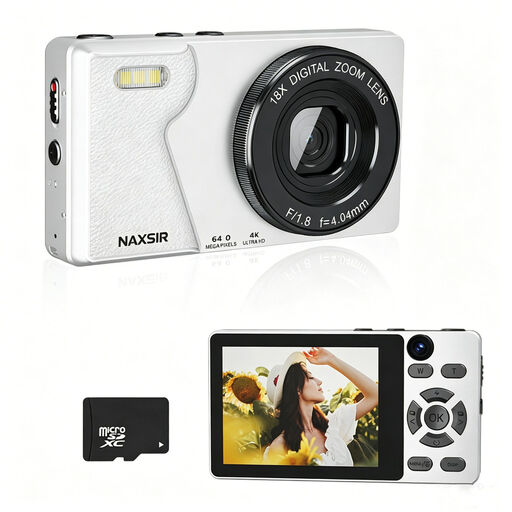
If you’re looking for a compact camera set-up, the product name lists autofocus and digital zoom; check whether these let you frame and focus on your jar from the distance you want.
The product name lists 4K Ultra HD, 64 MP photo resolution, 18x digital zoom, autofocus and a 32 GB memory card.
 No image available
If you’re looking for a portable point-and-shoot camera, the product name lists a zoom function; take a test shot to see whether the jar fits nicely in the frame from your table.
The product name lists 5K, 80 MP, 18X zoom and a white finish.
 No image available
If you want to vary the framing, the product name lists 12X optical zoom; check that the lens can focus on your jar from the distance you need at the setting you want to use.
The product name lists 12X optical zoom, 4K, 64 MP and Wi-Fi.
 No image available
If you want to make videos as well as photograph jars, the product name lists vlogging features; consider whether this camera suits the way you work with still images.
The product name lists a 1-inch CMOS sensor, 4K/120fps video, 3-axis stabilisation, tracking and an included microphone.
 No image available
If you’re considering a pocket camera, the product name lists zoom; take a test shot to see whether the jar fits in the frame from the distance you have available.
The product name lists 4K, 44 MP and 16X zoom.
Measure how far away you can position the camera, then try the zoom setting you want from that spot, with the jar and background in place. The focal length partly determines what fits in the frame; the minimum focusing distance tells you how close the camera can be and still focus.
Not just because of reflections: first try setting up the jar and camera securely, and softening or repositioning the available light. Articles from Canon Nederland and Nikon Nederland describe lighting choices and a stable position as aspects of food photography; this doesn’t guarantee a specific result.
Check which lens actually comes in the box and whether you need a separate lens for the details you want to capture. The Canon EOS R50 kit is described as coming with an RF-S 18-45mm; the Nikon macro option mentioned uses a separate lens.
When you buy from a business at a distance, you generally have 14 days to change your mind; the Dutch government points out that conditions and exceptions may apply. In the Netherlands, the seller is your point of contact if a product is faulty and you need a solution; there is no fixed general statutory warranty period of two years.
Not without permission. According to the Dutch government, you need the creator’s permission to use someone else’s copyright-protected photos; a photo for personal use can’t simply be shared or published. For publication, it’s best to take your own photos or get permission.