
Repair detail filmmaker
You film screws, connectors and other small tasks, and want to check focus and exposure while recording.


When filming small repair details up close, look for focus-assist tools and an HDMI signal that’s compatible with your camera. A larger screen can be more convenient for viewing from your workbench. If you also want to view or record the footage on a computer, you’ll need a suitable HDMI capture solution as well as the camera: a camera monitor alone won’t handle this step. Always check the capabilities of your exact camera and chosen product.
You film screws, connectors and other small tasks, and want to check focus and exposure while recording.
You want to follow the framing while keeping your hands on the repair. Screen size and positioning will both influence your choice.
You want to view the camera feed in computer software, so you need to distinguish between a standard monitor display and HDMI capture.
Choose this option: if you mainly want to check focus and exposure from the camera position during close-ups. Portkeys says the PT5 II has a 5-inch screen with peaking, waveform and false colour.
Bear in mind: there’s less screen area to view from a distance. Portkeys lists support for up to 4K UHD at 30p for the PT5 II; check that your camera’s HDMI signal is compatible.
Choose this option: if you want to follow the framing and movements at the repair bench from a little further away. FEELWORLD lists a 7-inch screen and support for HDMI signals up to 4K 60 Hz for the F7 PRO.
Bear in mind: you’ll need to consider space, power and cable routing on your workbench. Support for 4K input alone doesn’t tell you the screen’s physical resolution or what signal your camera outputs.
Choose this option: if you want to view or record the camera signal in computer software. Canon describes connecting via an HDMI-to-USB capture device for this.
Bear in mind: this is a different purchase option from buying a camera monitor alone. Check the HDMI output on your exact camera and the capture device’s compatibility.
First check whether your camera can output the signal you want. Then choose between viewing it on a screen and sending it to a computer.
| What to consider | What should you check? | Who is this important for? |
|---|---|---|
| Keeping small parts in focus | Check whether the exact model offers peaking and magnification, and test these features with your camera and recording settings. | When I film small parts, I want to see where the focus is without relying solely on the camera screen. This is the top priority for around 36% of consumers. |
| Camera connection and recording setup | Check the HDMI output, format, frame rate and camera mode, then compare them with the input on the monitor or capture device. | If I want to view the camera signal on a screen or in computer software, the connection needs to work with my camera and recording setup. This is the top priority for around 29% of consumers. |
| Framing from the workbench | Compare the screen size with your viewing distance and positioning. Check the physical screen resolution separately from the supported HDMI signals. | When I want to follow the composition from my workbench while carrying out a repair, seeing the framing matters more than having extra image-assist tools. Around 21% of consumers put this need first. |
| Power for longer sessions | Check the power options and what’s included with the exact version. If you’re powering the camera through the monitor, check the voltage and cable too. | If I’m planning longer recording sessions, I want to know in advance which power setup will last for the duration. This is the top priority for around 14% of consumers. |
A supported HDMI input signal and the physical screen resolution are two different specifications. FEELWORLD lists a screen resolution of 1920 × 1200 for the F7 PRO, as well as support for HDMI signals up to 4K 60 Hz.
Compare the screen resolution, HDMI input and your camera’s output setting separately.
In the computer setup described by Canon, the camera signal goes to the computer via an HDMI-to-USB capture device. A monitor alone won’t handle the capture step.
Before you buy, decide whether you only want to view the live feed or also want to receive it in computer software.
For the computer setup, you’ll need a separate capture device. Check which cables your setup requires too.
A power connection tells you what a monitor can use, not what’s included in every version.
Check the contents listed for the exact version, along with the required voltage and connection.
Depending on the power option you choose, you may need a battery, power supply or suitable adapter cable.
The PT5 II is an example of a compact HDMI monitor with image-assist tools for checking footage beside the camera.
The F6 PLUS is a compact model with image-assist tools. The F7 PRO is a separate, larger 7-inch alternative for a workbench.
The Shinobi II is a compact monitor worth comparing if you want to look into model-specific camera control as well as monitoring your footage.
The DC-550 Pro II is a compact alternative to compare if its stated screen brightness is relevant to your lighting setup.
This Joybuy pick is for anyone who wants to view or record the camera signal on a computer via HDMI. A capture card isn’t a standalone camera monitor.
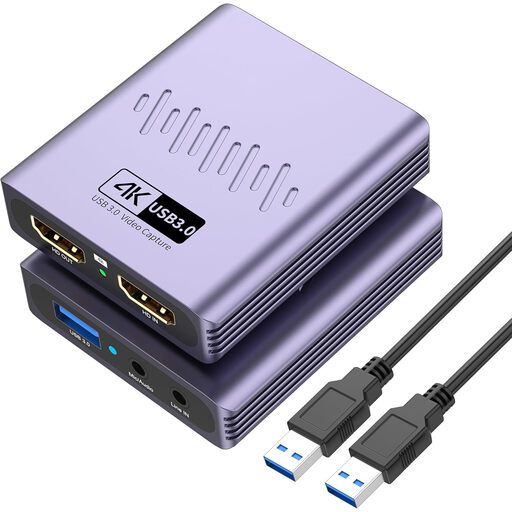 Image unavailable
Suitable for a workflow where you want to send the camera signal to a computer via HDMI.
The product name lists USB 3.0, 4K pass-through and video recording up to 1080p. Check that these features suit your camera and preferred recording settings.
A camera monitor alone won’t record to a computer. In the setup described by Canon, the camera signal goes to the computer via an HDMI-to-USB capture device. Also check the capabilities of your exact camera and capture device.
First check the cable, HDMI input, output setting and camera mode. Sony explains that, with certain camera settings, proxy recording and the display of HDMI information can affect what appears on an external screen. Check the instructions for your camera model.
It depends on the model and version you choose. Atomos lists power via an NP-F battery or USB-C PD for the Shinobi II, which has no built-in battery. Before buying, check what’s included and whether your power source is suitable.
According to ACM ConsuWijzer, a product must work as you could reasonably expect under normal use; if a product is faulty, the seller must put things right free of charge. ACM ConsuWijzer also states that online purchases come with a 14-day cooling-off period after delivery.
This doesn’t automatically apply to every product. The European Union’s Your Europe explains that CE marking only applies to products covered by specific EU rules. Check which rules apply to the exact monitor and any power supply. A CE mark is the manufacturer’s declaration of conformity, not an independent test certificate.