
Creator of close-up knitting tutorials
You want to check that small stitches and yarn stay in focus during a demonstration. Magnification and focus-assist tools can help; Atomos, for example, describes these features for the Shinobi II.


Choose a monitor that supports your camera’s video signal and is easy to read from your workstation. Magnification or focus peaking can help you check small stitches, while waveform or false colour can help you assess your hands and yarn against a dark background. For a fixed indoor setup, suitable power and mounting options are important too, while maximum brightness for outdoor use may not be a priority.
You want to check that small stitches and yarn stay in focus during a demonstration. Magnification and focus-assist tools can help; Atomos, for example, describes these features for the Shinobi II.
You want your hands and yarn to be clearly visible without treating the dark background as an exposure problem. Exposure tools such as waveform or false colour can help you assess brightness information in the image.
You film above a worktable and want to see the screen without moving the camera. Check that the connections, mounting options and power supply suit your setup.
Start with the camera image you want to assess: small stitches need to be clearly in focus, while the dark background calls for extra attention to the exposure of your hands and yarn. Then check that the connections, positioning and power supply work for your worktable.
| What to consider | What should you look for when buying? | Which consumers does this matter to? |
|---|---|---|
| Exposure of hands and yarn | Check whether the model has waveform or false colour, and whether the display suits your camera settings. | I want to assess the foreground clearly without using the dark background as the reference. Around 33% of consumers prioritise the exposure of hands and yarn. |
| Stitch sharpness | Check the panel resolution and whether magnification and focus peaking are available. | When I film small stitches and moving hands, I want to be able to check focus clearly. Around 27% of consumers prioritise detail and sharpness. |
| Connections, positioning and power | Compare the camera output and supported signals with the monitor; also check the mounting options, power specifications and what’s included in the box. | With a camera above the worktable, I want to be able to see the screen clearly and keep filming with a suitable power supply. Around 20% of consumers prioritise a practical table setup. |
| Essential features and accessories | Decide whether you only want to view the image, or also record, control the camera or view it wirelessly; check which cables and power components are included. | I don’t want to pay for features or accessories that my setup won’t use. Around 20% of consumers prioritise essential features and additional accessories. |
A monitor can receive a 4K signal even if its panel has a lower resolution. For example, Atomos specifies a 1920 × 1080 panel for the Shinobi II, alongside support for certain 4K input signals.
Check the panel resolution and supported input signals separately against your camera and the details you want to assess.
For a fixed indoor setup, being able to assess stitches and exposure clearly may matter more than having a screen designed for bright daylight. The Videomakers discusses high brightness mainly in relation to filming in bright daylight; this is not a performance comparison for your worktable.
Choose a brightness level that suits the lighting where you film, and check which image-assist tools the model offers.
A monitor-recorder adds a recording workflow you don’t need if you only want to assess the camera image. Camera control is also not available for every model or camera.
Decide whether you only want to view the image, record externally or control the camera from the screen. If you want to record or control the camera, check compatibility with your camera and which additional components are required.
A recorder can mean extra equipment; certain systems may require separate software licences for camera control.
According to Atomos, the Shinobi II is a compact HDMI monitor with magnification, focus-assist and exposure tools. The Ninja V is a separate monitor-recorder.
The F6 PLUS is an HDMI camera monitor with focus-assist and exposure tools, including focus assist and a histogram.
According to Portkeys, the LH5P II combines HDMI monitoring with tools such as waveform, peaking and false colour.
According to SmallHD, the Indie 5 is designed for setups that use 3G-SDI as well as HDMI.
According to Hollyland, the Mars M1 Enhanced combines a monitor with wireless transmitter and receiver functions, for anyone who wants to view the image remotely.
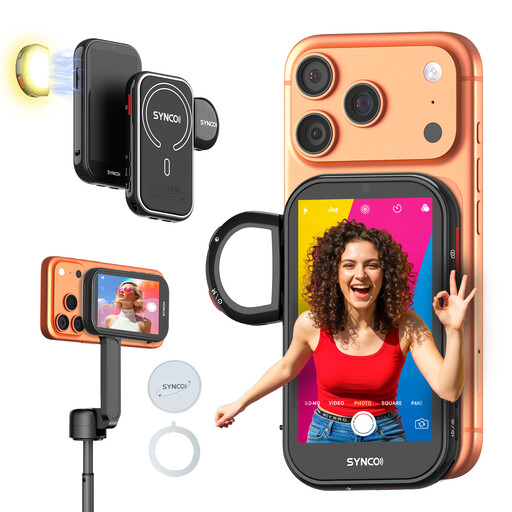
The option below is designed for remotely viewing an iPhone’s rear camera. Check whether this smartphone setup suits the way you film a knitting demonstration.
 No image available
Useful if you want to view an iPhone’s rear camera remotely; the product information states that Google Pixel is not compatible.
The product description lists wired mirroring and a wireless mode, as well as a built-in fill light.
The stated wireless viewing range of up to 50 m depends on the setup and is not guaranteed indoors.
Before buying, check that the version on offer has a CE mark.
No, a monitor won’t automatically make the recorded image brighter or sharper. Peaking, magnification and exposure tools help you assess the image, but they don’t replace focusing or adjusting the camera and lighting.
First, compare the camera output, connector and video settings with the monitor’s supported input signals. Mount the screen on a suitable holder and choose an appropriate power supply; for example, Atomos lists HDMI, a 1/4-inch mounting point and NP-F or USB-C PD power for the Shinobi II.
That depends on the monitor model and what’s included in the offer. Atomos specifies that the Shinobi II has no built-in battery, but can be powered via NP-F or USB-C PD; check whether a suitable power source and cable are included.
These tools show brightness information that lets you assess the exposure of your hands and yarn separately. SmallHD describes waveform as a display of brightness across the image; false colour marks brightness levels using colours. Check the scale and look at the normal image too.
Check whether the specific version on offer has a CE mark. According to the Dutch government, electrical appliances placed on the market in the EU must have a CE mark; a general brand specification alone does not confirm whether an individual offer meets this requirement.