For invitations you photograph regularly, where you want control over framing and settings, a mirrorless camera with a lens suited to the card size and shooting distance is a good fit. For occasional shots of the whole card, a compact camera may be enough. The Consumers’ Association describes a mirrorless camera with interchangeable lenses as the usual option, while Canon Europe suggests a standard kit lens or compact camera as a possible starting point for flat lays. In either case, your lighting setup and control over white balance and focus are important. Sony Netherlands explains how to adjust white balance when colours look different under artificial light.
Which camera is right for you?
Maker who wants to show print colours accurately
You photograph different designs under artificial light and want to judge whether the paper and ink look true to life. Adjustable white balance and a consistent lighting setup matter more to you than automatic colour effects. Sony Netherlands describes white balance as a setting you can adjust when automatic white balance doesn’t produce the colours you want.
Photographer of foil and glossy finishes
Your invitations have glossy or reflective details. You want to try moving the light and camera before buying a different camera. Nikon explains that a polarising filter can reduce reflections in suitable conditions, although it may also change the appearance of the gloss.
Maker of quick, straightforward product shots
You want to photograph a whole card without lots of separate equipment. A compact camera may be an option for a simple flat lay, provided its lens range and focusing distance suit your card and setup. Canon Europe suggests a standard kit lens or compact camera as a possible starting point for flat-lay photography.
What should you look for when choosing?
Mirrorless camera with standard zoom
Choose this if: you photograph complete invitations regularly and want to adjust your framing or settings. Their manufacturers describe the Canon EOS R50 kit and Nikon Z50II kit as coming with a standard zoom lens.
Bear in mind: a kit lens and camera body don’t guarantee that small lettering will be sharp or paper colours accurate. Check that the lens captures the details you want at your card size and shooting distance.
Mirrorless camera with a separately chosen lens
Choose this if: you want to pick a lens to suit your preferred framing and shooting distance. Sony describes the ZV-E10 version listed in the Netherlands as body only.
Bear in mind: you’ll need a compatible lens as well. Check the mount, focusing distance and framing for that specific lens. The camera body’s megapixel count alone doesn’t prove that it will capture fine print details sharply.
Compact camera with a fixed lens
Choose this if: you mainly want to photograph whole cards quickly and don’t want to change lenses. Canon describes the PowerShot G7 X Mark III as having a fixed zoom lens.
Bear in mind: the lens can’t be changed. Canon specifies a minimum focusing distance of 5 cm at wide angle and 40 cm at telephoto for this model, measured from the front of the lens. These distances don’t tell you how readable small lettering will be in your photo.
| What to consider |
What should you check? |
Who is this important for? |
| Colour under artificial light |
Check whether you can adjust the white balance and whether the photo file format you want is available. Sony Netherlands explains white balance settings and how to adjust colour settings. |
When I compare designs under the same lamp, I want the paper and ink to look consistent from one shot to the next. Around 36% of consumers give colour reproduction top priority. |
| Small lettering |
Check exactly what’s included in the kit, the lens mount and focusing distance, and how the image is framed with a card of your size. The specified minimum focusing distance may vary depending on the zoom setting. |
If small typography needs to remain readable, I want the card to be in focus and large enough in the frame at my working distance. Around 29% of consumers give the readability of small text top priority. |
| Reflections and gloss |
Check whether you have room to move the light and camera. If you’re considering a polarising filter, check that it fits the lens you’ve chosen. |
With foil or glossy paper, I want to manage reflections without unintentionally changing the look of the finish. Around 21% of consumers give reflections top priority. |
| Fewer separate components |
Compare a fixed lens with a camera body and separate lens, and check what’s actually included in the kit you’re considering. |
If I only photograph a whole card now and then, I want to be able to take the shot with as few separate components as possible. Around 14% of consumers give speed and ease of use top priority. |
Common buying pitfalls
-
Choosing a camera based on megapixels alone
The lens and shooting distance both affect how well you can frame the whole card and capture small details. The EOS R50 kit includes an RF-S 18-45mm lens, while the Sony ZV-E10 version reviewed is body only.
Compare the exact version and check with a card of your size that you can frame both the full invitation and the details you want.
If you choose a version without a lens, you’ll also need to select a compatible lens separately.
-
Expecting a new camera body to fix reflections on foil
The position of the light and camera affects the shot. A polarising filter can reduce reflections in suitable conditions, but it can also change how the gloss looks.
Take test shots with the light coming from different directions first. Before buying, check that the filter fits the lens and that the foil still has the look you want.
-
Assuming a fixed colour preset will give accurate colours
Artificial light can affect how colours appear. Sony Netherlands explains that you can adjust the white balance when automatic white balance doesn’t produce the colours you want; RAW images may need editing.
Compare a test shot taken under your own lights with the physical invitation, and keep the lighting setup the same for each design.
Editing RAW files takes extra time; Sony notes that you’ll need separate software.
Camera brands to consider
Canon
The examples mentioned include both a Canon mirrorless camera kit with an interchangeable lens and a compact camera with a fixed zoom. These models offer different ways to approach lens choice and equipment.
- Canon specifies an RF mount and 24.2 effective megapixels for the EOS R50; the kit mentioned includes an RF-S 18-45mm lens.
- EF-M lenses aren’t compatible with the RF mount. The specified focusing distance for the PowerShot G7 X Mark III varies with the zoom setting.
Nikon
According to Nikon Netherlands, the Nikon Z50II kit mentioned comes with a NIKKOR Z DX 16-50mm f/3.5-6.3 VR lens.
- The kit contents include both the camera and the supplied zoom lens.
- The lens’s VR feature doesn’t prove that small print will look sharp under your lighting setup.
Sony
The Sony ZV-E10 mentioned is an option if you want to choose your own E-mount lens; the version reviewed in the Netherlands is described as body only.
- Sony specifies an APS-C sensor, 24.2 effective megapixels and RAW photo support for the ZV-E10.
- If you choose a body-only version, you’ll still need to select a suitable lens. Sony’s general guidance on RAW and white balance isn’t a test of this model photographing printed material.
Cameras at Joybuy
Cameras at Joybuy that are relevant to this topic. For invitations, pay particular attention to the focusing distance, lens and how well small details are rendered.
 Image unavailable
Mini Action Camera 4K with clip
For invitations, this is only worth considering if it focuses at your working distance and captures small text large enough in the frame. Check this before buying.
The product title mentions a 1.54-inch screen, a 140° viewing angle, app control, LED light and a 1200 mAh battery.
View at Joybuy
 Image unavailable
KINSI Mini Vlog Camera 4K with Wi-Fi
For close-ups of printed material, check that the camera focuses at your working distance and that the lens can frame the card appropriately.
The product title mentions 64 MP, a 330° rotating lens, a 1.72-inch touchscreen and a tripod.
View at Joybuy
 Image unavailable
KOMERY G7 5K digital camera
If you’re considering this camera for invitations, check that the lens focuses at your working distance and that small text is readable in the frame.
The product title mentions 80 MP and 18× zoom.
View at Joybuy
 Image unavailable
KOMERY W6 digital camera
Before using it to photograph printed invitations, check the focusing distance and whether the lens can frame your card size properly in your workspace.
The product title mentions 12× optical zoom, 4K and 64 MP.
View at Joybuy
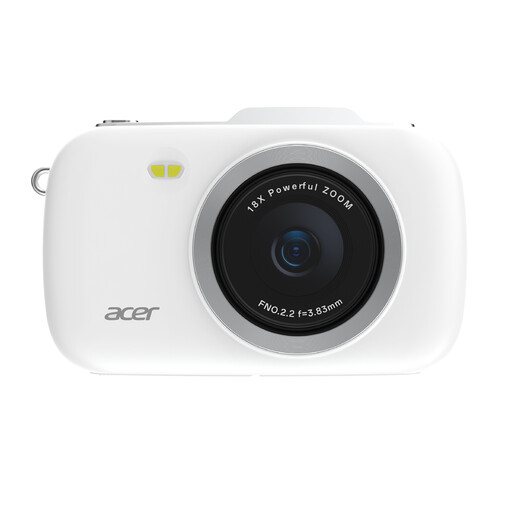 Image unavailable
KOMERY G7-A 4K digital camera
For invitations, its suitability depends on whether it focuses at your working distance and captures the small details you want. Check this before choosing.
The product title mentions 80 MP and 18× zoom.
View at Joybuy
Frequently asked questions
Why do white cards sometimes look tinted under artificial light?
White balance adjusts the colours in your photo to suit the light. You could start with automatic white balance, then try a different or manual setting if the colours don’t look the way you want. If your camera supports RAW images, you can also adjust the white balance when editing them, as Sony Netherlands explains.
What can I do if stripes appear in photos taken under LED or fluorescent lighting?
According to Canon, some flickering LED and fluorescent light sources can cause banding when you use an electronic shutter. Take a test shot with your lighting and, if your camera allows it, try a different shutter mode or light source. This doesn’t guarantee that every combination will solve the problem.
Should I contact the manufacturer about a faulty camera?
No. According to the Dutch government, the retailer is responsible for resolving issues with a faulty product. The Netherlands doesn’t have a fixed statutory guarantee period; a manufacturer’s guarantee and any extra cover you’ve bought are separate from your statutory right to a product that works as it should.
Can I publish photos of invitations with names or addresses online?
That depends on the personal data shown and how you want to publish the photo. A name and address are personal data; according to the Dutch Data Protection Authority, consent is usually needed to publish other people’s personal data. Check which legal basis under the GDPR applies, and make any details that don’t need to be shown unreadable. If the design belongs to someone else, check the rights before making it public too.


