
Skyline and reflection photographer
Wants to frame both parts of the scene from a chosen viewpoint and can wait for the right water or light. Canon Europe describes calm water as ideal for clear reflections.


If you want to frame both the harbour skyline and its reflection from different viewpoints, choose a camera whose lens can capture the composition you want from your chosen spot. A mirrorless camera gives you a choice of lenses, while a compact camera is easier to carry around. For twilight shots, RAW and control over exposure are useful for comparing results. But if you’re shooting without a tripod, also consider the stabilisation of the specific camera-and-lens combination and the weight of the complete kit. Reflections also depend on the water and your viewpoint, not just the camera; Canon Europe notes that calm water is ideal for clear reflections.
Wants to frame both parts of the scene from a chosen viewpoint and can wait for the right water or light. Canon Europe describes calm water as ideal for clear reflections.
Wants to capture bright skies, illuminated buildings and a dark foreground in a controlled way, and is considering shooting in RAW or using a tripod.
Moves between viewpoints and prioritises a portable kit and handheld shooting over extensive equipment.
| What to consider | What should you check? | Who should take this into account? |
|---|---|---|
| Framing the skyline and reflection | Check the focal length range of the included lens and assess the composition from your intended viewpoint. | If I want to capture the skyline and reflection together, I’ll consider the composition from my spot by the water. Around 33% of consumers say framing is their main concern. |
| Exposure at twilight | Check for RAW shooting, adjustable exposure and whether you can place the camera somewhere stable. | If I want to capture a bright sky and dark quayside at the same time, I want to be able to adjust the exposure myself. Around 27% of consumers prioritise control in low light. |
| Portability and handheld shooting | Compare the combined weight of the body and lens, and check the stabilisation of the exact combination. | If I’m walking between different viewpoints, I don’t want to carry more than is practical. Around 20% of consumers give portability top priority. |
| What’s included in the kit | Check which lens and accessories are included with each offer, and which lens mount the camera has. | If I’m looking for a ready-to-use kit, I want to know what’s included with the body before comparing options. Around 20% of consumers pay closest attention to what’s included. |
A polarising filter can actually reduce reflections on water, as Nikon explains. That could work against you if you want the reflection to remain visible.
First decide whether you want to reduce glare or preserve the reflection. If needed, compare shots taken with and without the filter.
A body without a lens isn’t the same complete purchase as a kit with a lens. Even offers for the same camera model can include different items.
Check the exact model, lens and included accessories before comparing kits.
Stabilisation helps counter camera shake, but it won’t freeze moving water. Your choice of exposure also affects how the water looks in the photo.
Choose deliberately between a short exposure and a longer exposure with the camera placed somewhere stable.
EOS R mirrorless cameras offer a choice of RF and RF-S lenses to help you get the composition you want.
Z mirrorless cameras are available with different lens kits; the included lenses can vary between offers.
Sony E-mount mirrorless cameras include APS-C models that let you choose a lens to suit the composition you’re aiming for.
X-mount mirrorless cameras include models that let you compare RAW shooting and in-body stabilisation.
LUMIX G cameras with a Micro Four Thirds mount are an option if you’re weighing up stabilisation and screen features.
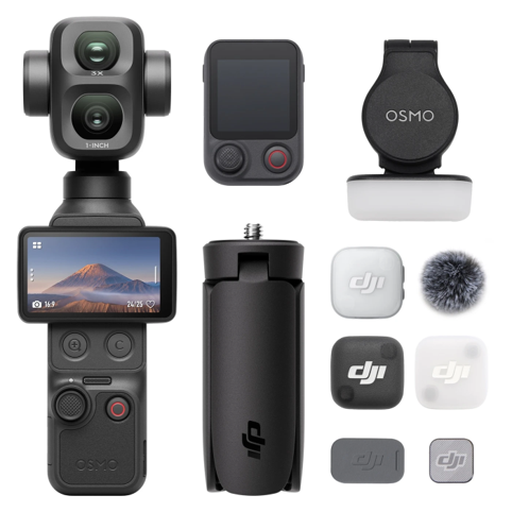
This selection includes compact DJI Osmo Pocket cameras and Sony mirrorless cameras with a 16–50 mm zoom lens. For an Osmo Pocket model, check that its photo features suit the still images you want to take. With the Sony kits, check whether the zoom range suits your viewpoint.
 No image available
The compact Pocket design suits anyone looking for a camera they can take with them; check that the lens composition suits your viewpoint.
The product description lists a 20 mm f/2.0 lens and a 1-inch CMOS sensor.
 No image available
The stated 2× zoom may be useful for adjusting your framing; check that the photo features suit the way you plan to use it for harbour shots.
The title lists a 1-inch CMOS sensor, 2× zoom, 3-axis stabilisation and 107 GB of built-in storage.
Also listed: 4K/240fps and a swivelling 2-inch screen.
 No image available
The compact design could suit anyone walking between viewpoints; check that the camera offers the photo controls you want.
The product description lists a 1-inch CMOS sensor, 3-axis stabilisation and a swivelling 2-inch touchscreen.
The title also lists 4K/120fps video.
 No image available
The included zoom lens gives you framing options; compare its range with the distance to the skyline from your chosen shooting spot.
The product description lists a 24.2 MP APS-C sensor, a tilting screen and OSS lens stabilisation.
 No image available
The 16–50 mm zoom lens can help you adjust the framing to suit your viewpoint; check that the range works for the skyline and reflection you want to capture.
The product description lists a 24.2 MP APS-C sensor, a tilting screen and an electronic viewfinder.
The stated weights are 396 g for the body and 116 g for the lens.
Choose a viewpoint and composition that show both the skyline and the water; calm water can produce a clearer reflection. Don’t automatically use a polarising filter: according to Nikon, it can actually reduce reflections on water.
No, it depends on how you use the camera and the exposure you choose. Decide whether you’ll be shooting handheld or from somewhere stable. For handheld shots, check the stabilisation of the specific body-and-lens combination.
Check whether the offer includes a lens, a suitable way to charge the camera and a memory card. For online purchases by consumers in the Netherlands, there is generally a 14-day cooling-off period, according to the Dutch government. The legal guarantee is separate from any manufacturer’s warranty and, according to ACM ConsuWijzer, depends on what you could reasonably expect from the product under normal use.
There isn’t one general rule that applies to every harbour or location. The Port of Rotterdam Authority states that business premises in the port of Rotterdam are off limits without permission, and that you must ask the relevant company for permission to take photos of or on those premises. This guidance for a particular location doesn’t automatically apply to every harbour. The Dutch Data Protection Authority also distinguishes between private use of images showing identifiable people and wider distribution.