
Detail seeker
You want to reveal individual seeds and fine textures, and you’re happy to bring a suitable macro lens.


For spontaneous close-ups with minimal equipment, a compact camera with a built-in close-up mode is a good fit. For individual seeds and fine textures, a mirrorless camera with a suitable macro lens gives you more choice of magnification and working distance. If you mainly photograph whole seed heads, try the minimum focusing distance of your current lens first. In woodland light, bear in mind the shutter speed and shallow depth of field: image stabilisation won’t keep a moving stem still.
You want to reveal individual seeds and fine textures, and you’re happy to bring a suitable macro lens.
You want to take quick close-ups as you go, with as little equipment and as few lens changes as possible.
You take photos beneath trees or in a light breeze, and want to weigh up shutter speed, depth of field and available light.
First decide whether you’d rather avoid changing lenses, magnify the tiniest details or try out your current lens.
A good fit if: you want to take spontaneous close-ups on the go without a separate lens.
Bear in mind: a fixed lens limits your choice of magnification and working distance.
A good fit if: you want to capture small details at a larger scale or choose a lens and working distance to suit your subject.
Bear in mind: you’ll need to bring a camera body and a suitable lens. Working at close range calls for extra care with focusing and lighting.
A good fit if: you mainly photograph whole seed heads or larger details and aren’t yet sure whether you need more magnification.
Bear in mind: a standard zoom lens won’t necessarily offer the magnification of a dedicated macro lens.
| What to consider | What should you check? | Who is this important for? |
|---|---|---|
| Fine details and working distance | Check the lens’s maximum magnification and the space between the lens and the subject. | If I want to capture individual seeds at a larger scale, I need to know how much the lens magnifies and how much room there is in front of it. Around 36% of consumers put magnifying fine details first. |
| Minimal equipment | Compare the weight of the complete setup and see whether you can go from a wide shot to a close-up without changing lenses. | If I want to photograph a seed head quickly while out walking, a lightweight setup that’s ready to go matters. Around 29% of consumers put ease of carrying first. |
| Sharpness in woodland light and when subjects move | Check the exposure options and consider whether extra lighting or focus bracketing would suit your subject. | When I’m photographing beneath trees or trying to capture a moving stem, I want to be able to balance shutter speed, light and depth of field. Around 21% of consumers prioritise control over sharpness in challenging light. |
| Protection in wet weather | Check the protection information for the exact camera and lens combination, and follow the usage restrictions. | If I go out in wet weather too, I want to know what protection my complete setup offers. Around 14% of consumers put protection on wet-weather walks first. |
Maximum magnification depends on the lens you use. A camera body or any old kit lens won’t automatically offer the macro magnification of a dedicated macro lens.
Before buying, check the exact lens included in the set, its mount and its maximum magnification.
You may need a separate, compatible macro lens to get the magnification you want.
Focusing distance and magnification are different things. Getting very close to a seed head can also make lighting and composition more difficult.
Compare the magnification specification with the working distance, and try your preferred framing from a realistic distance.
Image stabilisation helps counter camera shake, but it won’t stop your subject from moving. Shutter speed and available light still matter.
Check whether you can adjust the shutter speed and exposure, and consider whether extra lighting would be practical on your route.
Depending on how you work, you may need extra lighting to expose your subject properly.
The Tough TG-7 is a compact camera option with built-in macro modes, while the OM-5 Mark II is a separate mirrorless camera option.
The RF system offers different magnification options when paired with a compatible mirrorless camera body and lens.
The Z series is an option if you want to pair a Nikon Z body with a separate NIKKOR Z macro lens.
The FE 90 mm F2.8 Macro G OSS is a separate macro option for a camera with a Sony E-mount.
The XF80mmF2.8 R LM OIS WR Macro is an option in the Fujifilm X lens system if you’re looking for a macro lens.
Joybuy product selection for this topic.
 No image available
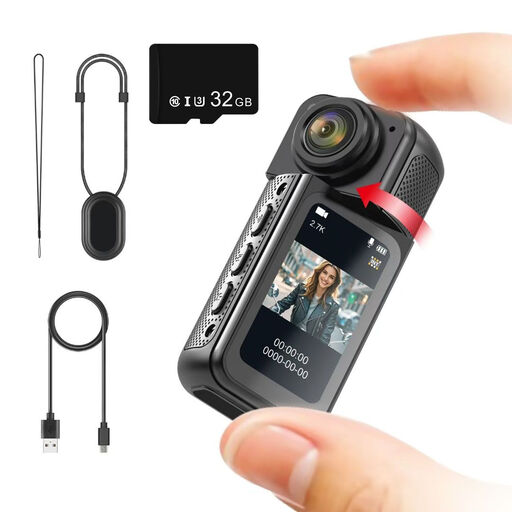
With a stated weight of 35 g and a magnetic mount, this camera could suit anyone who wants to carry very little on a walk. Check that its recording and close-up capabilities are suitable for photographing seed heads.
The product name lists a 180° rotating lens, a 1.47-inch IPS screen and a 32GB memory card.
Not necessarily. For a larger subject, first try the minimum focusing distance of your current lens and see whether the framing is good enough. Smaller details may need greater magnification.
Focus stacking combines shots taken at different focus points, and works best when the subject stays still enough between shots. If the seed head is moving, also take shutter speed and available light into account.
Follow the care and drying instructions for your exact camera and lens. Protection on one component doesn’t prove that the whole combination is waterproof. Canon warns that the seal on the RF 100mm F2.8L Macro IS USM does not completely prevent water droplets from getting in.
According to ACM ConsuWijzer, online purchases generally come with a cooling-off period of up to 14 days after delivery, with some exceptions. Your statutory guarantee is separate from any seller’s guarantee. The seller is responsible for ensuring the product does what you can reasonably expect it to do.
It depends on the area and the local rules. Staatsbosbeheer refers visitors to the signs at the entrance for any specific rules. This isn’t general permission to leave the path to photograph a seed head.