
3D model maker
You want raised sections and different layers of folds to remain clearly visible. So, consider the depth of field you need and keep the camera in a fixed position.


First decide whether you mainly want to photograph the whole origami model or magnify its smaller folds. Then check that your chosen camera and lens can achieve this on your table. A compact camera has a fixed lens, while with an interchangeable-lens camera you choose a suitable lens. Canon and Nikon quote different magnifications for specific macro lenses; these are not general performance figures for the camera body. Whichever route you choose, a stable set-up and careful white balance will help. Canon UK recommends keeping the composition fixed for product photography, while Nikon UK advises checking the white balance when the light changes.
You want raised sections and different layers of folds to remain clearly visible. So, consider the depth of field you need and keep the camera in a fixed position.
You want to make a small folded pattern fill the frame. Compare the close-up capabilities of the complete camera-and-lens combination.
You want to get started without separate lenses. Check whether a fixed-lens camera can achieve the framing you want on your table.
Start with the framing you need, then decide whether you want a fixed lens or to choose a suitable lens yourself. If possible, take a test shot from the distance you can use at your table.
| What to consider | What to check before buying | Who is this important for? |
|---|---|---|
| Keeping the whole model in focus | Consider the depth of field you need. For focus stacking, check exactly what the camera model records and whether it can combine the images in-camera. | If I want the different layers and points of the whole model to be clearly visible, I look for sharpness at different distances. Around 36% of consumers prioritise a sharp image of the whole subject. |
| Magnifying small folds | Check the maximum magnification and focusing distance of the exact lens, or try the close-up mode with a detail of a similar size. | If I want fine lines to fill the frame, I compare the magnification of the complete camera-and-lens combination. Around 29% of consumers prioritise these folded details. |
| Paper colour and window light | Check the white balance settings and keep the light as consistent as possible during a series of shots. Try to position the camera securely. | If the paper colour needs to look consistent across different photos, I pay attention to the light and white balance. Around 21% of consumers prioritise colour reproduction and repeatable results in window light. |
| A manageable set-up | With an interchangeable-lens camera, check the lens mount and what’s included in the kit. Also allow space for the camera, model and any support you might need. | If I want to get started without changing lenses, I check whether a fixed-lens camera can achieve the framing I want. Around 14% of consumers value a simple, complete set-up above all. |
The quoted 1:2 and 1:1 magnifications apply to specific lenses. A camera kit may include a different lens model.
Before buying, check the full model name, the lens mount and exactly what’s included in the kit.
You may need to buy a separate compatible lens to achieve the magnification you want.
Being able to focus up close doesn’t necessarily mean the whole model will fit in the frame, or that there’ll be enough room to light it with window light.
Test a whole-model shot and a close-up of a similarly sized model, from a distance that works on your table.
A fast lens doesn’t guarantee that every part of a 3D model will be in focus at the same time. Taking several focus-bracketed shots also requires a stable camera.
First decide how much depth of field you need, then consider the aperture, shutter speed and whether to use focus stacking.
A tripod or support may take up room on your table; a series of focus-bracketed shots takes extra time.
An interchangeable-lens camera option for anyone considering an RF camera with a separately chosen close-up lens.
A Z-system camera option for anyone wanting to pair a camera body with a separate macro lens.
A compact camera option for anyone wanting to try close-ups with a camera that has a fixed lens.
These cameras are suitable for photographing origami models. Check for each one whether you can achieve the framing you want from your table.
 No image available
The product information mentions landscape photography and close-ups. Check with your own model whether you can achieve the framing you want.
The product information lists 4K and 64 MP.
 No image available
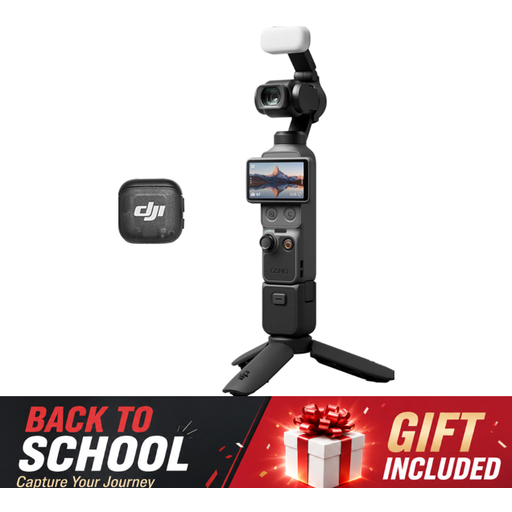
The product title mentions photography and video. Try it with an origami model to see whether the camera offers the close-up framing you want.
The product title lists a 1-inch CMOS sensor, 4K/120fps video and 3-axis stabilisation. It also mentions a microphone in the Creator Combo.
 No image available
The product title mentions photography. Try it from your work area to see whether the camera can frame the whole model and the folds you want.
The product title lists a 1-inch CMOS sensor and 4K/120fps video. The product information mentions a rotating touchscreen.
 No image available
The product information mentions product photography. Check whether the included lens can achieve the framing you want from your table.
The kit name lists a 16–50 mm lens. The product information mentions an APS-C sensor.
Not necessarily. First check whether the whole model fits in the frame from the distance available. A 1:1 specification is mainly relevant if you want very small details to fill the frame.
First consider the depth of field you need, using the aperture setting and focus point. If your camera has focus bracketing or focus stacking, you can use several focus positions. Canon describes focus bracketing with the option to combine images in-camera on the EOS R50. Check the manual and keep the camera steady.
Keep the light as consistent as possible throughout a series of photos, check the white balance and, where possible, avoid mixing window light with lamps that have different colour temperatures. Nikon UK recommends checking the white balance again when lighting conditions change.
Check that the lens and accessories you need are included in the kit. For a consumer purchase, the seller is responsible for the statutory guarantee if the product doesn’t meet what you could reasonably expect, according to the Netherlands Authority for Consumers and Markets. Online purchases generally come with a statutory cooling-off period of up to 14 days after delivery; ACM ConsuWijzer explains the exceptions.