Who is this guide for?

Creator of detailed invitations

You want fine lettering, illustrations and card edges to remain clear even after cropping. So consider the lens, focusing and usable image resolution, not just the camera body. Consumentenbond points out that both the lens and the image sensor contribute to photo quality.

Designer working with colour-critical print

You compare the photo with the printed card and want to avoid unwanted colour casts on the paper and in the design. Even lighting and adjustable white balance are important here. Canon Nederland explains that artificial light can make a white surface look yellow, while fluorescent light can give it a green cast.

Seller taking product photos regularly

You photograph several designs in the same style. A stable setup helps keep the background and crop consistent between shots. Canon Nederland says a tripod can help you achieve a consistent composition.

What should you look for when choosing?

Compact camera

Choose this option: if you photograph invitations occasionally and a test shot shows that the text remains legible in your final crop.

Bear in mind: the fixed lens limits your choice of angle of view and magnification.

Mirrorless camera

Choose this option: if you take photos regularly, want to crop your images or would like to choose a lens to suit the card and the available shooting height.

Bear in mind: the body alone is not a complete setup; check which lens, support and lighting you need.

Your current camera setup

Choose this option: if a test shot already gives you the legibility and colour you need.

Bear in mind: a different setup will not automatically overcome limitations with your current lens or settings.

What to consider What to check before buying Who is it important to?
Legible text and print detail Check the supplied lens, whether there is enough room to frame the whole card and whether a test file remains legible after cropping. I want small lettering to remain legible at the size I’ll use the photo. Around 31% of consumers give text legibility top priority.
Colour against a white background Check whether you can adjust the white balance, then assess a test shot alongside the actual card in even light. I want the paper and print colours to look true to life in the photo, without an unwanted colour cast. Around 25% of consumers put colour reproduction first.
Repeatable overhead shots Check that the camera and support can sit steadily above the card together, and that you can assess the composition. I photograph several designs and want to keep the same framing and background. Around 25% of consumers prioritise consistency.
Cost for occasional use Compare the complete setup: body, included lens and any support or lighting. First, take a test shot with the equipment you already have. I only take photos occasionally and don’t want to buy extra equipment until I know what my current setup can’t do. Around 19% of consumers start by considering the total purchase cost.

Common pitfalls

  • Choosing based on megapixels alone

    Having more room to crop a photo does not, by itself, prove that small lettering will remain sharp. The lens, focus and camera stability all play a part too.

    Assess a test file after cropping it in the way you actually intend to use it, and check the lens and setup as well.

  • Assuming a camera body is a complete photography kit

    With a mirrorless camera, the lens mount and the exact contents of the kit determine which lens you can actually use.

    Before buying, check the full model name, the included lens and whether it is compatible with the camera body.

    You may need to buy a suitable lens, memory card, tripod or lighting separately. Check which items are included with the version you’ve chosen.

  • Making the background white without considering the card

    The white background and the invitation paper are separate parts of the shot. A correction aimed only at the background can also affect how the card looks.

    For a test shot, check both the paper and the background, and adjust the lighting and white balance before taking a series of photos.

Camera brands to consider

Canon

The EOS R50 is an APS-C mirrorless camera with an RF mount, for anyone looking to use interchangeable lenses.

  • Canon specifies 24.2 effective megapixels and support for RF and RF-S lenses.
  • Canon does not list sensor-shift stabilisation for this body. Check which lens and support are included with the kit you choose.

Sony

The ILCE-6400 is an APS-C mirrorless camera with an E mount. RAW shooting may be useful if you want to edit your files afterwards.

  • Sony specifies approximately 24.2 effective megapixels and RAW shooting for the ILCE-6400.
  • Check the full model name and kit contents: the ILCE-6400 and ILCE-6400A are not necessarily the same purchase option.

Nikon

The Z50II is a mirrorless camera option if you want to check the composition and colour settings as you shoot.

  • Nikon describes a tilting touchscreen and Picture Control presets whose effects can be seen on the screen or in the viewfinder.
  • A visible preset does not prove that print colours will be reproduced accurately. Check the result with a test shot.

Fujifilm

The X-M5 is an APS-C mirrorless camera with an X mount, for anyone who wants to pair an interchangeable lens with room to crop as needed.

  • Fujifilm specifies 26.1 million effective pixels for the X-M5.
  • That specification alone says nothing about the sharpness of the kit lens you choose or the colour accuracy of an invitation photo.

Cameras at Joybuy

These cameras may suit anyone considering a compact setup or a mirrorless camera with a choice of lenses for invitation photos. Use a test shot of your own card to assess legibility, colour and cropping.
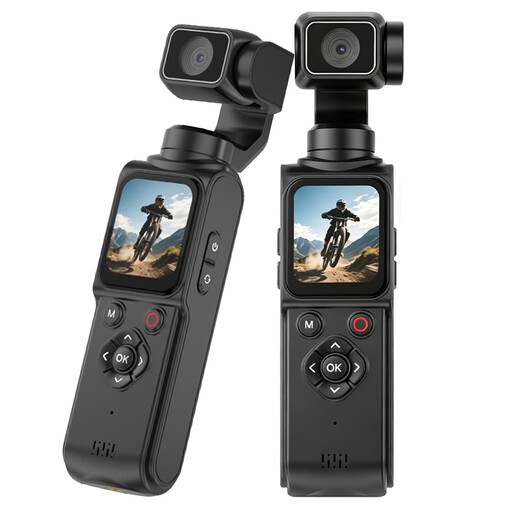
KINSI Mini Vlog Camera 4K, 64 MP, with tripod

KINSI Mini Vlog Camera 4K, 64 MP, with tripod

The tripod mentioned in the product name may suit a fixed setup; check with a test shot whether small text remains sharp enough.

The product name lists 4K, 64 MP, a 330° rotating lens, a 1.72-inch touchscreen and a tripod.

View at Joybuy

Komery W6 digital camera, 64 MP, 12× optical zoom

Komery W6 digital camera, 64 MP, 12× optical zoom

The zoom may be useful if you want to try different framing; check with your own invitation that the smallest text remains legible in the image.

The product name lists 12× optical zoom, 4K and 64 MP.

View at Joybuy
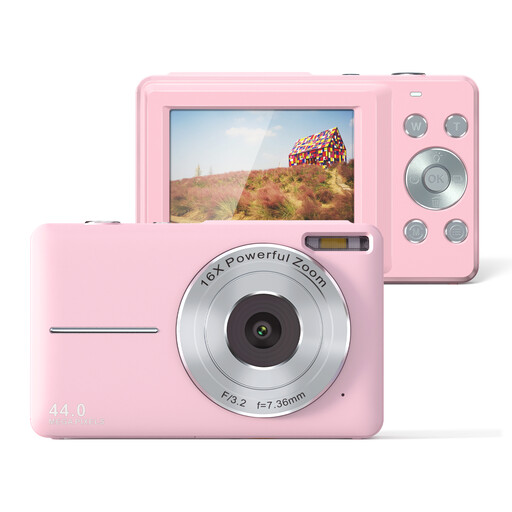
Songdian Pocket Camera 4K, 44 MP, pink

Songdian Pocket Camera 4K, 44 MP, pink

This pocket camera may suit anyone looking for a compact option; take a test shot to see whether it captures the card and fine detail well enough.

The product name lists 4K, 44 MP and 16× digital zoom. According to the product description, a microSD card is not included.

View at Joybuy

Sony ZV-E10 with 16–50 mm zoom lens, black

Sony ZV-E10 with 16–50 mm zoom lens, black

The zoom lens may suit changing your framing; check with a test shot whether the distance and crop you choose keep small text legible.

The product description lists a 24.2 MP APS-C sensor and a 16–50 mm kit lens. A memory card and adapter/charger are not included, according to the description.

View at Joybuy

Sony Alpha A6100 with 16–50 mm f/3.5–5.6 OSS II lens

Sony Alpha A6100 with 16–50 mm f/3.5–5.6 OSS II lens

The lens listed in the product name may be useful if you want to adjust the framing; check with a test shot that the whole card and fine text are in sharp focus.

The product description lists a 24.2 MP APS-C sensor and a 16–50 mm lens.

View at Joybuy

Frequently asked questions

Do you need to buy a macro lens for every invitation?

No, not necessarily. First check whether the included lens captures the whole card sharply and whether the smallest text remains legible in the final image you intend to use. Only consider another lens if a test shot shows that your current lens is the limiting factor.

How can you prevent a white background from looking yellow or green?

Use lighting that is as even as possible and check the white balance with a test shot. Canon Nederland explains that artificial light can make a white surface look yellow, while fluorescent light can make it look green. So check the colour of the invitation itself too.

How can you keep a series of invitation photos consistent?

Position the camera securely above your workspace and keep the framing and background the same as you swap the cards. Canon Nederland recommends a tripod to help achieve a consistent composition; using the self-timer can help reduce movement caused by touching the camera.

Is a scanner better suited to a flat card?

A scanner may be a good choice if you only want to digitise the flat printed material and don’t need a staged image with a photographed background. Epson describes the Perfection V39II as a flatbed scanner for photos and documents; choose based on the final image you need.

What cooling-off period and warranty apply to an online purchase in the Netherlands?

For online consumer purchases, you generally have a statutory cooling-off period of up to 14 days after delivery, subject to legal exceptions. ACM ConsuWijzer explains this cooling-off period. There is no fixed two-year period for the statutory warranty in the Netherlands: according to the Dutch government, a product must meet the standard you can reasonably expect of it.
