Start with the smallest details you want to show and the space you need to light the bracelet properly. A compact camera with a close-up mode keeps your setup simple. A mirrorless camera with a suitable macro lens gives you more choice over magnification and framing, but you’ll need to check the lens, mount and full kit separately. Whichever you choose, a fixed lighting setup and carefully adjusted white balance are important.
Who is this buying guide for?
Maker who wants to show off bead details
If you want to show individual beads, textures or clasps, start by deciding on your preferred shooting distance and magnification. For example, Nikon specifies 1:1 magnification for its separate NIKKOR Z MC 50mm f/2.8 lens.
Seller who wants consistent colours
When photographing several bracelets under artificial light, using the same lighting and white balance each time helps you assess colour reproduction. Shopify Netherlands discusses reflections and lighting in jewellery photography, while Canon Netherlands explains how artificial light can affect colour reproduction.
Home photographer with a small setup
If you want to take both full-bracelet shots and close-ups without choosing a separate lens straight away, consider a camera with built-in close-up options. OM SYSTEM lists macro modes and RAW recording for the Tough TG-7.
What should you look for when choosing?
First, decide which shot you need to take reliably: a bead detail, the whole bracelet or both. Then consider how much space you have for lighting and how much equipment you want to use.
Your current camera or smartphone
Choose this if: the whole bracelet and the details you want to show are already coming out sharp enough.
The trade-off: close-up options and manual settings depend on the device you already own.
Compact camera with a close-up mode
Choose this if: you want to photograph a bead close up without changing lenses.
The trade-off: a fixed lens keeps your kit simple, but gives you less choice of optics.
Mirrorless camera with a macro lens
Choose this if: you want to set a specific magnification, shooting distance or composition.
The trade-off: check that the lens you want is compatible with the camera body and included in the kit.
| What to consider |
What to check before buying |
Who should prioritise this? |
| Small beads and clasps |
Check the magnification of the exact lens or close-up mode, and make sure it can achieve the framing you want. |
If you want individual beads to fill the frame, prioritise magnification; around 36% of consumers say detail is their top priority. |
| Colour under artificial light |
Check the white balance settings and, if you want to make adjustments later, whether the exact model supports RAW. |
If you photograph several bracelets under the same lamp, you’ll want to assess colour differences accurately; around 29% of consumers prioritise colour consistency. |
| Sharpness across the bracelet |
Consider how you want to focus and whether a stable setup suits the way you take photos. |
If you want to show details at different distances in focus at the same time, sharpness across the bracelet matters; around 21% of consumers prioritise this. |
| A complete, easy-to-handle kit |
Compare what’s included in the offer with what you need to photograph both a whole bracelet and a close-up. |
If you want to get started easily without researching separate lenses, choose a straightforward kit; around 14% of consumers prioritise this. |
Common buying mistakes
-
Choosing a camera body because the system supports macro photography
The 1:1 magnification specified by Nikon and Sony applies to particular lenses. It doesn’t automatically apply to every camera body or kit zoom lens.
Check the exact model, lens mount, included lens and the lens’s magnification in the offer.
-
Assuming the minimum focusing distance is the ideal working distance
When you’re close to a reflective bead, it can be harder to position the camera and a soft light source properly.
Consider your preferred framing and the angle of the light together; don’t base your choice on the shortest distance alone.
-
Trying to fix colour casts simply by buying a different camera
Canon Netherlands explains that artificial light can visibly shift colours and that white balance affects how they look.
Check your lights, reflections and white balance first. Only then compare the settings available on different cameras.
Brands to consider
Canon
The EOS R50 is one possible entry point into mirrorless photography, with a compatible RF or RF-S lens purchased separately.
- Canon specifies a 24.2-megapixel APS-C sensor for the EOS R50 and lists focus bracketing.
- These camera body specifications don’t tell you what magnification the included lens offers, so check the lens separately.
Nikon
The Z50II can be paired with a compatible Z lens for a macro setup you can expand over time.
- Nikon specifies 1:1 magnification for its separate NIKKOR Z MC 50mm f/2.8 lens and lists it as suitable for Z cameras in DX format.
- This lens specification doesn’t apply to the Z50II body or any kit lens. Nikon gives a minimum focusing distance of around 5 cm between the front of the lens and the subject, which may limit the space available for lighting.
Sony
The α6400 is an APS-C mirrorless camera with an E-mount that can be paired with a separate macro lens.
- Sony specifies 1:1 magnification for its separate E 30 mm F3.5 Macro lens, model SEL30M35.
- The short focusing distance means you’ll need to check whether there’s enough room around the bracelet to position artificial lighting.
OM SYSTEM
The Tough TG-7 has a fixed lens and built-in close-up options, so you won’t need a separate macro lens.
- OM SYSTEM lists RAW recording, macro modes and a minimum focusing distance of 1 cm for the TG-7.
- That distance alone doesn’t tell you whether the lighting will work well with every reflective bead.
Joybuy product selection
The selection below is a Joybuy camera and lighting bundle for product photography. For beaded bracelets, check separately whether it can achieve the close-up framing you want.
 No image available
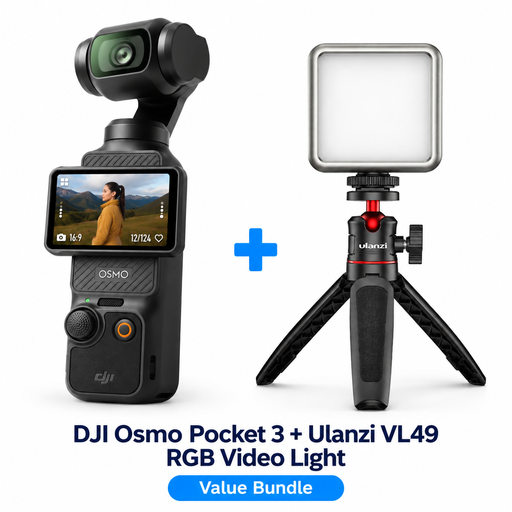
DJI Osmo Pocket 3 with Ulanzi VL49 RGB LED Video Light
This bundle combines a DJI Osmo Pocket 3 with a Ulanzi RGB video light, for anyone looking for a camera and extra lighting for product photography.
For small bead details, check that this camera can achieve the shooting distance and framing you want; extra lighting doesn’t replace that check.
View at Joybuy
Frequently asked questions
How can I get started with artificial light without buying a different camera?
Start with a stable setup, soften distracting reflections and check the white balance with the lights you use. Then assess a photo of the whole bracelet separately from one of the smallest beads you want to show.
Is a short focusing distance the same as a useful macro shot?
No. The distance alone doesn’t tell you how large the bead will appear in the final frame or how much room you’ll have for lighting. Check the magnification of the exact lens, and consider your preferred framing and lighting position together.
What should I check when using a fixed photo setup?
Make sure there’s no visible dust on the beads, background or lens, and check that the lighting position and white balance stay the same before taking a series of shots. This makes it easier to compare product photos; changing cameras won’t automatically fix an inconsistent setup.
What rights do I have as a private individual when buying a camera online?
According to ACM ConsuWijzer, consumers who buy online generally have a statutory cooling-off period of up to 14 days after delivery, with some exceptions. The legal guarantee is separate from any manufacturer’s warranty. If a product doesn’t do what you could reasonably expect under normal use, contact the seller. These consumer rules don’t necessarily apply to business purchases.


