Start with the image size you want for the button. Check the lens’s maximum magnification, not just the camera body. A compact camera with a macro mode needs less separate equipment; a mirrorless camera with a suitable macro lens offers more choice over magnification and shooting style, but requires a separate lens and possibly a tripod. For delicate buttons, use window light without leaving them exposed for long, and keep the white balance consistent to achieve comparable colours.
Who is this guide for?
Collectors who value fine detail
If you want to capture stamps, engravings or surface texture in close-up, compare the lens’s maximum magnification and working distance. Sony Netherlands and Nikon Netherlands highlight the importance of these lens characteristics.
Creators of colour-accurate catalogue photos
If you photograph several buttons in changing window light, consider a fixed camera setup and consistent white balance. Canon Netherlands explains how a tripod can help you recreate product compositions, while shooting in RAW gives you control over white balance during editing.
Anyone looking for an easy-to-use close-up camera
If you’d rather not swap separate lenses, compare a compact camera with a macro mode against a mirrorless camera that needs a suitable macro lens. The Dutch Consumers’ Association lists ease of use and camera size among the factors to consider.
What should you consider when choosing?
Compact camera with macro mode
Best for: anyone who wants to take close-ups without choosing or changing a separate lens. According to OM SYSTEM, the OM SYSTEM TG-7 has a Microscope macro mode.
Trade-off: take a test shot to see whether the button appears large enough in the frame. A macro mode alone doesn’t tell you what image size you’ll get.
Mirrorless camera with a macro lens
Best for: anyone who wants to tailor magnification to the details they’re after and is happy to choose a camera body and lens as a set.
Trade-off: a standard kit lens isn’t automatically suitable for extreme close-ups. The lens you choose and the space in front of it both matter.
| What to consider |
What should you check? |
Who is this important for? |
| Magnification and working distance |
Check the maximum magnification of your chosen lens and the space between the lens and the button. Also assess a test crop at the final size you want. |
If I want small engravings to be clearly visible, I compare magnification and working distance; around 36% of consumers prioritise magnifying details above all else. |
| Colour and consistency |
Check whether you can adjust the white balance and set up the camera securely. For a series of photos, keep the composition and exposure as consistent as possible. |
For a catalogue with comparable colours and crops, I want a consistent workflow in changing window light; around 29% of consumers put consistency first. |
| Sharpness across the relief |
Check whether the camera and lens are suitable for your preferred focus bracketing or stacking workflow. Try to get the whole button in focus with the setup you intend to use. |
For a raised or curved button, I want more of the relief to appear sharp in the image; around 21% of consumers prioritise depth of field above all else. |
| Equipment and simplicity |
Compare a complete compact camera with a complete camera body and lens setup. If you’re considering a kit, check the magnification achieved by the supplied lens. |
If I want to take photos without a separate lens, a simple, complete setup matters more than expandability; around 14% of consumers choose simplicity as their main consideration. |
Common buying mistakes
-
Assuming ‘macro’ means 1:1 magnification
Maximum magnification varies from lens to lens. Canon states that the RF-S 18-45mm kit lens achieves a maximum of 0.16× with autofocus, while the separate RF 85mm F2 MACRO IS STM reaches a maximum of 0.5×.
Compare the stated magnification of the exact lens you plan to use with the image size you want for the button.
-
Comparing camera bodies alone
The stated 1:1 magnification applies to specific, separate macro lenses; it doesn’t come automatically with the camera body.
Compare complete camera-and-lens combinations, and consider whether a stable setup, such as a tripod, suits the way you work.
A mirrorless camera setup may require a separate macro lens and, potentially, a tripod.
-
Leaving a delicate button in strong window light for too long
Light can damage collection items, and attached historic textiles are particularly light-sensitive.
Prepare your camera setup in advance and avoid exposing delicate objects to light for longer than necessary.
Camera brands to consider
OM SYSTEM
The TG-7 is a compact camera with a built-in Microscope macro mode. The OM-5 Mark II is a mirrorless option for anyone interested in exploring features such as focus stacking.
- OM SYSTEM lists RAW shooting and a macro mode for the TG-7.
- According to OM SYSTEM, the TG-7 has a 12MP sensor. To achieve 1:1 magnification with the OM-5 Mark II, you’ll need a suitable, separate macro lens, such as the M.Zuiko 60mm F2.8 Macro.
Canon
The EOS R50 is an RF mirrorless camera that lets you choose a lens to suit the magnification you want for your buttons.
- Canon specifies a 24,2MP APS-C sensor for the EOS R50.
- Canon states that the RF-S 18-45mm kit lens achieves a maximum magnification of 0.16× with autofocus. The separate RF 85mm F2 MACRO IS STM reaches a maximum of 0.5×, not 1:1.
Nikon
The Z series is an option if you want to pair a Z camera body with a dedicated macro lens.
- Nikon specifies 1:1 magnification for the Z MC 50mm f/2.8, which can be used on FX- and DX-format Z cameras.
- According to Nikon, at the minimum focusing distance there’s around 5 cm between the front of the lens and the subject.
Sony
An E-mount mirrorless camera paired with the separate E 30mm F3.5 Macro is one option for photographing small objects on a table.
- Sony lists 1:1 magnification for this lens.
- Sony gives the working distance as 2,4 cm. Check that this short distance suits your setup and the delicacy of the button.
PENTAX
The WG-8 is a compact camera alternative to consider if you’re weighing up built-in lighting alongside your preferred window light.
- Ricoh Imaging lists a built-in ring light and a sensor of around 20 megapixels.
- A ring light isn’t automatically a substitute for window light; assess the lighting you want for your setup separately.
Cameras on Joybuy
The Joybuy products below are compact cameras. For antique buttons, check that the chosen camera suits the close-up distance and magnification you need.
 No image available
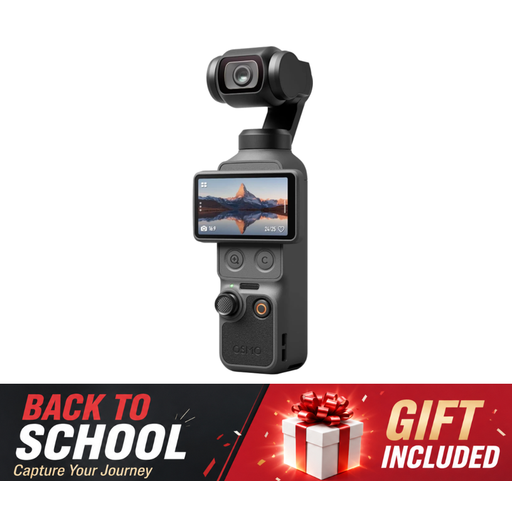
DJI Osmo Pocket 4 Standard Combo
This pocket camera could suit you if you’re looking for a compact setup. For small button details, first check that its close-up distance and magnification meet your needs.
The product name lists a 1″ CMOS sensor, 4K/240fps, 2× lossless zoom, 107 GB of built-in storage and a rotating 2″ screen.
Joybuy
 No image available
Osmo Pocket 4 Creator Combo
This pocket camera is worth considering if you’re looking for a compact setup. Check separately that its close-up distance and magnification are suitable for the button you’re photographing.
The product name lists a 1″ CMOS sensor, 4K/240fps, 2× lossless zoom, 14-stop dynamic range and 107 GB of built-in storage. The description mentions a handle with a 1/4″ thread.
Joybuy
No image available
DJI Osmo Pocket 3 Creator Combo
This compact camera could suit you if you want a small setup. Before photographing antique buttons, check that its close-up capabilities deliver the image size you need.
The product name lists a 1″ CMOS sensor and 4K/120fps video. The product description mentions fast focusing on still subjects and a rotating 2″ screen.
Joybuy
 No image available
Sony ZV-1 compact camera
This compact camera could be a good option if shooting in RAW matters for your workflow. Also check that the close-up distance suits the shot you want of the button.
The product specifications list 20 Mpx, 2,7× optical zoom, RAW shooting and a tilting screen.
Joybuy
Frequently asked questions
Is a camera body with a standard zoom lens enough to capture small button details in close-up?
Not necessarily: check the maximum magnification of the exact lens you plan to use. Canon states that the RF-S 18-45mm kit lens achieves a maximum of 0.16× with autofocus, while the separate RF 85mm F2 MACRO IS STM reaches a maximum of 0.5×.
How can I photograph a series of buttons with similar colours and crops?
Use a consistent composition and keep the camera steady, for example with a tripod. Check the white balance if the window light changes. Canon describes RAW as a way to give you more control over adjustments afterwards.
Can I leave delicate buttons with attached fabric by the window for a long time?
Avoid exposing them to light for longer than necessary. The Cultural Heritage Agency of the Netherlands describes light damage to collection items and notes that textiles are particularly light-sensitive. Tailor your approach to the button’s material and condition.
Do I always need a separate macro lens for a mirrorless camera?
To achieve the 1:1 magnification mentioned for the OM SYSTEM OM-5 Mark II, you need a suitable, separate macro lens. Check which lens is included with each combination and the maximum magnification it offers.
What should I look for in a camera for photographing a delicate button?
Check the lens’s maximum magnification and working distance, and prepare your setup in advance. That way, you can take the photo without exposing the button to window light for longer than necessary.


