
Action photographer in the hall
You want to capture jumps and quick steps sharply, so you’ll need to consider the shutter speed and whether the autofocus can track a moving subject.


For photographing dancers in motion in a dark hall, a mirrorless camera with a lens suited to your distance from the stage and the available light gives you more control over settings. A compact camera may suit you better if you want to avoid changing lenses and its fixed zoom range is sufficient. Check which lens is included in the kit, and test the focusing and shutter speed in similar lighting. Before publishing identifiable photos, check with the school and confirm what consent is needed for that purpose.
You want to capture jumps and quick steps sharply, so you’ll need to consider the shutter speed and whether the autofocus can track a moving subject.
For a performance with limited lighting, you’ll want to weigh up shutter speed, aperture and ISO together.
If you can’t get closer, check in advance whether the included or fixed lens offers enough reach.
Best suited to you if: fast movement and low light are priorities, and you can choose a lens that suits your distance from the stage.
Bear in mind: the camera body alone doesn’t determine the reach or brightness of the lens. Check the lens mount and which lens is included in the kit, too.
Best suited to you if: you want to take photos without changing lenses and have checked in advance that the fixed zoom range suits your position.
Bear in mind: the lens can’t be changed, and the maximum aperture may get smaller as you zoom in.
| What to consider | What should you check? | Who will value this most? |
|---|---|---|
| Fast movement | Check whether you can set the shutter speed, whether autofocus can track a moving subject, and what conditions apply to continuous shooting. | If I want to capture jumps and quick steps, I’m looking for a combination of shutter speed and focusing that suits the movement. Around 36% of consumers prioritise freezing motion. |
| Low stage lighting | Compare the maximum aperture at the focal length you’ll use, and check which lens is included. Test the exposure in similar lighting. | At a dark performance, I want to know whether I can use a fast shutter speed without the photo becoming too dark. Around 29% of consumers prioritise low-light performance. |
| Reach from your seat | Find out where you’re allowed to sit or stand, then compare the field of view you need with the zoom range and the lens’s aperture at its longest focal length. | If I can’t get closer to the stage, I want to work out in advance whether the dancer will appear large enough in the frame from my seat. Around 21% of consumers focus on the usable reach from a fixed position. |
| Complete kit | Check what’s in the box and whether you’ll need a lens or any other accessories. With a mirrorless camera, the lens must be compatible with the mount. | If you want a camera that’s easy to take along, a fixed lens may be practical, but you’ll need to accept its limitations. Around 14% of consumers prioritise the convenience of a complete kit. |
A high quoted shooting speed won’t compensate for a shutter speed that’s too slow or an exposure that’s too dark. Some shooting speeds are also available only with specific settings.
Assess shutter speed, lens and autofocus as a combination, and read the conditions that apply to the quoted shooting speed.
With a mirrorless camera, the reach and brightness also depend on having a suitable, compatible lens.
Check everything included in the kit and compare the maximum aperture at the focal length you’ll need from your position.
For publication by a school, the Dutch Data Protection Authority distinguishes between age groups: parental consent is required for pupils under 16; from the age of 16, the school must ask the pupil for consent.
Before publishing, ask what purpose the photos will be used for and what consent has been recorded, and follow the school’s arrangements.
For this choice, Canon offers both mirrorless cameras with interchangeable lenses and compact cameras with fixed lenses.
The Nikon Z50II is a mirrorless camera available with a choice of lens kits.
Sony offers both mirrorless cameras and compact cameras with fixed zoom lenses in this range.
The models below range from compact and vlogging cameras to mirrorless cameras with a zoom lens. For each model, consider whether the lens and photo controls suit your distance from the stage and the lighting in the hall.
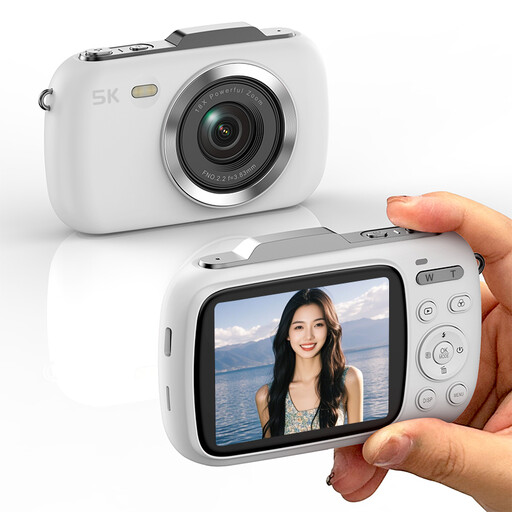 Image unavailable
The stated zoom range may help you adjust the framing from a fixed position. Test whether the focus and shutter speed are suitable for dancers in motion.
The product name specifies 5K, 80MP and 18X zoom.
 Image unavailable
The product name identifies this model as a vlogging camera. Check whether its photo controls and framing suit photographing dancers.
The product name lists 4K/120fps video, 3-axis stabilisation and face/object tracking. These specifications alone don’t indicate how sharp photos of moving dancers will be.
 Image unavailable
The stated optical zoom may help you adjust the framing from a fixed position. Take test shots to check whether the focus and shutter speed suit the movement.
The product name specifies 8X optical zoom, 5K and 64MP.
 Image unavailable
A mirrorless camera with a zoom lens included may suit you if you want to match the reach to your seat. Test the focus and shutter speed in the hall’s lighting.
According to the product information, the kit includes a 16–50mm zoom lens. At the telephoto end, the lens has a maximum aperture of f/5.6, which is worth bearing in mind when zooming in in low light.
 Image unavailable
The included zoom lens gives you a range to assess from your seat. Test whether the selected zoom setting and the hall’s lighting suit the movement.
The product name specifies a 16–50mm f/3.5–5.6 OSS II lens. At the telephoto end, the maximum aperture is f/5.6, so bear this in mind if you’re zooming in in low light.
A faster shutter speed is a sensible starting point for freezing movement, but it lets in less light. Nikon explains how shutter speed affects movement, so check the exposure too, and enable subject-tracking autofocus if available. There’s no single shutter speed that works for every dance move.
Image stabilisation can help reduce camera shake, but it can’t replace a shutter speed suited to the dancer’s movement. Check whether your chosen camera or lens has stabilisation and take some test shots. Nikon also recommends supporting the camera to reduce camera shake.
Check the contents of the exact kit, including the lens, battery, charger and memory card. With a mirrorless camera, the lens must fit the mount and provide the reach you need from your position.
The Dutch Data Protection Authority says that the school needs consent to publish photos: from parents for pupils under 16, and from the pupil themselves from the age of 16. Agree with the school in advance why the photos will be shared and what consent is required. This doesn’t mean that every private photo taken during a performance is prohibited.
In the Netherlands, the seller is the point of contact for a faulty product, according to the Dutch government. This is separate from any manufacturer’s warranty, so check the seller’s and manufacturer’s terms and conditions.